


Extending the Shuishalian Freeway (Freeway No. 6) to link Nantou County and Hualien County would require 18 new tunnels, while the route would cross eight geological faults zones and likely encounter geothermal water, a geophysical survey released by the Freeway Bureau showed.
The proposed 88.9km corridor for the highway extension would link Nantou County’s Puli Township (埔里) and Jian Township (吉安) in Hualien County.
In July 2023, the bureau commissioned Sinotech Engineering Consultants to conduct the survey, collect and analyze geophysical data, and complete magnetotelluric site surveys.
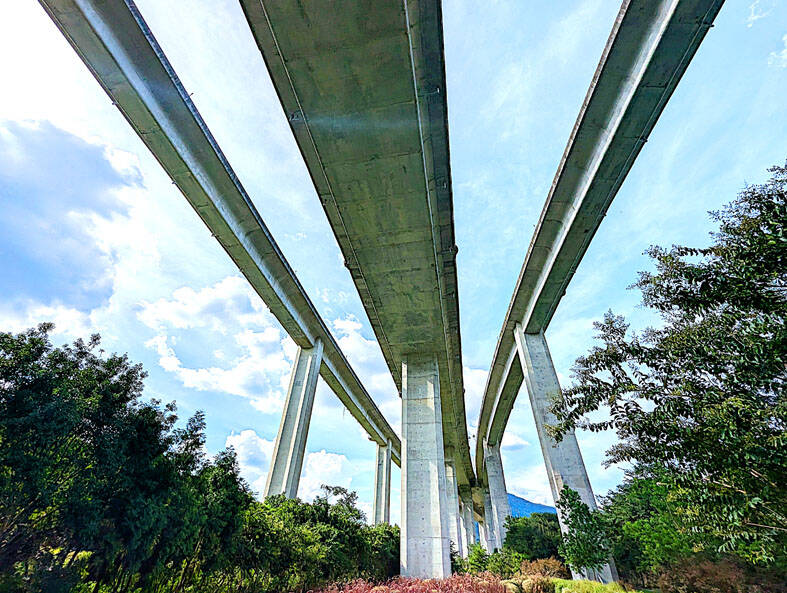
Photo: Wu Liang-yi, Taipei Times
Sinotech found that the 49.37km of freeway would have to be tunnels, with one of them — labeled tunnel No. 5 — to be 17.5km long, surpassing the 12.9km-long Hsuehshan Tunnel (雪山隧道), which connects New Taipei City and Yilan County on Chiang Wei-shui Memorial Freeway (Freeway No. 5).
The Nantou-Hualien corridor would pass to the west of Lushan geothermal area in Nantou County, which is where Yunhai Hot Spring (雲海溫泉) is.
Eighteen strata and rock formations were identified along the proposed route, which also crosses eight fault zones, the survey showed.
If the government approves the project, construction workers might encounter severe groundwater conditions similar to those faced during the construction of the Hsuehshan Tunnel.
If tunneling work encounters geothermal water, it could be as hot as 120°C to 180°C, although it was unclear if a low-resistivity zone in the area that tunnel No. 5 would be is a geothermal area, the bureau said.
Bureau Deputy Director General Chen Hung-ren (陳宏仁) said that the purpose of the survey was to gain a preliminary understanding of the geological formations along the corridor, adding that it is not a feasibility study.
Some sections of the extension would have to be built at elevations of 1km to 2km above sea level, Chen said.
Even if the project were technically feasible, those sections would likely be affected by fog and icy conditions, raising significant safety concerns, he said.
The annual maintenance costs for those sections of the completed road would be substantial, he added.

Considering that most countries issue more than five denominations of banknotes, the central bank has decided to redesign all five denominations, the bank said as it prepares for the first major overhaul of the banknotes in more than 24 years. Central bank Governor Yang Chin-lung (楊金龍) is expected to report to the Legislative Yuan today on the bank’s operations and the redesign’s progress. The bank in a report sent to the legislature ahead of today’s meeting said it had commissioned a survey on the public’s preferences. Survey results showed that NT$100 and NT$1,000 banknotes are the most commonly used, while NT$200 and NT$2,000

The Centers for Disease Control (CDC) yesterday reported the first case of a new COVID-19 subvariant — BA.3.2 — in a 10-year-old Singaporean girl who had a fever upon arrival in Taiwan and tested positive for the disease. The girl left Taiwan on March 20 and the case did not have a direct impact on the local community, it said. The WHO added the BA.3.2 strain to its list of Variants Under Monitoring in December last year, but this was the first imported case of the COVID-19 variant in Taiwan, CDC Deputy Director-General Lin Ming-cheng (林明誠) said. The girl arrived in Taiwan on

South Korea is planning to revise its controversial electronic arrival card, a step Taiwanese officials said prompted them to hold off on planned retaliatory measures, a South Korean media report said yesterday. A Yonhap News Agency report said that the South Korean Ministry of Foreign Affairs is planning to remove the “previous departure place” and “next destination” fields from its e-arrival card system. The plan, reached after interagency consultations, is under review and aims to simplify entry procedures and align the electronic form with the paper version, a South Korean ministry official said. The fields — which appeared only on the electronic form

The Ministry of Foreign Affairs (MOFA) is suspending retaliation measures against South Korea that were set to take effect tomorrow, after Seoul said it is updating its e-arrival system, MOFA said today. The measures were to be a new round of retaliation after Taiwan on March 1 changed South Korea's designation on government-issued alien resident certificates held by South Korean nationals to "South Korea” from the "Republic of Korea," the country’s official name. The move came after months of protests to Seoul over its listing of Taiwan as "China (Taiwan)" in dropdown menus on its new online immigration entry system. MOFA last week


 RSS
RSS