


Human rights groups yesterday condemned the harassment of people who rallied to support the religious freedom of Tibetans, saying that it was typical transnational repression by China, not a mere disturbance or criminal case.
A candlelight vigil was held at Taipei’s Liberty Square on Tuesday in commemoration of the Tibetan uprising on March 10, 1959, with nearly 150 people in attendance.
Prominent attendees included Democratic Progressive Party legislators Puma Shen (沈伯洋) and Wu Pei-yi (吳沛憶), and Taiwan People’s Party Legislator Chen Chao-chi (陳昭姿), who are also members of the Taiwan Parliament Group for Tibet.
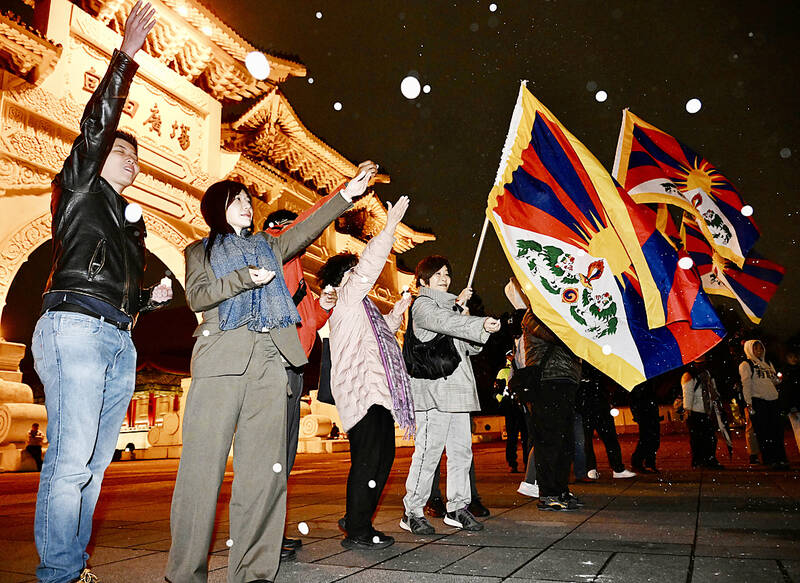
Photo: Lo Pei-de, Taipei Times
While the legislators were giving short speeches, a man in a black cap and red coat wearing a mask threw soundless firecrackers at the crowd.
The Human Rights Network for Tibet and Taiwan, along with 15 other human rights groups in Taiwan, yesterday issued a joint statement deploring such coercive actions.
The man attempted to harass the rally and disturb attendees, throwing firecrackers to create heavy smoke and smells, the statement said, adding that such malicious acts are common during Tibetans’ and Hong Kongers’ rallies against Chinese authoritarianism.
The rally was not affected much, as police officers stationed on-site promptly stopped the man, it said.
The police were escorting the man into a police car when another man showed up and tried to persuade the police to let go of his “younger brother,” the statement said.
However, rally personnel recognized the second man as the suspicious person who was sighted during the Tibetan uprising commemorative march in Taipei on Saturday last week, it said.
“He followed the marchers and kept photographing them when the procession moved from Far Eastern Sogo Department Store’s Zhongxiao outlet to Taipei 101,” the statement said.
Throwing firecrackers at people and photographing exiled Tibetans without consent aimed to intimidate and silence rally participants and supporters, it said, adding that such approaches are “gray zone” tactics the Chinese Communist Party commonly uses in exercising its “long-arm jurisdiction.”
They also reflected an organized, systemic crackdown pattern that should be regarded as transnational repression rather than a mere disturbance or criminal case, the statement said.
Such transnational repression not only targets Tibetans in Taiwan, but also constitutes a blatant provocation to Taiwanese democracy and freedom of assembly, it said.
Coercion such as this is often underestimated, but it builds an invisible prison in democratic societies around the world, the statement said, citing Swiss research.
“We remain unswaying against any form of violence and coercion in our determination to defend Tibetans’ cultural subjectivity and autonomy over the Dalai Lama’s reincarnation,” it said.
The Taipei Police Department’s Zhongzheng First Precinct yesterday confirmed that the two men, surnamed Lin (林), were brothers and Taiwanese.
The man who threw firecrackers was 21 years old and said he did it “just for fun,” it said.
Lin’s case has been transferred to the Taipei District Prosecutors’ Office on charges of coercion, intimidation of personal safety, interference with personal freedom, and contravening the Assembly and Parade Law (集會遊行法), the precinct said.

UPGRADE: The Kang Ding-class frigate is replacing its Chaparall missiles with Tien Chien II and Hua Yang VLS, which would provide it with long-range, 360° air defense Taiwan plans to produce 1,200 to 1,376 Hai Chien II missiles (海劍二, Sea Sword II) — also known as TC-2N — to serve as the standard air defense system of the navy’s surface combatant fleet, a source said yesterday. Last week, the Hai Chien II, the naval version of the Tien Kung II missile (天劍二, Sky Sword II), completed a live-fire test in waters off the National Chungshan Institute of Science and Technology’s Jiupeng facility (九鵬) in Pingtung County’s Manjhou Township (滿州). The MIM72 Chaparral and other dated air defense missiles that currently arm Taiwanese ships have inadequate range to combat Chinese

REASONS FOR TRAVEL: An assistant professor said that proposed amendments to penalize drivers if they used drugs overseas would not deter people from traveling People who operate a motor vehicle under the influence of marijuana would have their driver’s license revoked, even if they used the substance while overseas, the Ministry of Transportation and Communications said yesterday, citing proposed amendments to the Road Traffic Management and Penalty Act (道路交通管理處罰條例). The amendments would also authorize the government to revoke the licenses of people determined to have used Category 1 or Category 2 narcotics, even if they were not operating a vehicle while under the influence of drugs, as well as ban them from taking the license test for three years, the ministry said. People aged 18 or
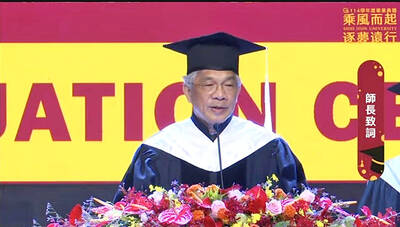
Shih Hsin University President Chen Ching-he (陳清河) yesterday issued a public apology for comments made in his commencement speech last week, stating that he has asked the school to suspend his duties and halt his wages for two months as a show of contrition. At the commencement ceremony on May 30, Chen said, “If you don’t manage your time well, or your own emotions, or your health, then I am telling every one of you — put a quick end to ‘you,’ because the world has no need for ‘you.’” The comments have sparked significant controversy online, and Chen through an open
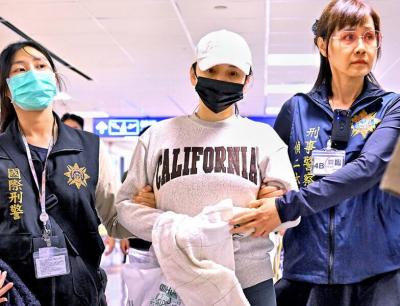
Johanne Liou (劉喬安), a Taiwanese woman who shot to unwanted fame during the Sunflower movement protests in 2014, returned to Taiwan last night after being deported from the US. She is to stand trial in Taiwan for charges involving embezzlement, fraud and drug crimes. The Criminal Investigation Bureau (CIB) said it took her into custody at Taiwan Taoyuan International Airport and would first question her before transferring her to the New Taipei District Prosecutors’ Office. She was arrested upon disembarking a flight from San Francisco that landed shortly before 7pm. Liou absconded to the US in 2019 after jumping bail


 RSS
RSS