


Sindian police cautioned people joining “treasure-hunting” or “night adventure” trips organized by online groups after two groups of young people were arrested last month for trespassing.
The Sindian Police Precinct said in a statement on Feb. 23 that they received calls on two separate days during the Lunar New Year holiday from an employee of the now-closed Naluwan Spring Resort Hotel in New Taipei City’s Wulai District (烏來) and arrested nine people for breaking into the hotel.
The first group — composed of a woman surnamed Juan (阮), 22, and two men, surnamed Lu (呂), 22, and Lin (林), 34 — entered the hotel through a side entrance with a damaged door at about 9pm on Feb. 20.
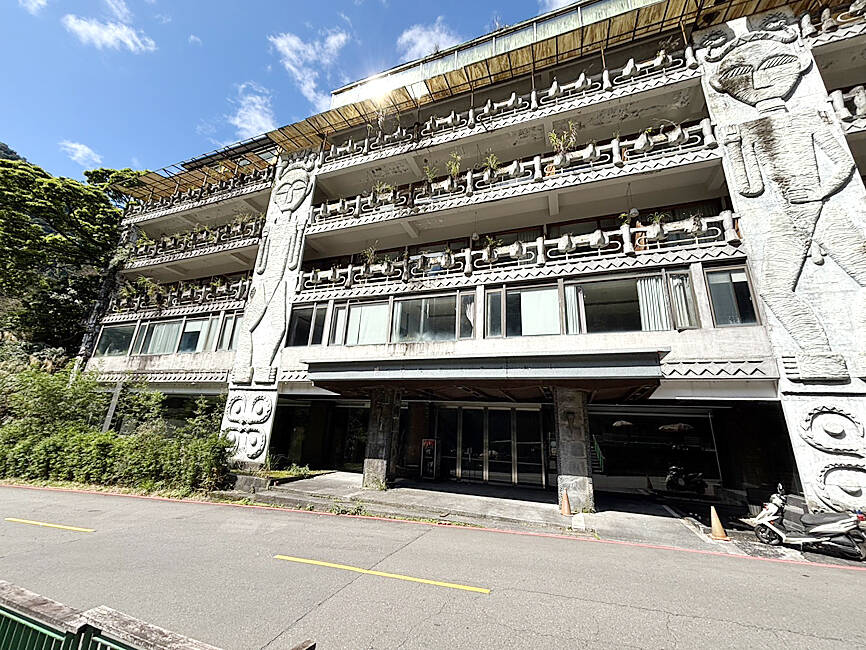
Photo copied by Lu Yun-feng, Taipei Times
Although the hotel has long stopped operating, it still has one employee, surnamed Huang (黃), 58, who guards the place.
When Huang discovered the intruders, he called the police, who arrived and searched the three.
An antique jade pendant was found on Lin, who said it was Juan who took the pendant, worth about NT$2,000, in the lobby, police said.
The trio are facing charges of theft and trespassing on private property, they said.
In the early hours of the following day, another group of six people made their way into the hotel through the same side entrance. Huang was awakened by the noise and called the police.
Although the police did not find any stolen items after searching the six — an underaged girl surnamed Wu (吳), three men aged 19, surnamed Chen (陳), Yu (俞) and Huang (黃), and two men aged 20, surnamed Liu (劉) and Chang (張) — the five adults were charged with trespassing and attempted theft.
Wu’s case would be handled by the Taipei Juvenile Court, police said.
Members of the two groups said they had found information about the hotel online and believing it was abandoned formed two groups via the social media app Line to explore and go “treasure hunting.
“Night adventure” trips have become popular online among people looking for thrills and excitement from exploring abandoned places, reportedly haunted houses or shuttered or derelict amusement parks, police said.
“Young people in these online-gathering groups are prompted by curiosity, or games of dare and the sense of adventure from exploring places at night. Some of these activities are billed as treasure hunting, but they often run afoul of the law, as they are entering private property and may get sued for theft by the owner if they take any item from the place,” police said.
Sindian police said they have checked and verified that the Wulai hotel is only temporarily closed and not abandoned property.
The hotel was temporarily shut down in 2015, when Typhoon Dujuan caused flash floods and landslides, cutting off roads and trapping the owners and five staff inside the hotel for days.
When global travel and tourism ceased during the COVID-19 pandemic, the hotel owners in 2021 decided to temporarily shut down the hotel, police said.
Sindian police urged people to double-check and verify posted notices on social media, especially messages tagged as “exploring abandoned places” or “treasure hunting at secret sites,” as most of them contain false information, and participants often end up trespassing on private property.
“It is illegal to enter a property without the owner’s permission, and those who do can be charged with trespassing or theft if they take anything,” police said.
“People must not blindly believe online rumors and misinformation and risk being arrested for engaging in illegal activities,” they added.
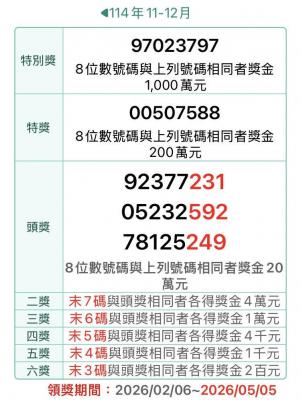
Seven of the 17 NT$10 million (US$311,604) winning receipts from the November-December uniform invoice lottery remain unclaimed as of today, the Ministry of Finance said, urging winners to redeem their prizes by May 5. The reminder comes ahead of the release of the winning numbers for the January-February lottery tomorrow. Among the unclaimed receipts was one for a NT$173 phone bill in Keelung, while others were for a NT$5,913 purchase at Costco in Taipei's Neihu District (內湖), a NT$49 purchase at a FamilyMart in New Taipei City's Tamsui District (淡水), and a NT$500 purchase at a tea shop in New Taipei City's

Taiwanese officials were shown the first of 66 F-16V fighter jets purchased by Taiwan from the United States, the Ministry of National Defense said yesterday, adding the aircraft has completed an initial flight test and is expected to be delivered later this year. A delegation led by Deputy Minister of National Defense Hsu Szu-chien (徐斯儉) visited Lockheed Martin’s F-16 C/D Block 70 (also known as F-16V) assembly line in South Carolina on March 16 to view the aircraft. The jet will undergo a final acceptance flight in the US before being delivered to Taiwan, the

Deliveries of delayed F-16V jets are expected to begin in September, Minister of National Defense Wellington Koo (顧立雄) said today, after senior defense officials visited the US last week. The US in 2019 approved a US$8 billion sale of Lockheed Martin F-16 jets to Taiwan, a deal that would take the nation’s F-16 fleet to more than 200 jets, but the project has been hit by issues including software problems. Koo appeared today before a meeting of the legislature’s Foreign Affairs and National Defense Committee, which is discussing different versions of the special defense budget this week. The committee is questioning officials today,

TALENT SCOUTING: The university is investing substantial funds in its future to bring in the kind of researchers that would keep the college internationally competitive National Taiwan University (NTU) plans to invest NT$2 billion (US$62.6 million) to launch two programs aimed at attracting and retaining top research talent, university president Chen Wen-chang (陳文章) said yesterday. The funding would support the “Palm Grove Scholars Project,” which targets academics aged 40 to 55. Up to 20 scholars would be selected, each receiving as much as NT$10 million annually, Chen said. The initiative is designed to attract leading researchers to Taiwan and strengthen NTU’s global competitiveness by fostering a more research-friendly environment and expanding international collaboration, he said. NTU is also introducing a “Hong Hu” chair grant, which would provide Palm


 RSS
RSS