


Chinese Nationalist Party (KMT) lawmakers yesterday visited the military airbase at Taipei International Airport (Songshan airport) to probe alleged misuse of funds by Premier Cho Jung-tai (卓榮泰) on his one-day visit to Japan last week, while the Democratic Progressive Party (DPP) accused the opposition of neglecting its duty to review budgets.
The “inspection tour” of the Songshan Air Command Center was headed by KMT Legislator Hsu Chiao-hsin (徐巧芯), joined by fellow KMT legislators Niu Hsu-ting (牛煦庭) and Cheng Cheng-chien (鄭正鈐), as part of this week’s official work agenda for the legislature’s Foreign Affairs and National Defense Committee.
Legislative committee conveners for the current session were chosen on Wednesday, with KMT Legislator Ma Wen-chun (馬文君) and DPP Legislator Chen Kuan-ting (陳冠廷) winning the vote as conveners of the committee, taking turns to set the agenda.
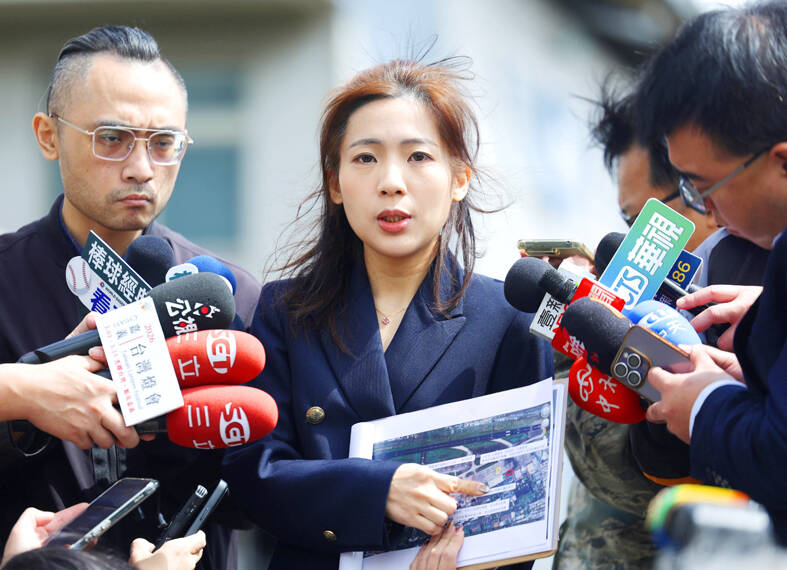
Photo: CNA
Ma had set the agenda for this and next week, listing an official “inspection tour” to the command center for legislators on the committee to find out if Cho had used public funds.
DPP legislators declined the invitation to join, saying they are not interested in helping the KMT “put on a show” for the media to denigrate the premier.
KMT lawmakers have accused Cho of abusing his authority as premier by using the military airbase to board a chartered flight for Japan to watch a World Baseball Classic game in Tokyo.
Cho said he paid for the personal trip out-of-pocket and it was not on an official visit.
Hsu said legislators have a duty to scrutinize government officials and their use of public funds.
The trio’s inspection aimed to find if Cho and his entourage used the airbase, and investigate the procedures for their entering and boarding the plane.
DPP Legislator Rosalia Wu (吳思瑤) condemned the KMT for the “inspection tour,” saying it was trying to make noise by insinuating wrongdoing by Cho, when the priority should be reviewing the NT$1.25 trillion (US$39.25 billion) special defense budget and the central government’s general operating budget for this year.
“The KMT is doing everything to delay and impede the review process, as Ma has put on the committee’s agenda for this and next week sessions questioning the Ministry of National Defense, the Ministry of Foreign Affairs, the Overseas Compatriot Commission and other agencies to do anything but review the special defense budget,” she said.
Separately, DPP Legislator Chung Chia-pin (鍾佳濱) said the command center is next to Taipei International Airport, which most people know is jointly used for civilian aviation and the air force.
Chung called on the KMT not to distort the matter, as Hon Hai Precision Industry Co founder Terry Gou (郭台銘) and other business tycoons have also used the airstrip.
“These cases would need prior application, checks and approval, to have personal chartered aircraft taking off and landing at Songshan Air Command Center,” he said. “Songshan airport for commercial flights is managed by the Civil Aviation Administration. The defense ministry’s Air Force Command is in charge of the military airbase, which is mainly utilized by military transport aircraft and for government administrative work by Cabinet ministers and top officials.”
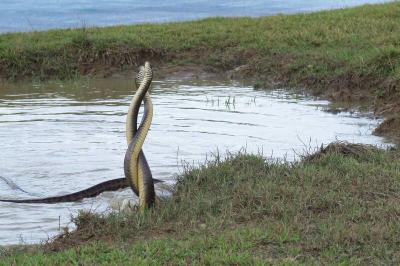
Kenting National Park service technician Yang Jien-fon (楊政峰) won a silver award in World Grand Prix Photography Awards Spring Season for his photograph of two male rat snakes intertwined in combat. Yang’s colleagues at Kenting National Park said he is a master of nature photography who has been held back by his job in civil service. The awards accept entries in all four seasons across six categories: architectural and urban photography, black-and-white and fine art photography, commercial and fashion photography, documentary and people photography, nature and experimental photography, and mobile photography. Awards are ranked according to scores and divided into platinum, gold and
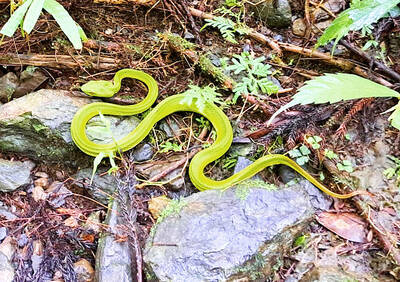
More than half of the bamboo vipers captured in Tainan in the past few years were found in the city’s Sinhua District (新化), while other districts had smaller catches or none at all. Every year, Tainan captures about 6,000 snakes which have made their way into people’s homes. Of the six major venomous snakes in Taiwan, the cobra, the many-banded krait, the brown-spotted pit viper and the bamboo viper are the most frequently captured. The high concentration of bamboo vipers captured in Sinhua District is puzzling. Tainan Agriculture Bureau Forestry and Nature Conservation Division head Chu Chien-ming (朱健明) earlier this week said that the
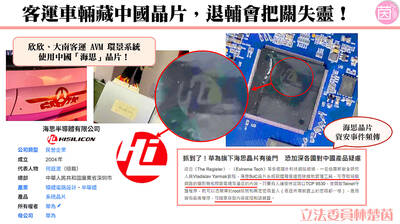
BREACH OF CONTRACT: The bus operators would seek compensation and have demanded that the manufacturer replace the chips with ones that meet regulations Two bus operators found to be using buses with China-made chips are to demand that the original manufacturers replace the systems and provide compensation for breach of contract, the Veterans Affairs Council said yesterday. Democratic Progressive Party Legislator Michelle Lin (林楚茵) yesterday said that Da Nan Bus Co and Shin-Shin Bus Co Ltd have fielded a total of 82 buses that are using Chinese chips. The bus models were made by Tron-E, while the systems provider was CYE Electronics, Lin said. Lin alleged that the buses were using chips manufactured by Huawei subsidiary HiSilicon Co, which presents a national security risk if the

The National Immigration Agency has banned two Chinese from returning to Taiwan, after they published social media content it described as disrespectful to national sovereignty. The agency imposed a two-month ban on a Chinese man surnamed Liang (梁) and a permanent ban on a woman surnamed Yang (楊), an influencer with 23 million followers, in October last year and last week respectively. Minister of the Interior Liu Shyh-fang (劉世芳) yesterday said on the sidelines of a legislative meeting that Chinese visitors to Taiwan are required to comply with the rules and regulations governing their entry permits. The government has handled the ban and


 RSS
RSS