


The Mainland Affairs Council (MAC) yesterday condemned Beijing for suppressing freedom of speech and the press after a Chinese National People’s Congress (NPC) said that Gusa Press (八旗文化) editor-in-chief Li Yanhe’s (李延賀) sentencing was a “punishment for Taiwanese independence die-hards.”
Li, commonly known by his pen name Fucha (富察), was arrested and detained by Chinese national security authorities when he was visiting relatives in China in March 2023.
He was then stealthily prosecuted and sentenced to jail.
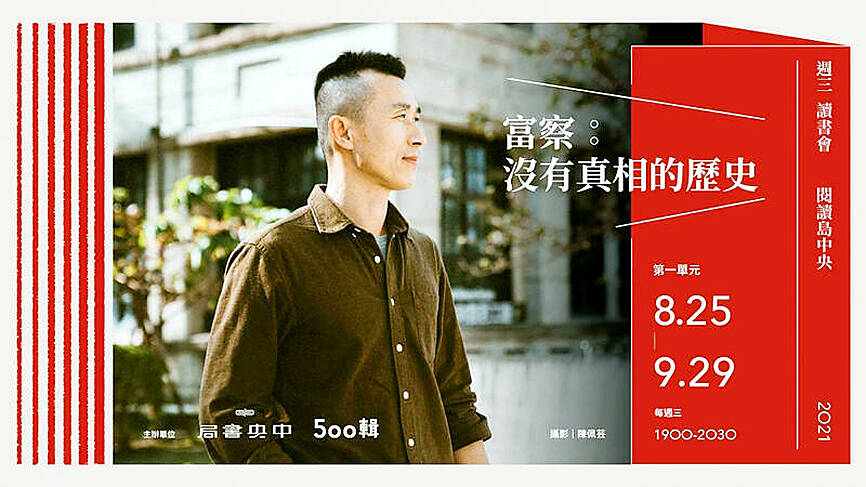
Photo: screen grab from Facebook
It was not until March last year that China’s Taiwan Affairs Office (TAO) announced the charges against him, saying that Li was convicted of “inciting secession,” given a three-year prison term and deprived of political rights for a year, with 50,000 yuan (US$7,230) in personal assets confiscated.
The NPC yesterday delivered a work report on the Chinese Supreme People’s Court and the Chinese Supreme People’s Procuratorate (SPP).
The work report said the court “enforced the Anti-Secession Law and harshly punished Taiwanese independence die-hards, giving sentences to Li Yanhe, who was convicted of inciting secession and undermining national unity, as required by law.”
SPP Procurator-General Ying Yong (應勇) said the agency is resolute in defending national security and would strictly punish “criminals” threatening national security.
The Chinese Communist Party (CCP) sentenced Li simply to suppress freedom of speech and publication, the MAC said.
Such suppression reflected the CCP’s autocratic nature, which reminds Taiwanese of their democratic way of life, it said.
On June 5 last year, China’s Guangzhou Municipal Public Security Bureau issued warrants for 20 Taiwanese it considered members of the Information, Communications and Electronic Force Command, with a bounty of 10,000 yuan on each of them.
Also in June last year, the TAO announced penalties on Taiwan-based companies related to Shen Tu-cheng (沈土城), father of Democratic Progressive Party Legislator Puma Shen (沈伯洋), banning them from engaging in any transaction or cooperation with organizations, businesses or people in China.
In October last year, China’s Chongqing Municipal Public Security Bureau established a criminal case against Puma Shen on charges of being involved in “secessionist activities.”
The CCP in January included Minister of the Interior Liu Shyh-fang (劉世芳) and Minister of Education Cheng Ying-yao (鄭英耀) as “Taiwanese independence die-hards,” and listed prosecutor Chen Shu-yi (陳舒怡) as an accomplice in “separatist activities.”
Last month, Hong Kong media outlets accused Liu’s nephew of operating businesses in China to supply political donations for her, while the TAO later said it would “investigate it as required by law.”


UPGRADE: The Kang Ding-class frigate is replacing its Chaparall missiles with Tien Chien II and Hua Yang VLS, which would provide it with long-range, 360° air defense Taiwan plans to produce 1,200 to 1,376 Hai Chien II missiles (海劍二, Sea Sword II) — also known as TC-2N — to serve as the standard air defense system of the navy’s surface combatant fleet, a source said yesterday. Last week, the Hai Chien II, the naval version of the Tien Kung II missile (天劍二, Sky Sword II), completed a live-fire test in waters off the National Chungshan Institute of Science and Technology’s Jiupeng facility (九鵬) in Pingtung County’s Manjhou Township (滿州). The MIM72 Chaparral and other dated air defense missiles that currently arm Taiwanese ships have inadequate range to combat Chinese

REASONS FOR TRAVEL: An assistant professor said that proposed amendments to penalize drivers if they used drugs overseas would not deter people from traveling People who operate a motor vehicle under the influence of marijuana would have their driver’s license revoked, even if they used the substance while overseas, the Ministry of Transportation and Communications said yesterday, citing proposed amendments to the Road Traffic Management and Penalty Act (道路交通管理處罰條例). The amendments would also authorize the government to revoke the licenses of people determined to have used Category 1 or Category 2 narcotics, even if they were not operating a vehicle while under the influence of drugs, as well as ban them from taking the license test for three years, the ministry said. People aged 18 or
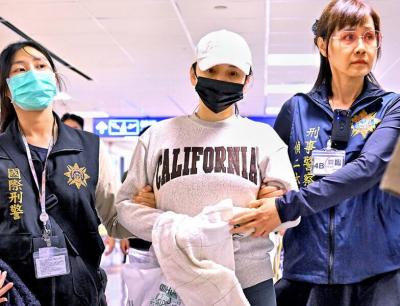
Johanne Liou (劉喬安), a Taiwanese woman who shot to unwanted fame during the Sunflower movement protests in 2014, returned to Taiwan last night after being deported from the US. She is to stand trial in Taiwan for charges involving embezzlement, fraud and drug crimes. The Criminal Investigation Bureau (CIB) said it took her into custody at Taiwan Taoyuan International Airport and would first question her before transferring her to the New Taipei District Prosecutors’ Office. She was arrested upon disembarking a flight from San Francisco that landed shortly before 7pm. Liou absconded to the US in 2019 after jumping bail
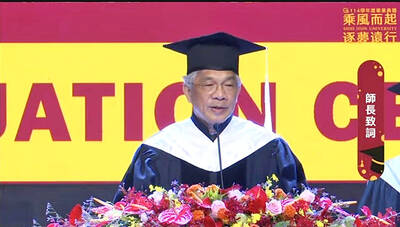
Shih Hsin University President Chen Ching-he (陳清河) yesterday issued a public apology for comments made in his commencement speech last week, stating that he has asked the school to suspend his duties and halt his wages for two months as a show of contrition. At the commencement ceremony on May 30, Chen said, “If you don’t manage your time well, or your own emotions, or your health, then I am telling every one of you — put a quick end to ‘you,’ because the world has no need for ‘you.’” The comments have sparked significant controversy online, and Chen through an open


 RSS
RSS