


Chinese President Xi Jinping’s (習近平) remarks that he would not tolerate partial loyalty from the Chinese military toward the Chinese Communist Party (CCP) reflected the Chinese state leadership’s unease about its control, the Mainland Affairs Council (MAC) said yesterday.
Annual meetings of the 14th Chinese National People’s Congress (NPC) and the National Committee of the Chinese People’s Political Consultative Conference commenced last week.
In his role as the CCP general secretary and Central Military Commission (CMC) chairman, Xi on Saturday attended a plenary meeting with delegations of the Chinese People’s Liberation Army (PLA) and the Chinese People’s Armed Police Force in the attendance.
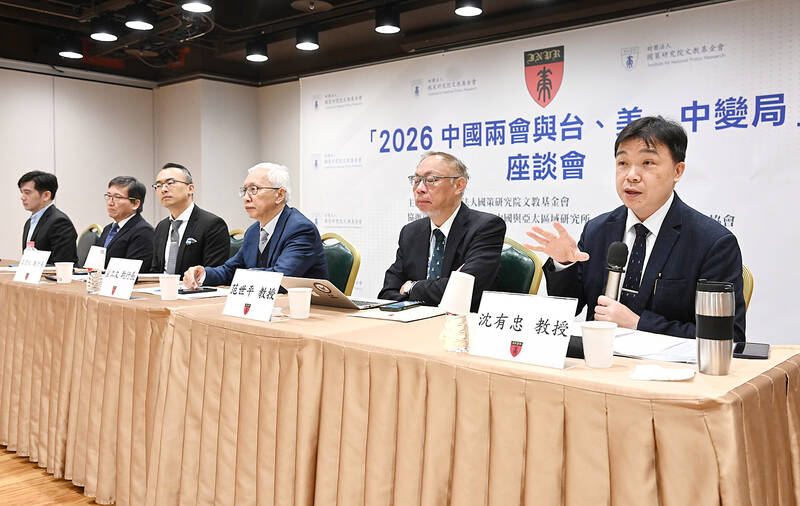
Photo: Lin Cheng-kun, Taipei Times
Xi said in his address that anyone in the Chinese military harboring incomplete loyalty to the party is intolerable.
There is no place for corrupt elements, and the fight against corruption must be advanced with unwavering determination, he added.
Xi’s remarks and CMC Vice Chairman Zhang Shengmin’s (張升民) order saying “the whole military must follow Xi’s command” reflected the Chinese leadership’s “deep unease” about its control of the military, MAC Deputy Minister Shen Yu-chung (沈有忠) said yesterday at a forum in Taipei held by the Institute for National Policy Research.
Starting with the CMC’s Equipment Development Department and the PLA’s Rocket Force, Xi has escalated his purges of several senior military officials into an unprecedented large-scale purge of the entire military leadership, Shen said.
Regardless of the reason, it is evident that Xi, with such a massive political purge, is seeking to rebuild a military that is unquestionably loyal to him and the party, rather than a military of which first priority is Chinese people, Shen said.
Xi has been using “political army building” and “anti-corruption reform” as excuses to purge dissent while escalating military intimidation against Taiwan, he said.
Citing Taiwan’s achievement in defeating South Korea in their World Baseball Classic Pool C game, Shen said solidarity and self-development are the only means to clinch a victory against a tough enemy.
Taiwan’s national sovereignty, along with freedom and democracy, is the greatest bipartisan common ground, he said, adding that the legislature should put aside political differences and back bills aimed at enhancing national defense.
It should also expedite cooperation with other democratic countries such as the US and Japan to ensure sustainable development of Taiwanese sovereignty and democracy via national strength, he added.
Meanwhile, the second plenary meeting of the fourth session of the NPC was held yesterday at the Great Hall of the People in Beijing.
NPC Standing Committee Chairman Zhao Leji (趙樂際) at the presented an NPC standing committee report regarding the implementation of the Chinese constitution, saying that the NPC standing committee has decided to establish Oct. 25 as the “Day of Taiwan’s Restoration.”
The decision was made following last year’s events commemorating the 80th anniversary of the end of World War II and the 80th anniversary of “Taiwan’s restoration,” he said.
The NPC Standing Committee made the decision based on the Chinese constitution to demonstrate its “unwavering determination” in upholding the “one China” principle and defending Chinese national sovereignty, unity and territorial integrity, Zhao said.
The goal is to strengthen the common historical memory of compatriots across the Taiwan Strait and inspire all Chinese people to strive in solidarity for “reunification” of the motherland and rejuvenation of the Chinese nation, he said.
Former Tunghai University Cross-Strait Research Center deputy executive director Hung Pu-chao (洪浦釗) yesterday said that “this is a typical case of lawfare — listing the ‘Retrocession Day’ as a Chinese holiday to portray Taiwan as part of China.”

NATIONAL SECURITY: Authorities are working to confirm the identities of the military personnel involved and investigating possible illegal conduct and regulatory violations Authorities are probing possible national security implications after Kinmen police and immigration officers on Sunday found a Chinese woman allegedly posing as a tourist while engaging in prostitution involving more than 10 military personnel. The woman, surnamed Chen (陳), has since been deported, authorities said, adding that investigators are still working to confirm the identities of those implicated, as the records only listed code names and aliases. The case stemmed from a report received by the Kinmen District Prosecutors’ Office on Friday last week from the Jinhu Precinct of the Kinmen County Police Bureau. On Sunday, police, along with the National Immigration
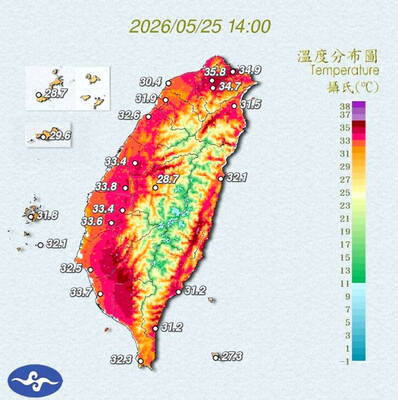
STAY COOL: The HPA recommended that people stay hydrated, use air-conditioning or fans while indoors, wear loose-fitting clothes and walk in the shade while outdoors Employers must implement measures such as installing cooling equipment, and providing drinking water and rest breaks for outdoor workers starting from Monday next week, the Taipei Department of Labor said on Sunday. Employers who fail to comply could face fines of NT$30,000 to NT$300,000 under the Occupational Safety and Health Act (職業安全衛生法), the department said. Businesses in Taipei employing fewer than 100 workers, as well as registered self-employed workers with labor insurance coverage, could receive on-site assessments and guidance from occupational safety consultants to help them apply for central government subsidies to implement or improve heat-protection measures, it said. Under the Ministry of

GLOBALGIVING: ‘ Caving to external pressure is not acceptable for an organization that has cultivated justice reform and human rights for 30 years,’ one NGO said A slew of non-government organizations (NGOs) have withdrawn from the GlobalGiving fundraising platform after it announced it would use “Chinese Taipei” instead of “Taiwan” from next month. The Taiwan Good Rice Association wrote on Facebook on Friday that it was informed on April 28 via a teleconference call of the change, which was made because the platform wanted to operate in China. Taiwan Good Rice is to terminate all cooperative relationships with GlobalGiving in response to the platform’s “unilateral and non-negotiable” decision to remove references to Taiwan, the NGO said. “Taiwan is in the official name of Taiwan Good Rice Association and the

Chinese Nationalist Party (KMT) Chairwoman Cheng Li-wun (鄭麗文) yesterday briefed her party’s Central Standing Committee regarding her scheduled visit to the US between Monday next week and June 16, saying that her purpose would be to persuade the US that the Republic of China (ROC) Constitution was a “one China” constitution that would foster stable and peaceful cross-strait relations. The ROC Constitution is the most important defense for all Taiwanese citizens, as it upholds our democracy and has contributed to our robust economy, which aligns with international and US interests, she said. “We would not be troublemakers and drag the US under,”


 RSS
RSS