


The Ministry of Education today released a new Web page providing supplementary educational materials on aspects of the 228 Incident and the White Terror not included in the school curriculum.
The new resource hub focuses on human rights and transitional justice, providing videos, guided readings, personal stories from victims and links to various museums and related literature for further learning.
The Web page was designed to use accessible digital resources to fill gaps in the current history curricula, the ministry said.
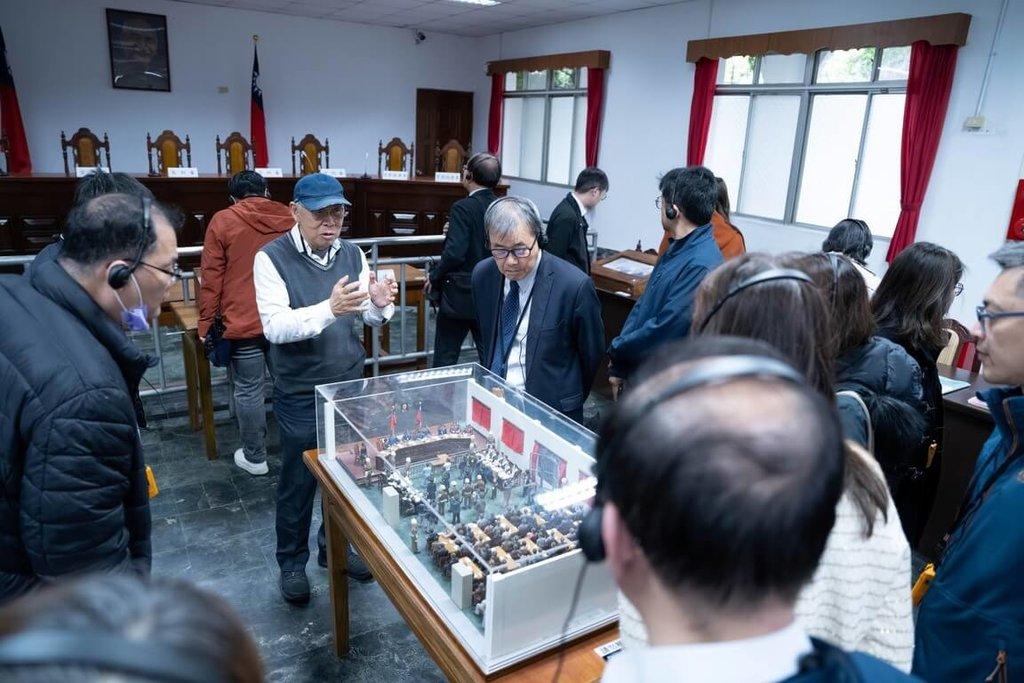
Photo courtesy of the Ministry of Education via CNA
The “108 curriculum,” implemented in high schools in 2019, does teach transitional justice, although older curricula lack teaching materials on the subject, it said.
The Web page teaches students about the 228 Incident of 1947, a series of violent crackdowns on protesters in the weeks and months following the brutal beating of a tobacco vendor in Taipei by government agents on Feb. 27, 1947.
The incident led to the White Terror era, a period of political persecution that began when former president Chiang Kai-shek (蔣介石) of the Chinese Nationalist Party (KMT) declared martial law in 1949, which lasted until 1987.
The front page features a video narrated by Lan Shi-bo (藍士博), executive director of the Memorial Foundation of 228, explaining what caused the incident, the political and social consequences and how it triggered the start of the White Terror period.
New topics would be added monthly that focus on important historical events or figures in Taiwan, it said.
Minister of Education Cheng Ying-yao (鄭英耀) recently visited the National Human Rights Museum’s Jingmei White Terror Memorial Park in New Taipei City and shared his experience touring the former military detention center and hearing from those affected.
History does not only live in textbooks, but in the memories of those who survived it, he said.
The museum was the site of military trials where political prisoners were detained, prosecuted, tried and imprisoned.
Only when people understand their own history can they truly appreciate the present day and Taiwan’s hard-won democracy and freedom, he added.
The Web page can be accessed at www.hre.pro.edu.tw/bukeliaoma.
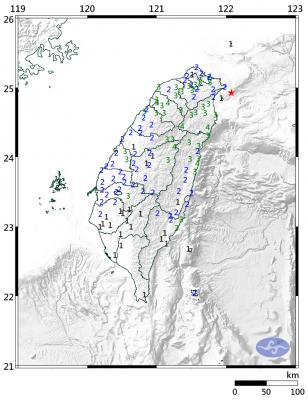
A magnitude 6.1 earthquake struck off the coast of Yilan County at 8:39pm tonight, the Central Weather Administration (CWA) said, with no immediate reports of damage or injuries. The epicenter was 38.7km east-northeast of Yilan County Hall at a focal depth of 98.3km, the CWA’s Seismological Center said. The quake’s maximum intensity, which gauges the actual physical effect of a seismic event, was a level 4 on Taiwan’s 7-tier intensity scale, the center said. That intensity level was recorded in Yilan County’s Nanao Township (南澳), Hsinchu County’s Guansi Township (關西), Nantou County’s Hehuanshan (合歡山) and Hualien County’s Yanliao (鹽寮). An intensity of 3 was
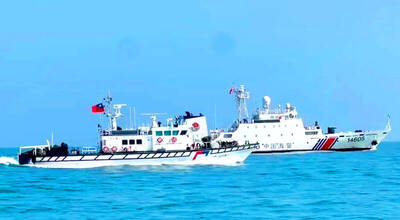
Instead of focusing solely on the threat of a full-scale military invasion, the US and its allies must prepare for a potential Chinese “quarantine” of Taiwan enforced through customs inspections, Stanford University Hoover fellow Eyck Freymann said in a Foreign Affairs article published on Wednesday. China could use various “gray zone” tactics in “reconfiguring the regional and ultimately the global economic order without a war,” said Freymann, who is also a nonresident research fellow at the US Naval War College. China might seize control of Taiwan’s links to the outside world by requiring all flights and ships entering or leaving Taiwan
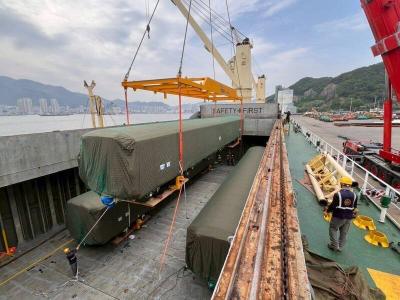
The first of 10 new high-capacity trains purchased from South Korea’s Hyundai Rotem arrived at the Port of Taipei yesterday to meet the demands of an expanding metro network, Taipei Rapid Transit Corp (TRTC) said yesterday. The train completed a three-day, 1,200km voyage from the Port of Masan in South Korea, the company said. Costing NT$590 million (US$18.79 million) each, the new six-carriage trains feature a redesigned interior based on "human-centric" transportation concepts, TRTC said. The design utilizes continuous longitudinal seating to widen the aisles and optimize passenger flow, while also upgrading passenger information displays and driving control systems for a more comfortable
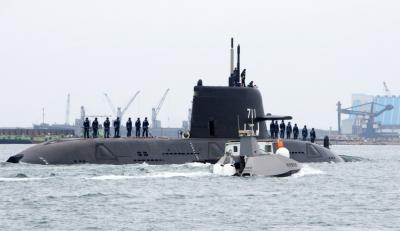
Taiwan's first indigenous defense submarine, the SS-711 Hai Kun (海鯤, or Narwhal), departed for its 13th sea trial at 7am today, marking its seventh submerged test, with delivery to the navy scheduled for July. The outing also marked its first sea deployment since President William Lai (賴清德) boarded the submarine for an inspection on March 19, drawing a crowd of military enthusiasts who gathered to show support. The submarine this morning departed port accompanied by CSBC Corp’s Endeavor Manta (奮進魔鬼魚號) uncrewed surface vessel and a navy M109 assault boat. Amid public interest in key milestones such as torpedo-launching operations and overnight submerged trials,


 RSS
RSS