


The Ministry of Environment is to collaborate with the public sector and the National Pingtung University of Science and Technology in developing livestock biogas power generation techniques to improve river quality.
A research center and biogas power generation facilities would be set up on the university’s property near the Nioujiaowan River (牛角灣溪) in Pingtung County’s Neipu Township (內埔), the ministry said yesterday.
The ministry launched the program in accordance with the Act for Promotion of Private Participation in Infrastructure Projects (促進民間參與公共建設法), and invited private companies with biogas development expertise to apply by May 4.
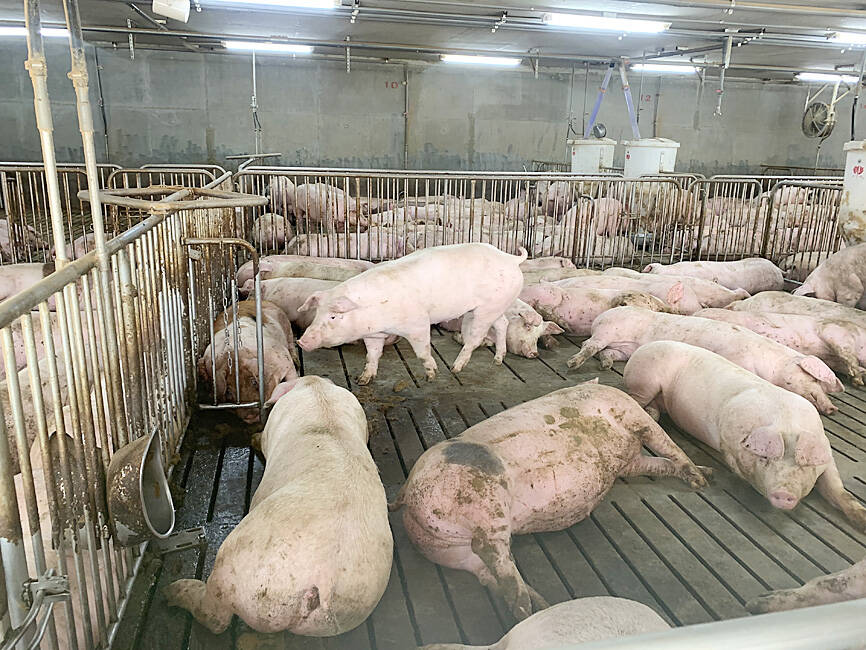
Photo: Lin Jing-hua, Taipei Times
Water Quality Protection Department Director Wang Yue-bin (王嶽斌) said the program aims to use livestock excreta produced by the thousands of pigs, cattle and chickens at the university, as well as other livestock in surrounding farms.
Ministry data showed that the facilities could help process the biomass produced by at least 25,000 pigs at the university and surrounding pig farms.
The facilities are expected to generate 2 million kilowatt-hours of biogas electricity a year and reduce the pollutant load for the nearby Donggang River (東港溪) basin, Wang said.
The program is the first biogas power generation collaboration among the government, industry and academia, he said.
Meanwhile, the ministry also announced revisions to regulations related to the identification and calculation of illicit gains from contraventions of the Water Pollution Control Act (水污染防治法).
Many unscrupulous businesses discharge sewage via bypasses, fail to install well-functioning sewage facilities or fail to operate such facilities the right way, Wang said.
To prevent such circumventions, which aim to reduce sewage processing costs, the revisions include sewage treatment fees paid to businesses as part of illicit gains and use evidence-based estimation to calculate sewage volume, he said.
The revisions also changed the deadline for recovering illicit gains by specifying that all illicit gains generated during the period when illegal activities occurred could be recovered, Wang said.
That means the recovery of illicit gains would have no upper limit and would extend to a broader range of illegal activities, such as bypass discharge, thereby better deterring industry players from illegally disposing waste, he added.

Considering that most countries issue more than five denominations of banknotes, the central bank has decided to redesign all five denominations, the bank said as it prepares for the first major overhaul of the banknotes in more than 24 years. Central bank Governor Yang Chin-lung (楊金龍) is expected to report to the Legislative Yuan today on the bank’s operations and the redesign’s progress. The bank in a report sent to the legislature ahead of today’s meeting said it had commissioned a survey on the public’s preferences. Survey results showed that NT$100 and NT$1,000 banknotes are the most commonly used, while NT$200 and NT$2,000

The Centers for Disease Control (CDC) yesterday reported the first case of a new COVID-19 subvariant — BA.3.2 — in a 10-year-old Singaporean girl who had a fever upon arrival in Taiwan and tested positive for the disease. The girl left Taiwan on March 20 and the case did not have a direct impact on the local community, it said. The WHO added the BA.3.2 strain to its list of Variants Under Monitoring in December last year, but this was the first imported case of the COVID-19 variant in Taiwan, CDC Deputy Director-General Lin Ming-cheng (林明誠) said. The girl arrived in Taiwan on

South Korea is planning to revise its controversial electronic arrival card, a step Taiwanese officials said prompted them to hold off on planned retaliatory measures, a South Korean media report said yesterday. A Yonhap News Agency report said that the South Korean Ministry of Foreign Affairs is planning to remove the “previous departure place” and “next destination” fields from its e-arrival card system. The plan, reached after interagency consultations, is under review and aims to simplify entry procedures and align the electronic form with the paper version, a South Korean ministry official said. The fields — which appeared only on the electronic form

The Ministry of Foreign Affairs (MOFA) is suspending retaliation measures against South Korea that were set to take effect tomorrow, after Seoul said it is updating its e-arrival system, MOFA said today. The measures were to be a new round of retaliation after Taiwan on March 1 changed South Korea's designation on government-issued alien resident certificates held by South Korean nationals to "South Korea” from the "Republic of Korea," the country’s official name. The move came after months of protests to Seoul over its listing of Taiwan as "China (Taiwan)" in dropdown menus on its new online immigration entry system. MOFA last week


 RSS
RSS