


Nearly 70 percent of respondents in an online survey would support unmarried couples and single women having children, provided that support systems are improved, the Childcare Policy Alliance said today.
As Taiwan’s marriage rate and birthrate continue to decline, Taiwan should follow in the footsteps of other aging societies, such as South Korea and Singapore, and begin shifting views on unmarried couples having children, it said.
The alliance released the survey findings today at a news conference ahead of International Women’s Day on Sunday.
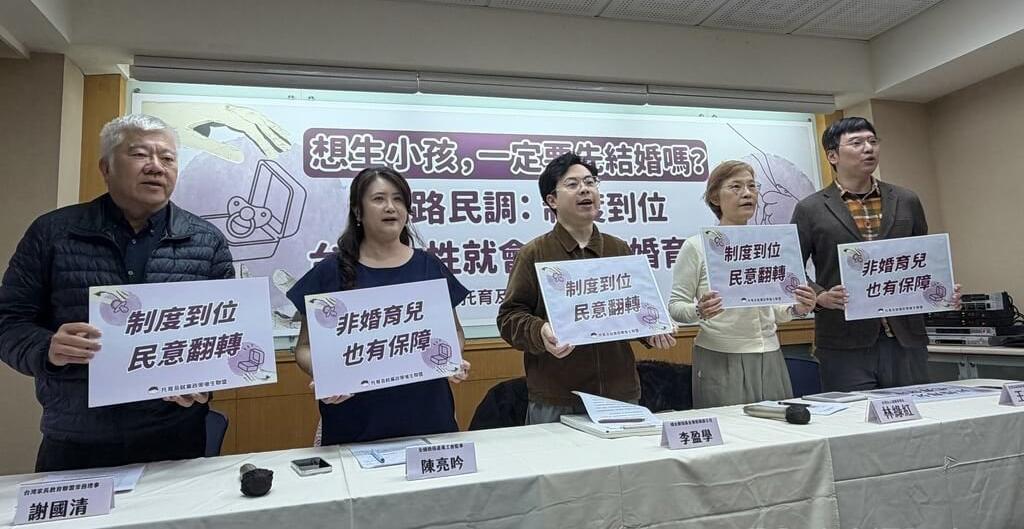
Photo: CNA
The online questionnaire asked 1,305 respondents, 88.5 percent of whom were women, their attitudes toward unmarried and single women having children.
The survey found that in the absence of protections, nearly 71 percent of respondents opposed non-marital childbearing and 61 percent opposed single parenthood.
However, nearly 70 percent of respondents supported non-marital or single-parent households if measures such as public childcare, anti-discrimination protections and requirements that both parents share child-rearing responsibilities were put in place.
Taiwan is not as conservative as it might seem, and opposition does not stem from moral judgement, but from practical concerns that single parents might lack resources, alliance spokesman Wang Chao-ching (王兆慶) said.
Taiwan’s fertility rate is one of the world’s lowest alongside Singapore.
Singapore’s birthrate recently fell to just 0.87, with Singaporean officials saying that subsidy policies are no longer effective, and cultural shifts regarding marriage and childbearing are instead needed to boost fertility, Wang said
South Korean officials have also said that more unmarried couples are now having children, he added.
In Europe, between 40 and 60 percent of children are born to unmarried parents and fertility rates remain at about 1.5 to 1.6, he said.
Meanwhile, in Taiwan and South Korea where a culture of “marriage before children” prevails, birthrates have plummeted, he added.
Many Taiwanese women want children but not marriage, said Lin Lu-hung (林綠紅), head of Taiwan Women's Link.
Some local governments subsidize egg freezing, though regulations require women to be married and hold an infertility diagnosis, she said.
Many eggs are therefore discarded as women wishing to use them are unmarried, she said.
The Legislative Yuan should prioritize passing amendments to the Assisted Reproduction Act (人工生殖法) that would allow single women to access assisted reproductive technology, she said.
Financial difficulties for single mothers are often put down to personal morality or poor choices, when really they are caused by wider systemic issues, Awakening Foundation policy department director Lee Ying-hsueh (李盈學) said.
The government should follow recommendations from the Organisation for Economic Co-operation and Development and provide sufficient public care resources and a legal environment that does not discriminate, she said.
Moreover, the government should allow single parents to receive the equivalent of two parents’ paid parental leave, up to 12 months in total, Alliance of Educare Trade Unions supervisor Chen Liang-yin (陳亮吟) said.
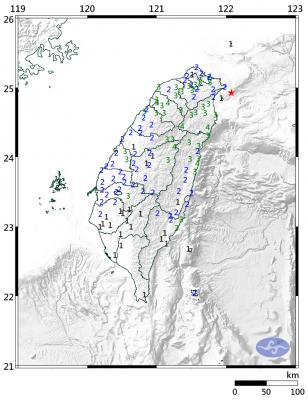
A magnitude 6.1 earthquake struck off the coast of Yilan County at 8:39pm tonight, the Central Weather Administration (CWA) said, with no immediate reports of damage or injuries. The epicenter was 38.7km east-northeast of Yilan County Hall at a focal depth of 98.3km, the CWA’s Seismological Center said. The quake’s maximum intensity, which gauges the actual physical effect of a seismic event, was a level 4 on Taiwan’s 7-tier intensity scale, the center said. That intensity level was recorded in Yilan County’s Nanao Township (南澳), Hsinchu County’s Guansi Township (關西), Nantou County’s Hehuanshan (合歡山) and Hualien County’s Yanliao (鹽寮). An intensity of 3 was
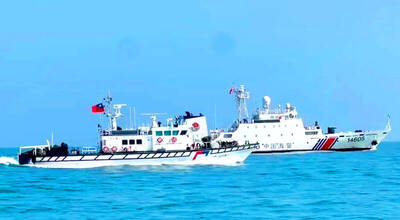
Instead of focusing solely on the threat of a full-scale military invasion, the US and its allies must prepare for a potential Chinese “quarantine” of Taiwan enforced through customs inspections, Stanford University Hoover fellow Eyck Freymann said in a Foreign Affairs article published on Wednesday. China could use various “gray zone” tactics in “reconfiguring the regional and ultimately the global economic order without a war,” said Freymann, who is also a nonresident research fellow at the US Naval War College. China might seize control of Taiwan’s links to the outside world by requiring all flights and ships entering or leaving Taiwan
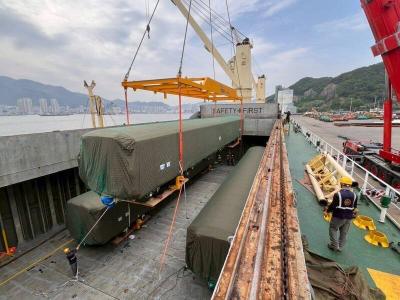
The first of 10 new high-capacity trains purchased from South Korea’s Hyundai Rotem arrived at the Port of Taipei yesterday to meet the demands of an expanding metro network, Taipei Rapid Transit Corp (TRTC) said yesterday. The train completed a three-day, 1,200km voyage from the Port of Masan in South Korea, the company said. Costing NT$590 million (US$18.79 million) each, the new six-carriage trains feature a redesigned interior based on "human-centric" transportation concepts, TRTC said. The design utilizes continuous longitudinal seating to widen the aisles and optimize passenger flow, while also upgrading passenger information displays and driving control systems for a more comfortable
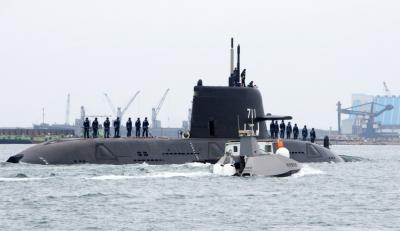
Taiwan's first indigenous defense submarine, the SS-711 Hai Kun (海鯤, or Narwhal), departed for its 13th sea trial at 7am today, marking its seventh submerged test, with delivery to the navy scheduled for July. The outing also marked its first sea deployment since President William Lai (賴清德) boarded the submarine for an inspection on March 19, drawing a crowd of military enthusiasts who gathered to show support. The submarine this morning departed port accompanied by CSBC Corp’s Endeavor Manta (奮進魔鬼魚號) uncrewed surface vessel and a navy M109 assault boat. Amid public interest in key milestones such as torpedo-launching operations and overnight submerged trials,


 RSS
RSS