


The Mainland Affairs Council (MAC) on Saturday issued its first economic risk warning for China this year, saying that Taiwanese businesses should evaluate carefully whether they conduct business there, due to economic loss and personal safety risks.
The council referred to a recent case, saying that investing and working in China involves considerable economic risks, and under China’s system in which politics and economy are inseparable, the political risks have risen sharply.
The Hong Kong-based Ta Kung Pao (大公報) newspaper on Friday targeted Minister of the Interior Liu Shyh-fang (劉世芳), saying that she had received political donations from her nephew, Yen Wen-chun (顏文群), who holds executive positions at three companies in China.
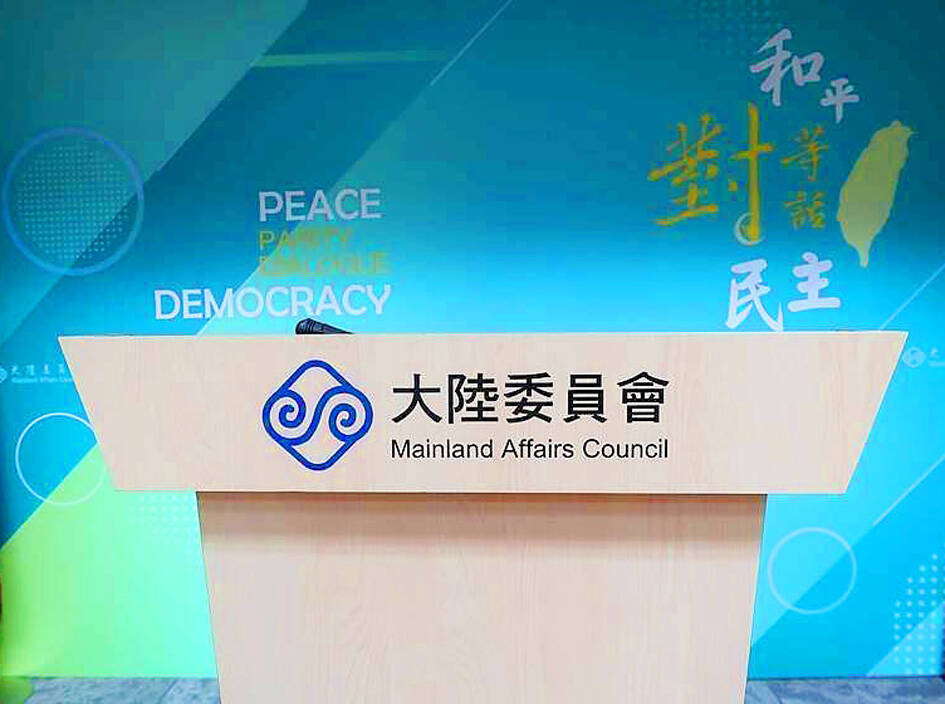
Photo: Chung Li-hua, Taipei Times
The report said that Liu, whom it described as a supporter of Taiwanese independence, allowed relatives to profit from business in China while discouraging cross-strait relations.
China’s Taiwan Affairs Office (TAO) said it is investigating the matter in accordance with laws and regulations.
The MAC on Saturday issued the “2026 China Economic Risk Warning,” urging Taiwanese businesses to carefully assess the situation before doing business in China.
China’s economy is struggling with internal structural adjustments, including ongoing economic downside risks, a sharp decline in foreign investment, high youth unemployment, insufficient consumption momentum and a sluggish real-estate market, the MAC said.
Massive government subsidies in China have led to industrial overcapacity, involution-style competition and stagnant prices or even deflation, it said, adding that all these factors would impact the operations and profitability of Taiwanese businesses and could lead to unpredictable risks.
China’s economy is also facing increasingly high external risks, as its unfair competitive practices and overcapacity have triggered an ongoing tariff and technology war with the US, it said.
Meanwhile, European countries and Japan have been increasing “de-risking” measures on trade with China, while global dumping of Chinese products has drawn international concern and led to more joint countermeasures, it said.
Such developments are likely to intensify investment and operational risks for Taiwanese businesses operating in China, it added.
“The Chinese economy continues to decline, and although Beijing claims its economic growth rate was 5 percent last year, international organizations and professional investment firms questioned the authenticity of these statistics and are pessimistic about the nation’s long-term economic development,” the MAC said.
The council said that in the past few years, foreign investors have significantly reduced or withdrawn their investments from China.
Taiwanese businesses should be more vigilant toward the immense economic risks of investing in China and readjust their overseas layouts, it said.
Chinese authorities, under the guise of punishing “Taiwanese independence advocates,” have targeted people and politically implicated innocent Taiwanese businesspeople, posing an unpredictable threat to their assets and personal safety, it said.
“The TAO’s distortion of facts, blatant intimidation of Taiwanese businesses, and unscrupulous political manipulation highlight the grim reality of an authoritarian state abusing its power,” the council said.
The council also urged Chinese Communist Party authorities to “cease interfering with normal economic and trade activities,” saying that it forces Taiwanese businesses to “de-risk” and sever supply chains, causing deteriorating cross-strait exchanges.

Taiwan has received more than US$70 million in royalties as of the end of last year from developing the F-16V jet as countries worldwide purchase or upgrade to this popular model, government and military officials said on Saturday. Taiwan funded the development of the F-16V jet and ended up the sole investor as other countries withdrew from the program. Now the F-16V is increasingly popular and countries must pay Taiwan a percentage in royalties when they purchase new F-16V aircraft or upgrade older F-16 models. The next five years are expected to be the peak for these royalties, with Taiwan potentially earning
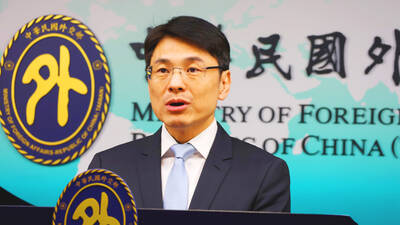
STAY IN YOUR LANE: As the US and Israel attack Iran, the ministry has warned China not to overstep by including Taiwanese citizens in its evacuation orders The Ministry of Foreign Affairs (MOFA) yesterday rebuked a statement by China’s embassy in Israel that it would evacuate Taiwanese holders of Chinese travel documents from Israel amid the latter’s escalating conflict with Iran. Tensions have risen across the Middle East in the wake of US and Israeli airstrikes on Iran beginning Saturday. China subsequently issued an evacuation notice for its citizens. In a news release, the Chinese embassy in Israel said holders of “Taiwan compatriot permits (台胞證)” issued to Taiwanese nationals by Chinese authorities for travel to China — could register for evacuation to Egypt. In Taipei, the ministry yesterday said Taiwan
‘LIKE-MINDED PARTNER’: Tako van Popta said it would be inappropriate to delay signing the deal with Taiwan because of China, adding he would promote the issue Canadian senators have stressed Taiwan’s importance for international trade and expressed enthusiasm for ensuring the Taiwan-Canada trade cooperation framework agreement is implemented this year. Representative to Canada Harry Tseng (曾厚仁) in an interview with the Central News Agency (CNA) said he was increasingly uneasy about Ottawa’s delays in signing the agreement, especially as Ottawa has warmed toward Beijing. There are “no negotiations left. Not only [is it] initialed, we have three versions of the text ready: English, French and Mandarin,” Tseng said. “That tells you how close we are to the final signature.” Tseng said that he hoped Canadian Prime Minister Mark Carney
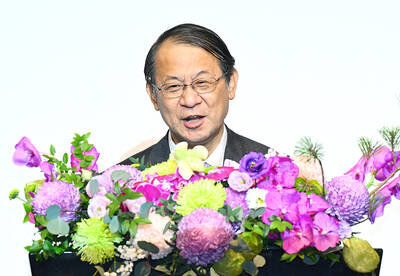
POSITIVE DEVELOPMENT: Japan and the US are expected to hold in-depth discussions on Taiwan-related issues during the meeting next month, Japanese sources said The holding of a Japan-US leaders’ meeting ahead of US President Donald Trump’s visit to China is positive news for Taiwan, former Japan-Taiwan Exchange Association representative Hiroyasu Izumi said yesterday. After the Liberal Democratic Party’s landslide victory in Japan’s House of Representatives election, Japanese Prime Minister Sanae Takaichi is scheduled to visit the US next month, where she is to meet with Trump ahead of the US president’s planned visit to China from March 31 to April 2 for a meeting with Chinese President Xi Jinping (習近平). Japan and the US are expected to hold in-depth discussions on Taiwan-related issues during the


 RSS
RSS