


Quantum technology is likely to become an important industry that would potentially be worth more than NT$1 trillion (US$32 billion), and Taiwan’s comprehensive industrial supply chain would give the nation a head start in the area, Academia Sinica president James Liao (廖俊智) said.
Quantum computers are regarded as a core technology linking high-performance computing and artificial intelligence (AI), the institution said in January, when it unveiled its 20-qubit superconducting quantum chip — designed and fabricated in-house — and announced it had successfully integrated it into a full quantum computing system.
This achievement positions Taiwan among the global frontrunners and marks the nation’s official entry into the domain of large-scale quantum chip fabrication, it added.
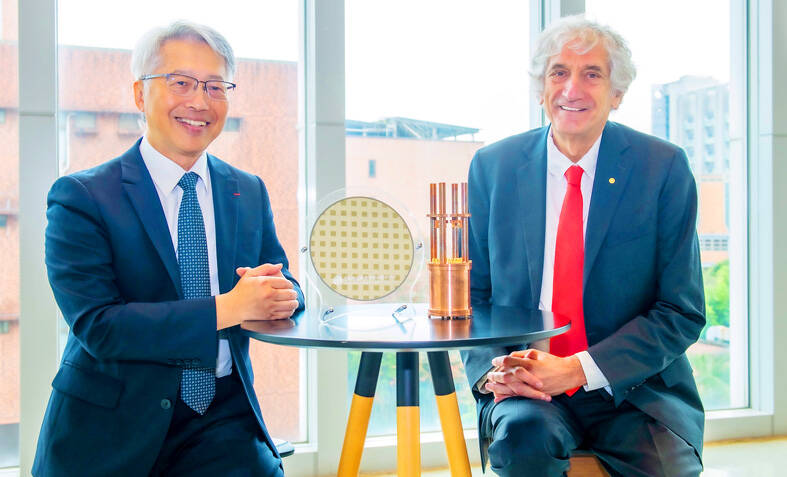
Photo courtesy of Academia Sinica
Academia Sinica chose to focus on quantum chip manufacturing several years ago, as Taiwan holds a significant niche in the processes and peripheral equipment required for low-temperature superconducting quantum computers, Liao said.
Taiwan possesses hardware foundations unmatched globally, including complete information technology (IT) supply chains, and comprehensive chip manufacturing and hardware supply chains led by Taiwan Semiconductor Manufacturing Co, he said.
From design and fabrication to packaging and related equipment, Taiwan has all the essential elements for quantum chip development, he added.
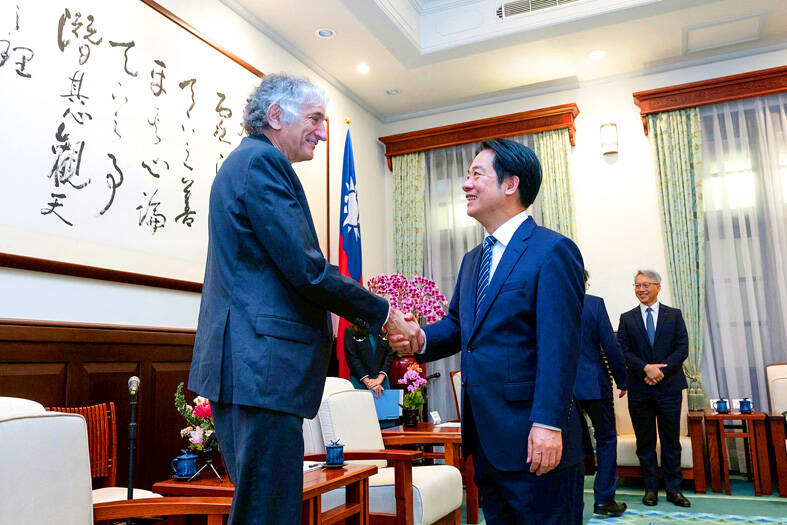
Photo courtesy of the Presidential Office
Quantum technology cannot be built overnight, but having such infrastructure would enable the nation to “run faster than others” when quantum computing takes off, Liao said.
As the nation’s industry sector has not yet entered the field, Liao expressed optimism that once development efforts bear fruit, quantum computing could become Taiwan’s next major industry — one that would be worth more than NT$1 trillion — as the nation possesses all the conditions to lead the world.
Academia Sinica noticed that the quantum race between the US, China and Europe had intensified before the COVID-19 pandemic, while Taiwan’s research efforts remained relatively scattered, he said.
The institute looked into resources nationwide and reported its findings to the government, which then coordinated cross-ministerial resources and, in 2021, established a national quantum team, he added.
Liao last week accompanied US scientist John Martinis, who won the Nobel Prize in Physics last year for quantum phenomena in superconductors, for a meeting with President William Lai (賴清德).
During the meeting, Liao said Taiwan should invest in the research and manufacturing of next-generation quantum computers, leveraging the nation’s strengths in semiconductor fabrication and scientific innovation, Academia Sinica said.
Lai expressed strong support for this vision and affirmed the strategic importance of quantum technology to Taiwan’s long-term development, it said.
Martinis expressed confidence in Taiwan’s strong foundation in semiconductor manufacturing and precision engineering, and said those capabilities position the nation exceptionally well in advancing quantum technologies, the institution cited Martinis as saying.
Martinis in his lecture, “Quantum Computing’s Industrial Revolution: From Lab to Fab,” said quantum technology is entering a new phase defined by engineering capability and manufacturing precision.
The realization of larger-scale quantum systems would depend on mature fabrication processes, robust system architectures, and interdisciplinary integration across physics, engineering and materials science, he said.
By tightly integrating academic research with practical engineering implementation, quantum computing could progressively transition from the laboratory to broader research and application domains, Martinis said.
The decisive step in moving quantum computing from research to practical application is the ability to build scalable and reproducible engineering systems, he said.
The central challenge lies in whether quantum platforms can be manufactured reliably and consistently at scale, he said, adding that quantum chip fabrication, systems integration and low-temperature circuit architecture would form the technological core of next-generation quantum computers.
Martinis has long championed the integration of systems engineering principles into the development of superconducting qubit platforms, Academia Sinica said.
Since the 1980s, he has been at the forefront of superconducting qubit research, which culminated in the landmark 2019 demonstration of “quantum supremacy,” a milestone that drew global attention, the institution said.
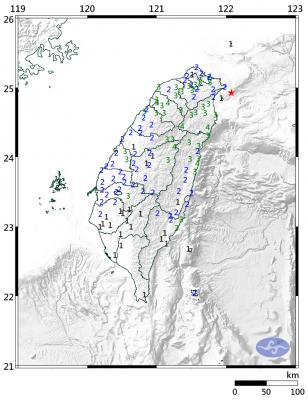
A magnitude 6.1 earthquake struck off the coast of Yilan County at 8:39pm tonight, the Central Weather Administration (CWA) said, with no immediate reports of damage or injuries. The epicenter was 38.7km east-northeast of Yilan County Hall at a focal depth of 98.3km, the CWA’s Seismological Center said. The quake’s maximum intensity, which gauges the actual physical effect of a seismic event, was a level 4 on Taiwan’s 7-tier intensity scale, the center said. That intensity level was recorded in Yilan County’s Nanao Township (南澳), Hsinchu County’s Guansi Township (關西), Nantou County’s Hehuanshan (合歡山) and Hualien County’s Yanliao (鹽寮). An intensity of 3 was
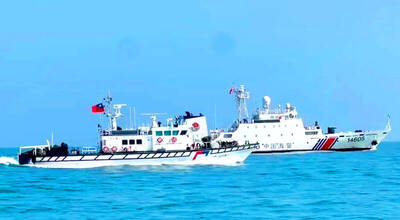
Instead of focusing solely on the threat of a full-scale military invasion, the US and its allies must prepare for a potential Chinese “quarantine” of Taiwan enforced through customs inspections, Stanford University Hoover fellow Eyck Freymann said in a Foreign Affairs article published on Wednesday. China could use various “gray zone” tactics in “reconfiguring the regional and ultimately the global economic order without a war,” said Freymann, who is also a nonresident research fellow at the US Naval War College. China might seize control of Taiwan’s links to the outside world by requiring all flights and ships entering or leaving Taiwan
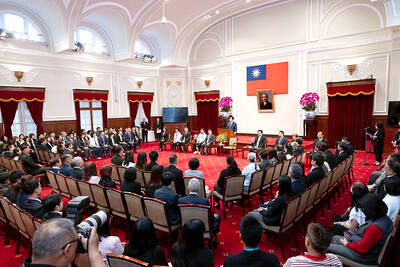
The next minimum wage hike is expected to exceed NT$30,000, President William Lai (賴清德) said yesterday during an award ceremony honoring “model workers,” including migrant workers, at the Presidential Office ahead of Workers’ Day today. Lai said he wished to thank the awardees on behalf of the nation and extend his most sincere respect for their hard work, on which Taiwan’s prosperity has been built. Lai specifically thanked 10 migrant workers selected for the award, saying that although they left their home countries to further their own goals, their efforts have benefited Taiwan as well. The nation’s industrial sector and small businesses lay
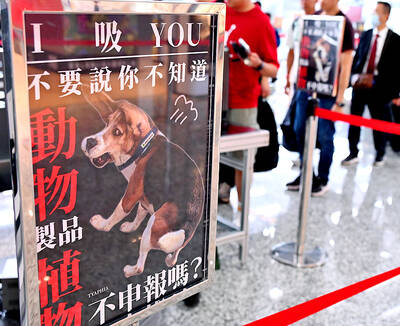
Quarantine awareness posters at Taiwan Taoyuan International Airport have gone viral for their use of wordplay. Issued by the airport branch of the Animal and Plant Health Inspection Agency, the posters feature sniffer dogs making a range of facial expressions, paired with advisory messages built around homophones. “We update the messages for holidays and campaign needs, periodically refreshing materials to attract people’s attention,” quarantine officials said. “The aim is to use the dogs’ appeal to draw focus to quarantine regulations.” A Japanese traveler visiting Taiwan has posted a photo on X of a poster showing a quarantine dog with a


 RSS
RSS