


The government should provide a firm timeline to transition Chiang Kai-shek Memorial Hall in Taipei away from a location that “worships a statue of a dictator,” the Taiwan Youth Association for Transitional Justice and Kiong-seng said yesterday.
The association issued the call at its Gongsheng Music Festival in Taipei to raise awareness of the 228 Incident among young people.
Yesterday was the 79th anniversary of the bloody crackdown launched by the then-Chinese Nationalist Party (KMT) regime against civilian demonstrators following an incident in Taipei on Feb. 27, 1947. The crackdown, which lasted into early May 1947, also marked the beginning of the White Terror era in Taiwan, in which thousands of people were arrested, imprisoned and executed.
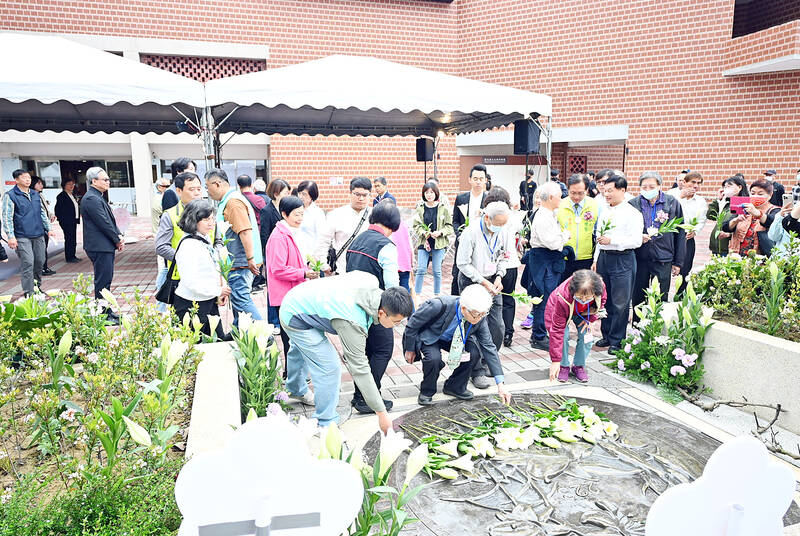
Photo: Liu Hsiao-hsin, Taipei Times
Premier Cho Jung-tai (卓榮泰) in June last year said that the memorial hall would be turned into a “democracy education park,” but eight months have passed and the Executive Yuan has yet to provide any plans, the association said.
Meanwhile, “the public and foreign tourists continue to worship the dictator, ignoring the harm the dictator has caused to Taiwan’s democracy,” it said.
The Taipei City Government should remove the name “Chiang Kai-shek Memorial Hall” from bus stops and MRT stations, it added.
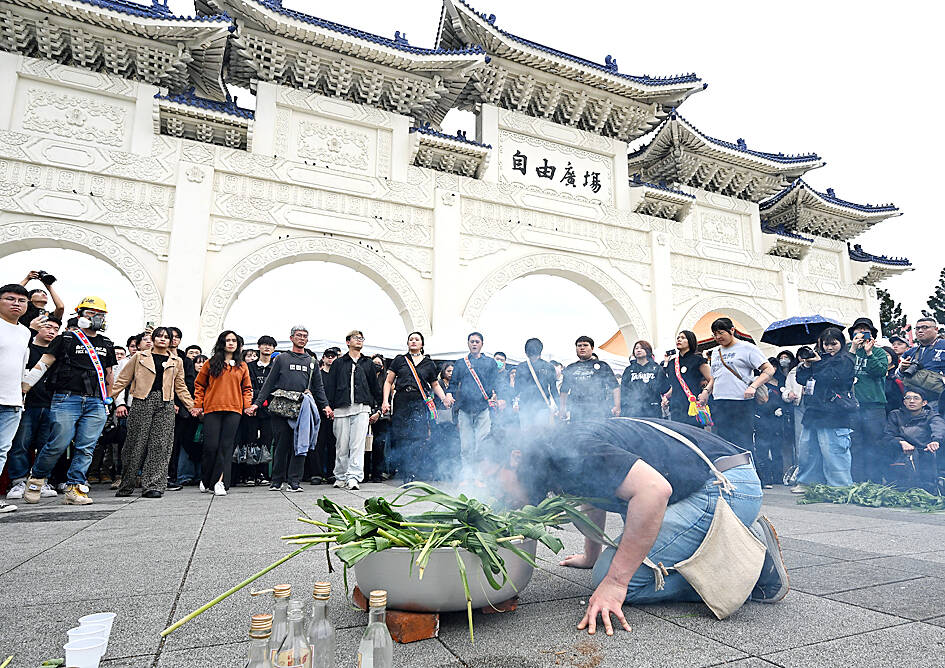
Photo: Liao Chen-huei, Taipei Times
The demands are not meant to divide, but to allow the public to redefine the space and truly become the masters of the location, the association said.
Separately, the Taiwan Statebuilding Party and the Taiwan Nation Alliance held a memorial event commemorating the 228 Incident in front of Chiang Kai-shek Memorial Hall.
Huang Chun-sheng (黃春生), a pastor, led a prayer to open the event, at which a list of people killed in the 228 Incident was carried up the stairs of the hall housing the statue of Chiang Kai-shek (蔣介石) statue and around the hall, symbolizing “the dead staring back” at the symbol of authoritarian rule and rising above it.
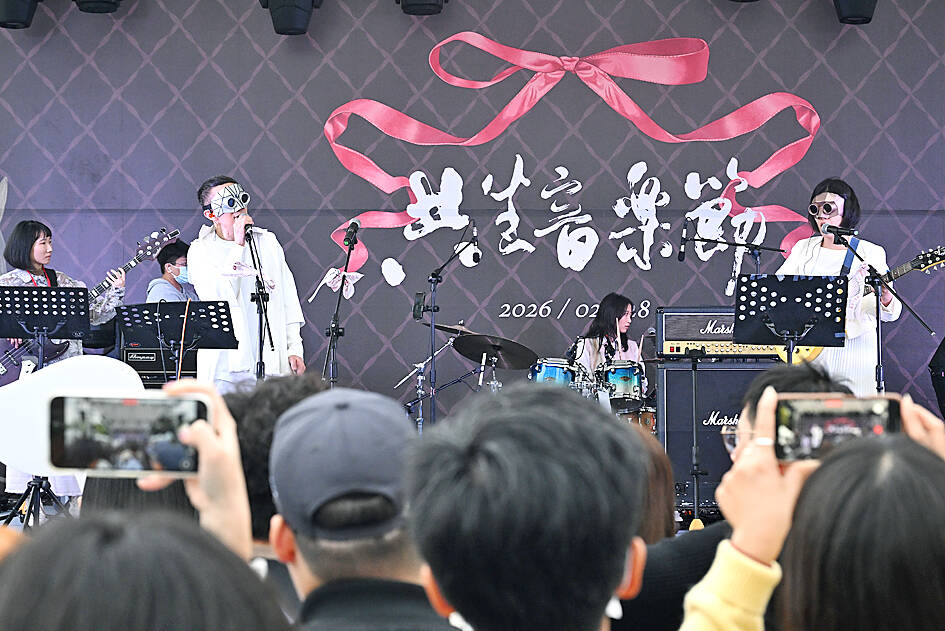
Photo: Liao Chen-huei, Taipei Times
The event closed with a requiem dance to convey “the commemoration of the dead by the living.”
At a separate ceremony held by the Taipei City Government, Taipei Mayor Chiang Wan-an (蔣萬安) apologized in his capacity as mayor to the descendants of people killed in the 228 Incident.
Chiang Wan-an, a purported descendant of Chiang Kai-shek, said that since taking office in 2022, he has directed the Taipei Department of Cultural Affairs to prioritize projects such as renovating Taipei 228 Memorial Museum, digitizing exhibitions and publishing two monographs by the end of this year.
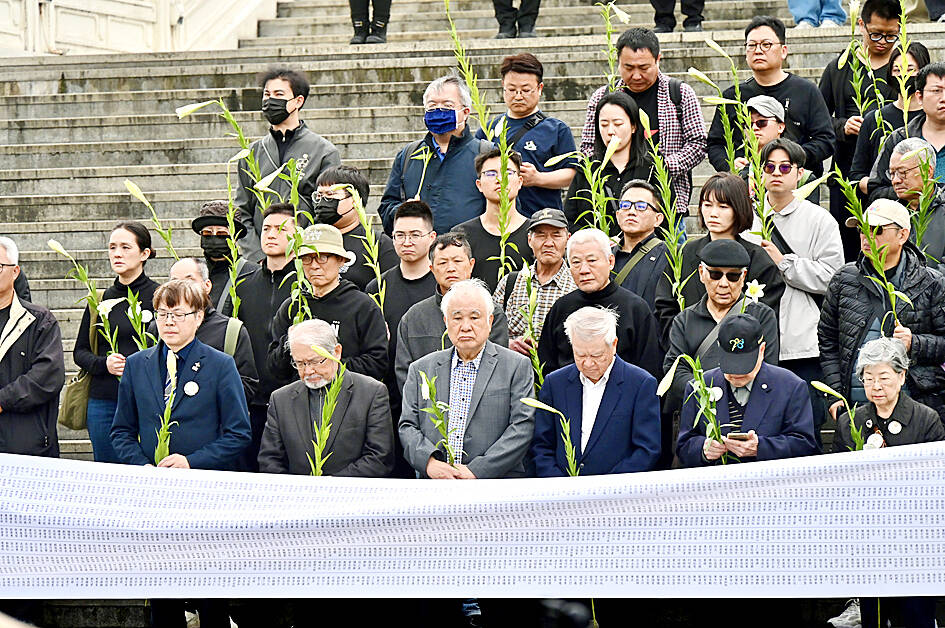
Photo: George Tsorng, Taipei Times
“Our attitude and stance are clear. We will certainly not shun history, but rather try our best to present as many aspects of it as possible through historical materials,” he said.
During the event, a descendant of a person killed in the 228 Incident was seen wearing a paper bag over their head while carrying a placard that read: “Forgiveness is impossible without addressing the facts.”
Asked to comment on the protest, the mayor said the city government would “do its utmost to heal the wounds.”
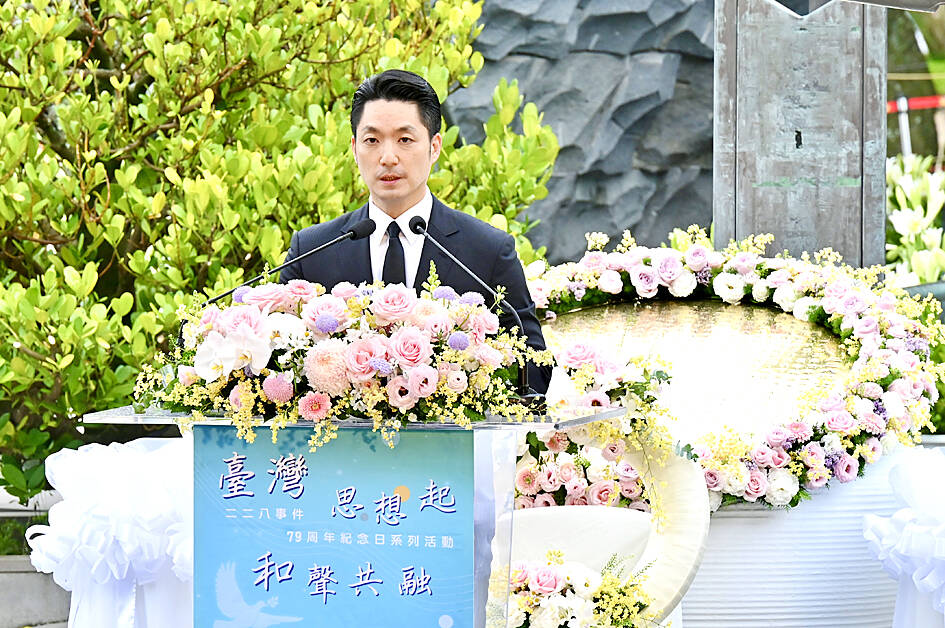
Photo: George Tsorng, Taipei Times
Meanwhile, former Taipei mayor Ko Wen-je (柯文哲), founding chairman of the Taiwan People’s Party (TPP), and TPP Chairman Huang Kuo-chang (黃國昌) participated in the One Day North to South bicycle ride to commemorate the Incident.
Ko said that since 2016, he has participated in the ride — in which teams complete sections linking Taipei and Kaohsiung — every year on Feb. 28.
“For Taiwan, 228 is a day to reflect on history and cherish democracy, but it’s also important not to dwell in sorrow,” he said.

Photo: Fang Pin-chao, Taipei Times
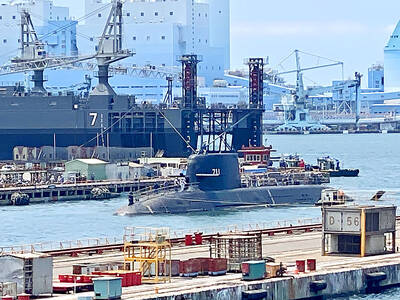
AGING: While Japan has 22 submarines, Taiwan only operates four, two of which were commissioned by the US in 1945 and 1946, and transferred to Taiwan in 1973 Taiwan would need at least 12 submarines to reach modern fleet capabilities, CSBC Corp, Taiwan chairman Chen Cheng-hung (陳政宏) said in an interview broadcast on Friday, citing a US assessment. CSBC is testing the nation’s first indigenous defense submarine, the Hai Kun (海鯤, Narwhal), which is scheduled to be delivered to the navy next month or in July. The Hai Kun has completed torpedo-firing tests and is scheduled to undergo overnight sea trials, Chen said on an SET TV military affairs program. Taiwan would require at least 12 submarines to establish a modern submarine force after assessing the nation’s operational environment and defense
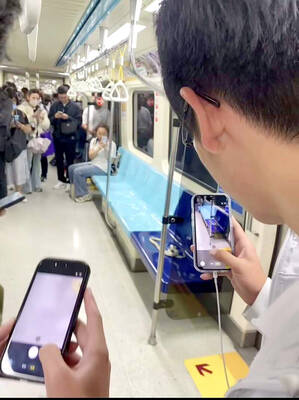
A white king snake that frightened passengers and caused a stir on a Taipei MRT train on Friday evening has been claimed by its owner, who would be fined, Taipei Rapid Transit Corp (TRTC) said yesterday. A person on Threads posted that he thought he was lucky to find an empty row of seats on Friday after boarding a train on the Bannan (Blue) Line, only to spot a white snake with black stripes after sitting down. Startled, he jumped up, he wrote, describing the encounter as “terrifying.” “Taipei’s rat control plan: Release snakes on the metro,” one person wrote in reply, referring
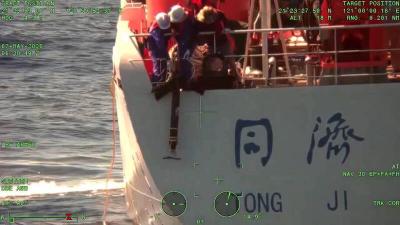
The coast guard today said that it had disrupted "illegal" operations by a Chinese research ship in waters close to the nation and driven it away, part of what Taipei sees a provocative pattern of China's stepped up maritime activities. The coast guard said that it on Thursday last week detected the Chinese ship Tongji (同濟號), which was commissioned only last year, 29 nautical miles (54km) southeast of the southern tip of Taiwan, although just outside restricted waters. The ship was observed lowering ropes into the water, suspected to be the deployment of scientific instruments for "illegal" survey operations, and the coast
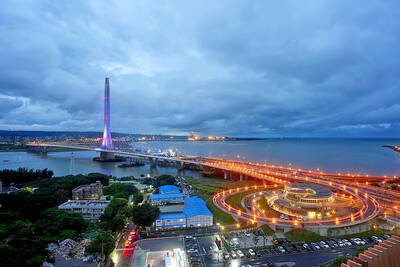
An inauguration ceremony was held yesterday for the Danjiang Bridge, the world’s longest single-mast asymmetric cable-stayed bridge, ahead of its official opening to traffic on Tuesday, marking a major milestone after nearly three decades of planning and construction. At the ceremony in New Taipei City attended by President William Lai (賴清德), Premier Cho Jung-tai (卓榮泰), Minister of Transportation and Communications Chen Shih-kai (陳世凱) and New Taipei City Mayor Hou Yu-ih (侯友宜), the bridge was hailed as both an engineering landmark and a long-awaited regional transport link connecting Tamsui (淡水) and Bali (八里)


 RSS
RSS