


The Ministry of Labor yesterday released a reference guide to help Taiwanese businesses prevent forced labor and “reduce operational risks” amid growing international scrutiny of migrant workers’ rights in the nation's supply chains.
The guide is intended to help businesses build “effective mechanisms” to prevent forced labor and embed “respect for human rights” in supply chain management, Workforce Development Agency Director Lydia Huang (黃齡玉) said.
“There have already been multiple cases in Taiwan and abroad showing that once forced labor conditions arise in a Taiwanese company or its supply chain, it can face consequences such as product detention, import bans or even the return of shipments,” Huang told a news conference in Taipei.
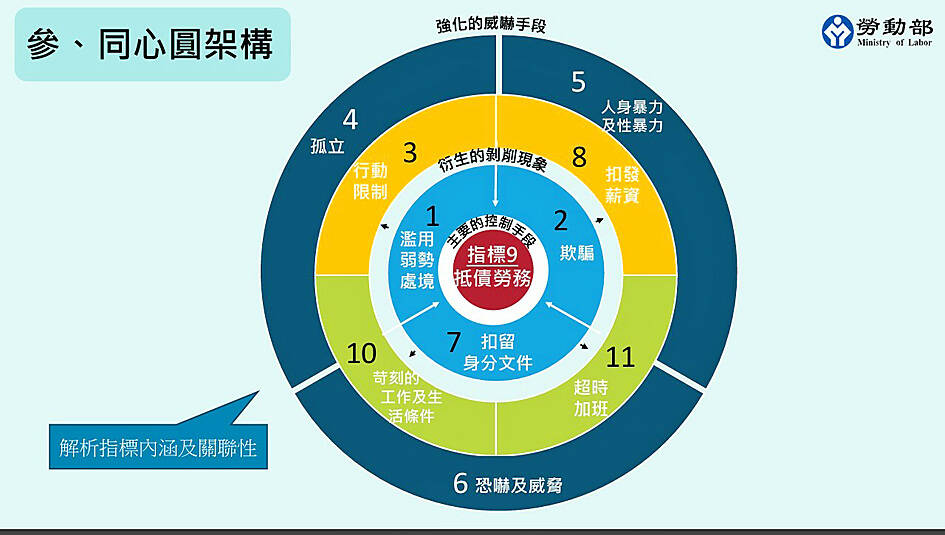
Photo courtesy of the Ministry of Labor
A notable example is bicycle maker Giant Manufacturing Co Ltd, which came under scrutiny after US authorities in September last year detained imports of its Taiwan-made products over forced labor allegations, with a subsequent import ban remaining in effect.
Apart from Giant, allegations of forced labor involving migrant workers have also surfaced in Taiwan’s distant-water fishing and manufacturing sectors in recent years, drawing concern from international organizations and foreign governments.
The guide was issued following the recent signing of the Taiwan-US Agreement on Reciprocal Trade, under which both sides agreed to include labor protections, such as a ban on imports of goods produced with forced labor.
The guide introduces the International Labour Organization’s 11 forced labor indicators, including signs of forced labor such as debt bondage, restriction of movement, excessive overtime and retention of identity documents, Huang said.
The guide also includes a self-assessment form for businesses, tools for identifying forced labor risks and corrective measures, case studies, an overview of relevant domestic laws and an introduction to major international audit tools, she said.
Through the guide, businesses can establish the “necessary basic understanding and internal management procedures,” Huang said, adding that the ministry hopes the same practices would also be implemented across downstream supply chains, especially when a company is a brand owner.
As the guide is not mandatory, Huang said that ministry would promote it through briefings and outreach sessions in partnership with the Ministry of Economic Affairs and the Ministry of Agriculture.
She described the guide as a “soft-law” approach aimed mainly at encouraging and advising businesses, but said it would eventually need to be written into law, “with the only question being how soon.”
While existing laws, including the Employment Service Act (就業服務法部分條文) and the Labor Standards Act (勞動基準法), already cover many indicators of forced labor, neither the guide nor yesterday’s press event mentioned any enhanced enforcement measures to be introduced by the authorities.

NATIONAL SECURITY: Authorities are working to confirm the identities of the military personnel involved and investigating possible illegal conduct and regulatory violations Authorities are probing possible national security implications after Kinmen police and immigration officers on Sunday found a Chinese woman allegedly posing as a tourist while engaging in prostitution involving more than 10 military personnel. The woman, surnamed Chen (陳), has since been deported, authorities said, adding that investigators are still working to confirm the identities of those implicated, as the records only listed code names and aliases. The case stemmed from a report received by the Kinmen District Prosecutors’ Office on Friday last week from the Jinhu Precinct of the Kinmen County Police Bureau. On Sunday, police, along with the National Immigration
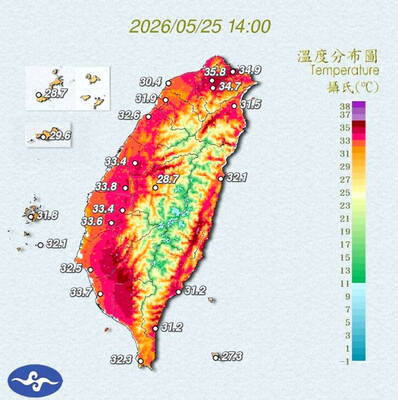
STAY COOL: The HPA recommended that people stay hydrated, use air-conditioning or fans while indoors, wear loose-fitting clothes and walk in the shade while outdoors Employers must implement measures such as installing cooling equipment, and providing drinking water and rest breaks for outdoor workers starting from Monday next week, the Taipei Department of Labor said on Sunday. Employers who fail to comply could face fines of NT$30,000 to NT$300,000 under the Occupational Safety and Health Act (職業安全衛生法), the department said. Businesses in Taipei employing fewer than 100 workers, as well as registered self-employed workers with labor insurance coverage, could receive on-site assessments and guidance from occupational safety consultants to help them apply for central government subsidies to implement or improve heat-protection measures, it said. Under the Ministry of

GLOBALGIVING: ‘ Caving to external pressure is not acceptable for an organization that has cultivated justice reform and human rights for 30 years,’ one NGO said A slew of non-government organizations (NGOs) have withdrawn from the GlobalGiving fundraising platform after it announced it would use “Chinese Taipei” instead of “Taiwan” from next month. The Taiwan Good Rice Association wrote on Facebook on Friday that it was informed on April 28 via a teleconference call of the change, which was made because the platform wanted to operate in China. Taiwan Good Rice is to terminate all cooperative relationships with GlobalGiving in response to the platform’s “unilateral and non-negotiable” decision to remove references to Taiwan, the NGO said. “Taiwan is in the official name of Taiwan Good Rice Association and the

Chinese Nationalist Party (KMT) Chairwoman Cheng Li-wun (鄭麗文) yesterday briefed her party’s Central Standing Committee regarding her scheduled visit to the US between Monday next week and June 16, saying that her purpose would be to persuade the US that the Republic of China (ROC) Constitution was a “one China” constitution that would foster stable and peaceful cross-strait relations. The ROC Constitution is the most important defense for all Taiwanese citizens, as it upholds our democracy and has contributed to our robust economy, which aligns with international and US interests, she said. “We would not be troublemakers and drag the US under,”


 RSS
RSS