


When best-selling Czech author Katerina Tuckova was in Taiwan earlier this month to promote the Chinese version of her novel The Last Goddess, she said the novel might resonate with Taiwanese readers because of a similar authoritarian past.
In an interview during the Taipei International Book Exhibition in the first week of this month, Tuckova said she saw her work as an effort to “preserve cultural memory” extinguished by state persecution.
“I wanted readers to know our own history and how we behaved under different regimes toward marginalized people, which can lead to losing a whole culture,” she said.

Photo: CNA
The Last Goddess draws heavily on 20th-century history, a period of major political upheaval in what was then Czechoslovakia, in creating its fiction. It follows modern-
day researcher Dora Idesova, who was raised by her aunt, a “goddess” of the White Carpathian Mountains believed to heal body and spirit through herbal knowledge and divination.
An ethnologist, Dora traces the persecution of the “goddesses” through 17th-century witch trials, Nazi scrutiny and communist repression.
In the novel, the “goddesses” were consistently targeted by the authorities. The Catholic Church accused them of witchcraft, Nazi officials attempted to appropriate them for ideological purposes and the communist regime labeled them enemies of the state.
Communism eventually destroyed the tradition by severing the generational transfer of knowledge, with the last recognized “goddess,” Irma Gabrilova, dying in 2001, Tuckova said.
She said she believed Taiwanese readers might relate to the novel, as Taiwan and the Czech Republic experienced political turmoil and totalitarian rule, during which “brutalities in the name of the regime destroyed individual lives.”
“The political changes taking place in my country are not so different from what Taiwan has experienced. You have your own history of totalitarianism and your own victims of political terror,” she said.
The goal of her novel was to give future generations an understanding of the perspectives of those who lived through authoritarian rule so that they can recognize how easily societies can shift if citizens remain passive, she said.
That happened in 1946, when voters made the communists the largest party in that year’s Czechoslovak parliamentary election without foreseeing the consequences.
Two years after that, in 1948, the communists staged a coup that ended free elections in the country until the 1990s after the Berlin Wall fell.
Beyond similarities between the histories of Taiwan and the Czech Republic, Tuckova drew parallels between the “goddesses” and shamanic women among some of Taiwan’s indigenous groups, including the Amis and Kavalan people.
She praised Taiwan for recognizing the importance of preserving cultural traditions before they disappear, which did not happen in the Czech Republic, because there was little left to save by the time people started to appreciate the culture.
“It is great that you make such a change in your society and try to preserve them [the indigenous shamanic cultures] and support them now, because we were too late,” she said.
Such was the persecution of the “goddesses” in Czechoslovakia that bias against them was built into the language, including the phrase “you lie like a goddess,” Tuckova said.
Tuckova said she first encountered the phrase while growing up under communism, unaware of its political meaning.
She only connected the dots many years later as a university student in the democratic-era Czech Republic when she heard about the ethnographic phenomenon of the “goddesses” and learned the old saying was actually communist propaganda aimed at discrediting them.
To counter that narrative, Tuckova spent more than a year gathering information from several sources, including official documents, history archives and writings, as well as interviews with people in the region who still had memories of the “goddesses.”
She then spent another year to piece together her novel, blending documented events with fiction while identifying only state actors and giving individuals anonymity.
Tuckova’s novels often focus on marginalized groups, particularly women. Her earlier work Gerta, about the post-World War II expulsion of ethnic Germans during the 1945 “Brno Death March,” helped spark broader public discussion about historical responsibility and reconciliation.
Similarly, The Last Goddess drew many to the mountains, where the “goddesses” once resided to learn more about the lost culture.
She said literature has the power to move readers emotionally in ways history books often cannot.
In recognition of her contribution to confronting modern history, she received the Freedom, Democracy and Human Rights Award from the Czech Republic’s Institute for the Study of Totalitarian Regimes in 2017.
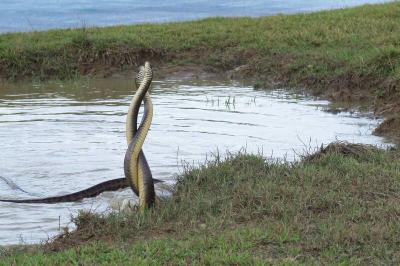
Kenting National Park service technician Yang Jien-fon (楊政峰) won a silver award in World Grand Prix Photography Awards Spring Season for his photograph of two male rat snakes intertwined in combat. Yang’s colleagues at Kenting National Park said he is a master of nature photography who has been held back by his job in civil service. The awards accept entries in all four seasons across six categories: architectural and urban photography, black-and-white and fine art photography, commercial and fashion photography, documentary and people photography, nature and experimental photography, and mobile photography. Awards are ranked according to scores and divided into platinum, gold and

SPACE VETERAN: Kjell N. Lindgren, who helps lead NASA’s human spaceflight missions, has been on two expeditions on the ISS and has spent 311 days in space Taiwan-born US astronaut Kjell N. Lindgren is to visit Taiwan to promote technological partnerships through one of the programs organized by the US for its 250th national anniversary. Lindgren would be in Taiwan from Tuesday to Saturday next week as part of the US Bureau of Educational and Cultural Affairs’ US Speaker Program, organized to celebrate the 250th anniversary of the signing of the Declaration of Independence, the American Institute in Taiwan (AIT) said in a statement yesterday. Lindgren plans to engage with key leaders across the nation “to advance cutting-edge technological partnerships and inspire the next generation of scientists and engineers,”

The Chinese Nationalist Party (KMT) caucus yesterday said it opposes the introduction of migrant workers from India until a mechanism is in place to prevent workers from absconding. Minister of Labor Hung Sun-han (洪申翰) on Thursday told the Legislative Yuan that the first group of migrant workers from India could be introduced as early as this year, as part of a government program. The caucus’ opposition to the policy is based on the assessment that “the risk is too high,” KMT caucus secretary-general Lin Pei-hsiang (林沛祥) said. Taiwan has a serious and long-standing problem of migrant workers absconding from their contracts, indicating that

TRADE-OFF: Beijing seeks to trade a bowl of tempura for a Chinese delicacy, an official said, while another said its promises were attempts to interfere in the polls The government must carefully consider the national security implications of building a bridge connecting Kinmen County and Xiamen, China, the Public Construction Commission (PCC) said yesterday. PCC Commissioner Derek Chen (陳金德), who is also a minister without portfolio, made the remarks in a meeting of the legislature’s Transportation Committee, after Democratic Progressive Party Legislator Hsu Fu-kuei (徐富癸) asked about China’s proposal of new infrastructure projects to further connect Kinmen and Lienchiang (Matsu) counties with Xiamen. China unveiled the bridge plan, along with nine other policies for Taiwan, on Sunday, the last day of Chinese Nationalist Party (KMT) Chairwoman Cheng Li-wun’s (鄭麗文) visit


 RSS
RSS