


Prolonged use of earbuds could cause bacteria levels in the ear to surge, as heat and moisture get trapped, a doctor warned, citing a rise in people seeking treatment for persistent ear itches.
Many of those people reported blocked ears or excessive itching, and often suspected that excessive earwax was to blame, otolaryngologist Chang Chia-chun (張嘉峻) wrote on social media.
However, most clinical examinations found that the culprits were fungal infections caused by wearing earbuds for several hours, he said.
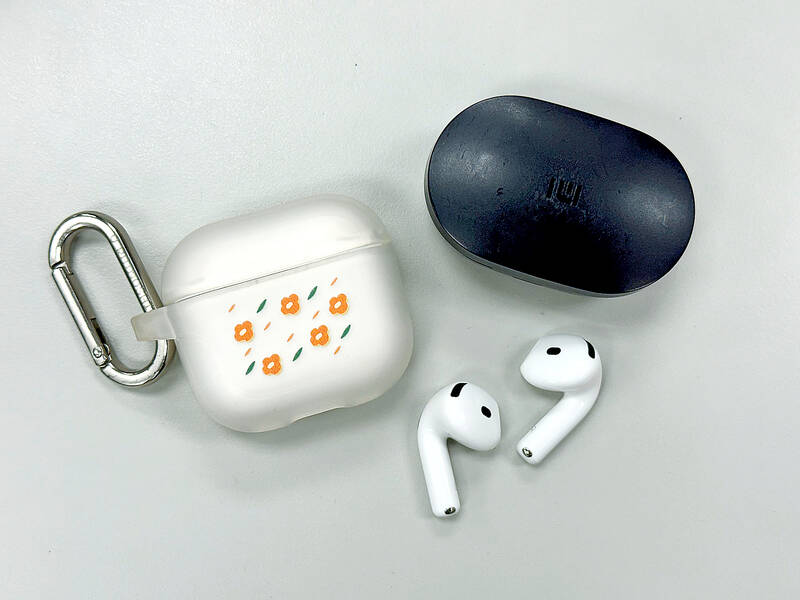
Photo: Tsai Yun-jung, Taipei Times
Many people are unaware that earbuds act like a “plug,” completely sealing the ear canal, Chang said.
Studies have shown that wearing them for an hour could significantly increase bacterial growth in the ear canal due to trapped heat and humidity, and poor ventilation, he said.
Some studies suggested that the growth rate of bacteria could increase by more than 10-fold under these conditions, creating an ideal environment for fungi to thrive, he added.
Chang urged people to be alert if they experience any of the following symptoms: intense itching deep inside the ear; foul-smelling liquid leaking from the ear canal; and muffled hearing, as if sounds are blocked by a thin membrane.
These could be symptoms of otomycosis, or fungal ear infection, he said, warning against using cotton swabs to relieve itching.
Using cotton swabs to dig into the ear could push fungal spores deeper into the canal or cause abrasions that might lead to more serious inflammation or cellulitis, he said.
Heavy earbuds users are advised to remove them every 50 minutes to allow the ear canal to ventilate; regularly use alcohol to disinfect the earbuds and keep them dry; and seek medical help if discomfort persists, he said.

Considering that most countries issue more than five denominations of banknotes, the central bank has decided to redesign all five denominations, the bank said as it prepares for the first major overhaul of the banknotes in more than 24 years. Central bank Governor Yang Chin-lung (楊金龍) is expected to report to the Legislative Yuan today on the bank’s operations and the redesign’s progress. The bank in a report sent to the legislature ahead of today’s meeting said it had commissioned a survey on the public’s preferences. Survey results showed that NT$100 and NT$1,000 banknotes are the most commonly used, while NT$200 and NT$2,000

The Centers for Disease Control (CDC) yesterday reported the first case of a new COVID-19 subvariant — BA.3.2 — in a 10-year-old Singaporean girl who had a fever upon arrival in Taiwan and tested positive for the disease. The girl left Taiwan on March 20 and the case did not have a direct impact on the local community, it said. The WHO added the BA.3.2 strain to its list of Variants Under Monitoring in December last year, but this was the first imported case of the COVID-19 variant in Taiwan, CDC Deputy Director-General Lin Ming-cheng (林明誠) said. The girl arrived in Taiwan on

South Korea is planning to revise its controversial electronic arrival card, a step Taiwanese officials said prompted them to hold off on planned retaliatory measures, a South Korean media report said yesterday. A Yonhap News Agency report said that the South Korean Ministry of Foreign Affairs is planning to remove the “previous departure place” and “next destination” fields from its e-arrival card system. The plan, reached after interagency consultations, is under review and aims to simplify entry procedures and align the electronic form with the paper version, a South Korean ministry official said. The fields — which appeared only on the electronic form

The Ministry of Foreign Affairs (MOFA) is suspending retaliation measures against South Korea that were set to take effect tomorrow, after Seoul said it is updating its e-arrival system, MOFA said today. The measures were to be a new round of retaliation after Taiwan on March 1 changed South Korea's designation on government-issued alien resident certificates held by South Korean nationals to "South Korea” from the "Republic of Korea," the country’s official name. The move came after months of protests to Seoul over its listing of Taiwan as "China (Taiwan)" in dropdown menus on its new online immigration entry system. MOFA last week


 RSS
RSS