


Some 280 artifacts from the days of Egypt’s pharaohs are now on display in Tainan, courtesy of the prestigious British Museum, in what has been hailed as the biggest Egyptology exhibition to ever be held in Taiwan.
The show at Chimei Museum, which runs until January 2027, is the Tainan museum’s fourth collaboration with the British Museum and presents artifacts from Egypt’s more than 30 dynasties spanning around 3,000 years -- from about 3,400 BC to 30 BC.
Among the relics on display are jewelry, burial relics, religious architecture and giant statues from the times of great monarchs, including Ramesses II, young Tutankhamun, Thutmose III, and female pharaoh Hatshepsut as well as Alexander the Great.
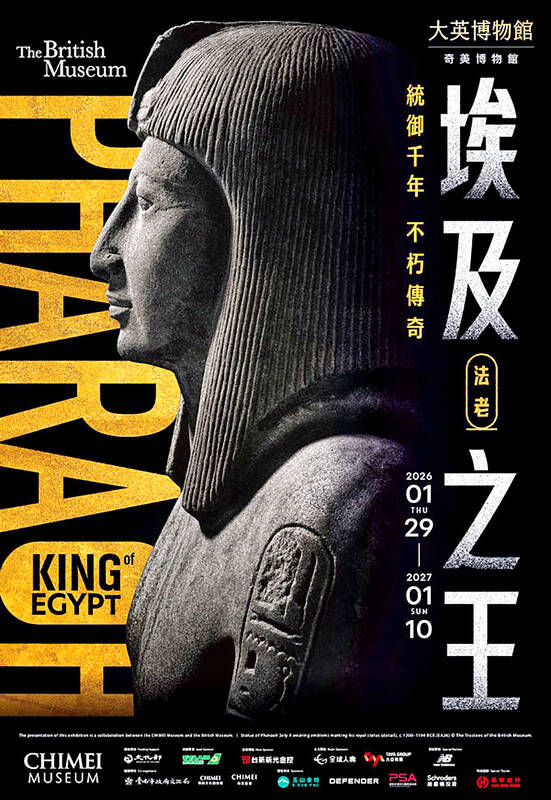
Photo: Screen grab from Chimei Museum’s Web site
The relics range from a gold piece as small as 2 centimeters to statues as heavy as 2 metric tons.
To attract prospective visitors other than history buffs, anthropologists, archaeologists and Egyptologists, Chimei Museum said it has organized guided tours to help educate curious visitors on the richness of Egypt’s history and will also offer a virtual reality experience.
For children, the museum has designed children-friendly tours, available at an extra cost of NT$150 (US$4.78), and will give them a chance to win souvenirs made in the likeness of animal-based Egyptian deities such as the cat- headed Bastet and crocodile-headed Sobek.
Visitors arriving from outside Tainan will be able to buy Taiwan high speed rail tickets at 15 percent off when purchasing a ticket to the Pharaoh exhibition.
Admission to the show is NT$580.
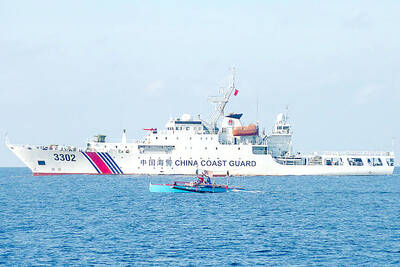
EXPANSIONIST: China deploys an average of 40 to 50 warships and coast guard vessels daily in the South China Sea, despite pledges not to militarize the region, an official said China is attempting to expand its influence across the First Island Chain and increase pressure on Japan by sending coast guard vessels into waters off of Taiwan under the pretext of maritime negotiations with Japan and the Philippines, a national security official said yesterday. China’s recent actions in the waters east of Taiwan and Japan and the Philippines’ exclusive economic zones (EEZ) are attempts to establish dominance in First Island Chain waters, said the official who declined to be named, adding that this is “expansion disguised as law enforcement.” Framing China’s actions solely as a cross-strait issue is a serious misjudgment that
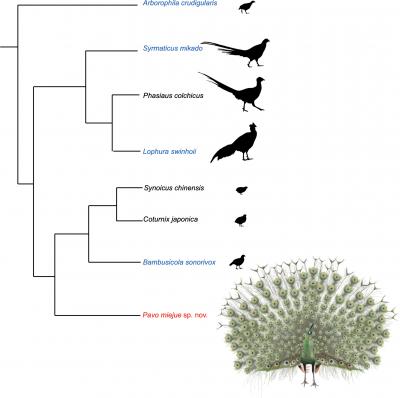
Through analyzing fossil evidence, a research team at National Taiwan University (NTU) discovered the largest endemic bird to have lived in Taiwan, naming it Pavo miejue, or extinct peafowl (滅絕孔雀). The Mikado pheasant, which is printed on the back of the NT$1,000 bank note, was previously believed to be the biggest endemic bird to Taiwan. The research team’s findings suggest that Pavo miejue lived during the Pleistocene epoch tens of thousands of years ago. It is the first endemic extinct bird species discovered and formally named in Taiwan. The study was coauthored by NTU Institute of Ecology and Evolutionary Biology professor Tsai Cheng-hsiu (蔡政修),
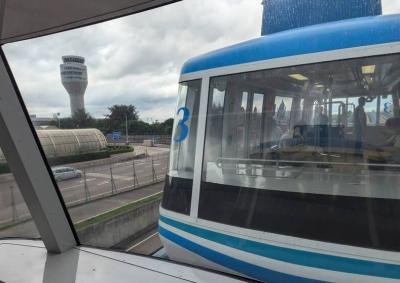
Taiwan Taoyuan International Airport is to suspend its automated Skytrain service connecting Terminal 1 and Terminal 2 starting on July 1 to facilitate connection works for the upcoming Terminal 3, the airport operator said today. Passengers and staff who need to travel between the two terminals after the suspension can instead use the Taoyuan MRT or the airport's 24-hour shuttle bus service, Taoyuan International Airport Corp said. The Taoyuan MRT Airport Line directly links the two terminals, while the shuttle buses are to operate around the clock, the company added. The Skytrain provides free transportation between the airport’s two terminals for travelers and
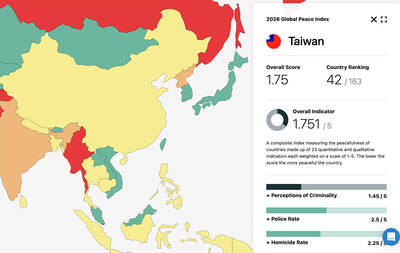
Taiwan ranked 42nd in terms of peacefulness among 163 countries, down five places from last year, according to this year’s Global Peace Index. With an overall score of 1.751, Taiwan dropped from 37th last year, the report published by the global Institute for Economics and Peace showed. The overall score measures a country’s level of peacefulness using 23 quantitative and qualitative indicators across three domains — ongoing domestic and international conflict, societal safety and security, and militarization. While Taiwan ranked 42nd worldwide, it was listed in ninth place among the 19 Asian-Pacific countries in the report, after New Zealand, Singapore, Japan, Malaysia,


 RSS
RSS