


Part of the NT$30 billion (US$951.84 million) agricultural support fund President William Lai (賴清德) announced on Friday would be used to boost competitiveness of local peanuts as tariffs on peanuts from the US are lifted, the Agriculture and Food Agency said yesterday.
Given that US peanuts would be exempt from tariffs under the Agreement on Reciprocal Trade signed by the two nations on Thursday, concerns were raised over the impact it would have on local peanuts.
The total planting area of peanuts in Taiwan is 17,000 hectares and local peanuts account for 75 percent of the market, the agency said, adding that domestic peanut consumption is about 56,000 tonnes per year.
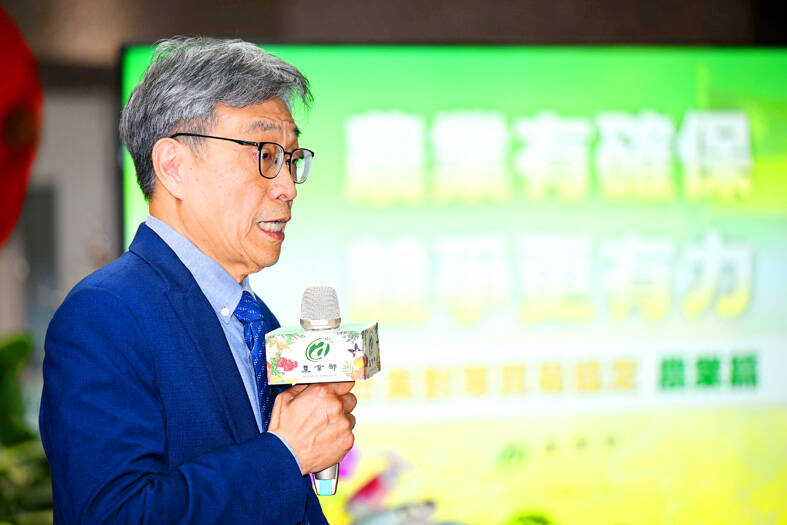
Photo: Chen Yi-kuan, Taipei Times
Minister of Agriculture Chen Junne-jih (陳駿季) said US peanut exports to Taiwan are mainly shelled peanuts and would not have a major impact on local unshelled peanuts.
US peanuts still need to compete with peanuts from India, Argentina and Brazil, Taiwan’s three major peanut import sources, which make up more than 90 percent of the shelled peanut market, he said.
Taiwanese peanuts are traditionally dried in the sun before they are transported and sold to wholesalers at markets, Chen said.
The government has been planning a systemic transformation of the peanut farming industry, he said, adding that domestically grown peanuts have great market potential that could be developed.
The agency said part of the NT$30 billion agricultural support fund would be dedicated to upgrading domestic peanut farming and its supply chain.
Peanut drying facilities and cold chain management would be established to scale up businesses, reduce costs and ensure food quality, it said, adding that contract farming and a procurement system for freshly harvested peanuts would be introduced to ensure farmers’ income and food safety.
The agency said it would also assist the industry in developing market segmentation between domestically grown peanuts and imported products, including by setting up a traceability certification system, and developing more diverse peanut products that would be hard to replace, such as steamed or roasted unshelled peanuts.
For example, Tainan No. 17 Peanut is a locally cultivated peanut variety that has stable quality and is suitable for steaming, it said.
Discussions with local farmers and industry players in critical peanut producing regions would be held after the Lunar New Year holiday, it added.

The Ministry of Finance this afternoon announced the winning numbers for the March-April uniform invoice lottery. The winning number for the NT$10 million (US$318,060) special prize is 19531471, and the winning number for the NT$2 million grand prize is 85941329. Three numbers were drawn for the NT$200,000 first prize: 07225810, 20231230 and 83518781. Those with receipts matching the last seven digits of any of the first-prize numbers will win the NT$40,000 second prize, while those matching the last six digits will win the NT$10,000 third prize. Those whose receipts match the last five digits of the first-prize numbers can claim the NT$4,000 fourth prize,

SIX SUBSIDIES: The monthly allowance for older farmers is to increase to NT$10,000, and NT$5,000 is to be given to homemakers under the national pension system, Lai said The government is to implement major welfare policies for disadvantaged groups, including raising the monthly allowance for older farmers to NT$10,000 and providing homemakers with NT$5,000 per month, President William Lai (賴清德) said yesterday. Lai made the remarks during a visit to Wangling Temple in Chiayi County, saying that the planned increases were being introduced amid economic growth and an increase in tax revenue. Touting a policy, in which the government plans to provide a monthly allowance of NT$5,000 for every child under the age of 18 in a bid to address Taiwan’s low birthrate, Lai said that if received for the
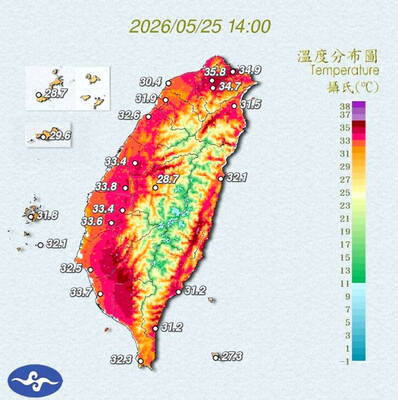
STAY COOL: The HPA recommended that people stay hydrated, use air-conditioning or fans while indoors, wear loose-fitting clothes and walk in the shade while outdoors Employers must implement measures such as installing cooling equipment, and providing drinking water and rest breaks for outdoor workers starting from Monday next week, the Taipei Department of Labor said on Sunday. Employers who fail to comply could face fines of NT$30,000 to NT$300,000 under the Occupational Safety and Health Act (職業安全衛生法), the department said. Businesses in Taipei employing fewer than 100 workers, as well as registered self-employed workers with labor insurance coverage, could receive on-site assessments and guidance from occupational safety consultants to help them apply for central government subsidies to implement or improve heat-protection measures, it said. Under the Ministry of

NATIONAL SECURITY: Authorities are working to confirm the identities of the military personnel involved and investigating possible illegal conduct and regulatory violations Authorities are probing possible national security implications after Kinmen police and immigration officers on Sunday found a Chinese woman allegedly posing as a tourist while engaging in prostitution involving more than 10 military personnel. The woman, surnamed Chen (陳), has since been deported, authorities said, adding that investigators are still working to confirm the identities of those implicated, as the records only listed code names and aliases. The case stemmed from a report received by the Kinmen District Prosecutors’ Office on Friday last week from the Jinhu Precinct of the Kinmen County Police Bureau. On Sunday, police, along with the National Immigration


 RSS
RSS