


Taiwan and the US have reached six key objectives in the trade negotiations, including securing substantial benefits for Taiwan’s industries and economy, leveling the playing field with major competitors such as Japan, South Korea and Europe, and addressing the disadvantage of high tariffs due to the absence of a free-trade agreement (FTA) between Taiwan and the US, President William Lai (賴清德) said yesterday.
Lai made the remarks at a news conference after Taiwan and the US signed the Agreement on Reciprocal Trade in Washington on Thursday.
Lai highlighted the six key outcomes of the negotiations.
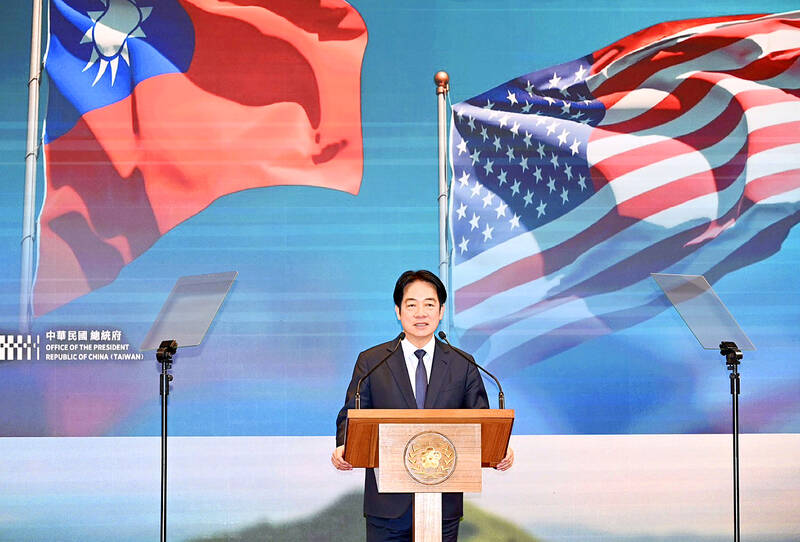
Photo: Lo Pei-de, Taipei Times
The first was securing reciprocal tariffs for Taiwan’s exports to the US, along with the most favorable treatment under Section 232 tariffs, he said.
Taiwan’s reciprocal tariff rate would be reduced to 15 percent, without stacking them on most-favored nation (MFN) rates, he said, adding that 2,072 Taiwanese products — 261 agricultural items and 1,811 industrial goods — would be exempt from these tariffs.
As a result, the average tariff on Taiwanese exports to the US would fall from 35.78 percent (32 percent plus the MFN rate) to 12.33 percent, significantly enhancing Taiwan’s competitiveness, Lai said.
Regarding Section 232 tariffs, Lai said Taiwan has secured most favorable treatment, including tax exemptions for semiconductors and semiconductor derivatives up to a certain quota, with most favorable treatment applied beyond that quota as well.
Other products, including automotive parts, furniture and aerospace components, also received most favorable treatment, he added.
The second key outcome was Taiwan’s adjustment to the US granting preferential tariffs, he said.
In response to concerns about the large trade surplus with the US, Taiwan agreed to lower tariffs on US imports, he said, adding that Taiwan maintained its commitment to food security and industrial resilience, successfully preserving tariff rates on 93 products and securing partial reductions on others.
Lai said the third achievement was in adjusting non-tariff trade measures.
Taiwan insisted on protecting public health while aligning with international standards, he said.
The country will continue to require the labeling of the country of origin for beef and pork products in dining establishments, and the border and post-market inspection mechanisms would remain unchanged, he said.
The fourth key achievement was accelerating the alignment of Taiwan’s trade and economic systems with international standards, based on the “Taiwan-US 21st Century Trade Initiative,” said Lai.
This includes intellectual property, labor standards, environmental regulations, trade facilitation, regulatory transparency and the digital trade environment. The goal is to mesh with global norms, making business operations more convenient, fair and transparent, he said.
Lai said Taiwan and the US have reached “a strong consensus on economic security” that would strengthen cooperation in areas such as tightening export controls on critical technologies, improving investment reviews and preventing country-of-origin laundering.
“This collaboration will help establish a reliable and resilient supply chain between Taiwan and the US, independent of China,” Lai said.
The sixth major achievement was the establishment of the Taiwan-US Investment Memorandum of Understanding, which creates a framework for bilateral investment between Taiwan and the US, he said.
“This will facilitate supply chain collaboration based on the ‘Taiwan model’,” Lai said, adding the US government would support Taiwanese companies investing in the US, helping integrate Taiwan’s semiconductor, information and communications technology, and electronics manufacturing sectors into the US economy, and in return, the US would encourage US companies to invest in Taiwan and introduce advanced technologies.
“This bilateral investment and procurement strategy will not only help balance trade between Taiwan and the US, but also strengthen the economic partnership, driving mutual prosperity and regional stability,” said Lai.
Lai also announced the establishment of a national economic “steering group,” adding that he would serve as the convener of the new group under the Presidential Office.
The group would be tasked with coordinating with the Executive Yuan’s Economic Development Commission — led by Premier Cho Jung-tai (卓榮泰) — to address structural economic challenges, he said.

NATIONAL SECURITY: Authorities are working to confirm the identities of the military personnel involved and investigating possible illegal conduct and regulatory violations Authorities are probing possible national security implications after Kinmen police and immigration officers on Sunday found a Chinese woman allegedly posing as a tourist while engaging in prostitution involving more than 10 military personnel. The woman, surnamed Chen (陳), has since been deported, authorities said, adding that investigators are still working to confirm the identities of those implicated, as the records only listed code names and aliases. The case stemmed from a report received by the Kinmen District Prosecutors’ Office on Friday last week from the Jinhu Precinct of the Kinmen County Police Bureau. On Sunday, police, along with the National Immigration

GLOBALGIVING: ‘ Caving to external pressure is not acceptable for an organization that has cultivated justice reform and human rights for 30 years,’ one NGO said A slew of non-government organizations (NGOs) have withdrawn from the GlobalGiving fundraising platform after it announced it would use “Chinese Taipei” instead of “Taiwan” from next month. The Taiwan Good Rice Association wrote on Facebook on Friday that it was informed on April 28 via a teleconference call of the change, which was made because the platform wanted to operate in China. Taiwan Good Rice is to terminate all cooperative relationships with GlobalGiving in response to the platform’s “unilateral and non-negotiable” decision to remove references to Taiwan, the NGO said. “Taiwan is in the official name of Taiwan Good Rice Association and the

HEAVY WEATHER: Typhoon Jangmi is due to crash straight into the Ryukyus as airlines look to shift flights to larger aircraft or cancel flights to Okinawa entirely Taiwan’s international air carriers announced flight adjustments over the weekend as Typhoon Jangmi is forecast to hit the Ryukyu Islands today and tomorrow. The Central Weather Administration (CWA) upgraded Jangmi from a tropical storm to a typhoon at 8am yesterday, with the eye located 580km south of Naha city. It was moving north at 19kph. Today, China Airlines’ CI-120, CI-121, CI-122 and CI-123 flights between Taoyuan and Naha, Okinawa, have been canceled as well as CI-132 and CI-133 between Kaohsiung and Naha. EVA Air’s BR-112, BR-113, BR-186 and BR-185 flights between Taoyuan and Naha are also canceled. Low-cost carrier Tigerair Taiwan canceled IT-230,
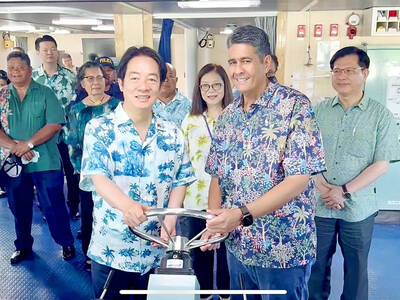
MULTIPRONGED APPROACH: China has sought to pressure Palau across a number of fronts, but the island nation has staunchly resisted overtures to ditch Taiwan Palau has been firm in backing Taiwan despite Chinese pressure that uses tourism economics, cyberattacks and criminal infiltration as tools to threaten the Pacific ally into renouncing its recognition of Taiwan as a sovereign state. The Presidential Office yesterday announced that Vice President Hsiao Bi-khim (蕭美琴) would visit Palau from Saturday to Wednesday next week at the invitation of Palauan President Surangel Whipps Jr. Whipps in April said in an interview that China had outspokenly asked Palau to “denounce Taiwan.” “And we have said: ‘We have no enemies, but nobody tells us who our friends are,’” he said. Whipps has told reporters multiple times


 RSS
RSS