


The Centers for Disease Control (CDC) yesterday reported the year’s first cases of whooping cough and measles.
A five-month-old in northern Taiwan on Jan. 23 began coughing and wheezing, and had a runny nose and nasal congestion, the CDC said, adding that the infant had not shown improvement despite multiple visits to doctors.
The infant was diagnosed with whooping cough on Tuesday and is gradually improving, it said.
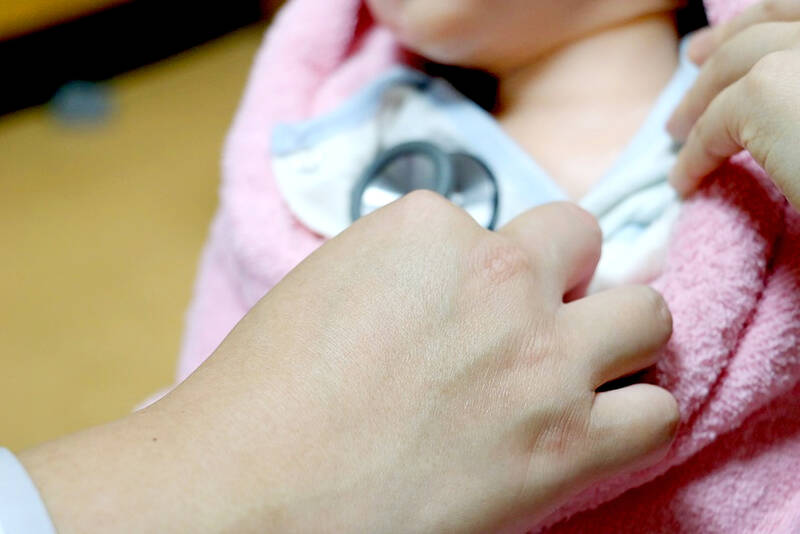
Photo: Taipei Times
The family has been in contact with four other people, two of whom are experiencing possible whooping cough symptoms, the CDC said, adding that it has reached out to arrange examinations and provide preemptive medication.
The two people would be monitored until March 4, the CDC said.
As the end of last month, Japan has reported more than 800 cases of whooping cough, while last year, it reported more than 80,000 cases, the CDC said.
China saw 900 cases last month and 35,000 cases last year; South Korea reported 62 cases last month and 5,500 cases last year; the US saw 700 cases last month and 28,000 cases last year, and Australia had more than 25,000 cases last year, it said.
There had been 81 cases of whooping cough locally from 2022 to last year, with people aged 11 to 18 comprising 35.4 percent of all cases, while infants younger than six months accounted for 25.6 percent, CDC Deputy Director-General Lin Min-cheng (林明誠) said.
Whooping cough symptoms are similar to those of the common cold and could be easily overlooked, resulting in its spread throughout the household, Lin said.
Vaccination remains the most effective way to prevent infants from contracting whooping cough, Lin added.
The CDC said that pregnant mothers should receive the tetanus, diphtheria and pertussis (whooping cough) booster shot at 27 to 36 weeks of pregnancy, and that partners of pregnant women should also get the booster.
Meanwhile, the CDC yesterday announced the nation’s first case of measles in an eight-month-old infant who returned from Vietnam last month.
The infant developed a fever, persistent cough and other symptoms and was hospitalized on Friday last week after developing a rash, the CDC said.
The patient’s family members and 395 others suspected of being in contact with the child would be monitored until Feb. 28, it added.
The CDC has issued measles travel alerts for Vietnam, Indonesia, India, Angora, Mexico, Yemen and Pakistan, and placed 30 other nations on the watch list, it said.
Infants should receive their measles, mumps and rubella (MMR) vaccines on time, and pregnant women and children younger than one should refrain from visiting areas where measles outbreaks have been reported, the CDC said.
If travel to those countries with infants aged six months to one year is necessary, they should receive MMR vaccines two to four weeks before traveling, it said.

Considering that most countries issue more than five denominations of banknotes, the central bank has decided to redesign all five denominations, the bank said as it prepares for the first major overhaul of the banknotes in more than 24 years. Central bank Governor Yang Chin-lung (楊金龍) is expected to report to the Legislative Yuan today on the bank’s operations and the redesign’s progress. The bank in a report sent to the legislature ahead of today’s meeting said it had commissioned a survey on the public’s preferences. Survey results showed that NT$100 and NT$1,000 banknotes are the most commonly used, while NT$200 and NT$2,000

The Centers for Disease Control (CDC) yesterday reported the first case of a new COVID-19 subvariant — BA.3.2 — in a 10-year-old Singaporean girl who had a fever upon arrival in Taiwan and tested positive for the disease. The girl left Taiwan on March 20 and the case did not have a direct impact on the local community, it said. The WHO added the BA.3.2 strain to its list of Variants Under Monitoring in December last year, but this was the first imported case of the COVID-19 variant in Taiwan, CDC Deputy Director-General Lin Ming-cheng (林明誠) said. The girl arrived in Taiwan on

South Korea is planning to revise its controversial electronic arrival card, a step Taiwanese officials said prompted them to hold off on planned retaliatory measures, a South Korean media report said yesterday. A Yonhap News Agency report said that the South Korean Ministry of Foreign Affairs is planning to remove the “previous departure place” and “next destination” fields from its e-arrival card system. The plan, reached after interagency consultations, is under review and aims to simplify entry procedures and align the electronic form with the paper version, a South Korean ministry official said. The fields — which appeared only on the electronic form

The Ministry of Foreign Affairs (MOFA) is suspending retaliation measures against South Korea that were set to take effect tomorrow, after Seoul said it is updating its e-arrival system, MOFA said today. The measures were to be a new round of retaliation after Taiwan on March 1 changed South Korea's designation on government-issued alien resident certificates held by South Korean nationals to "South Korea” from the "Republic of Korea," the country’s official name. The move came after months of protests to Seoul over its listing of Taiwan as "China (Taiwan)" in dropdown menus on its new online immigration entry system. MOFA last week


 RSS
RSS