


China has built an “army of lawyers” to intimidate and constrain Taiwan, threatening “long-arm jurisdiction” beyond its own borders to persecute what it calls “die-hard Taiwan independence separatists,” the Australian Strategic Policy Institute (ASPI) said in a report released on Tuesday.
The report, titled “An army of lawyers is advancing. Taiwan is the target,” said that Beijing’s “lawfare campaign” last year shifted from declaratory threats to active enforcement.
Last year, there was a “sharp rise” in cases of Taiwanese citizens going missing, being detained for questioning or having their personal freedom restricted in China, the report said.
Photo: EPA
Last year, 221 Taiwanese who traveled to China were reported missing, were detained and interrogated, or otherwise had their personal freedom restricted, compared with 55 in 2024, the report said, citing data provided by the Mainland Affairs Council and the Straits Exchange Foundation.
While Beijing frames these detentions as routine law enforcement, the pattern points to a deliberate strategy: “using vague or politicised national-security charges to intimidate Taiwanese citizens, deter travel and engagement with the mainland, and signal that legal risk now attaches to Taiwanese identity itself,” the report said.
The “trend sits alongside a more overt legal escalation: Beijing’s move to ‘prosecute’ alleged Taiwanese ‘separatists,’” the report said.
The Chinese Communist Party (CCP) has been targeting political figures, social media influencers and Taiwanese who travel to China, it said.
The move seeks to assert an “explicitly extraterritorial claim” that the CCP can investigate, list and punish Taiwanese irrespective of their nationality, residence or international law, it said.
“These actions are intended to chill political speech, constrain international engagement with Taiwan, and signal that support for Taiwanese democracy carries personal costs,” it added.
Citing Democratic Progressive Party Legislator Puma Shen’s (沈伯洋) case as an example, the report said that there is an “evolution in China’s lawfare toolkit.”
In October last year, the Chongqing Municipal Public Security Bureau announced that it had launched a criminal investigation into Shen for “secession” and “promoting Taiwanese independence.”
Chinese state-run media implied that he could be pursued internationally, including by Interpol, “despite the absence of jurisdiction or credible legal pathways,” the report said.
The strategic significance of Beijing’s move goes beyond what human rights groups described as “transnational repression,” it said.
The “logical next step” for China would be to seek Interpol red notices, test extradition arrangements, and pressure third countries to treat Chinese domestic law as enforceable beyond its borders, the report said.
“The message was unambiguous: political activism can generate legal and economic consequences not just for individuals, but for their families and commercial networks,” it said.
Meanwhile, bounty notices were placed on people accused of “psychological warfare and online manipulation,” it added.
The aim of legal warfare is to justify Beijing’s coercive measures under the guise of enforcing domestic laws, raise the perceived risk for journalists, activists and influencers to deter lawful political expression and reinforce the narrative that Taiwan’s democracy is a “hostile disinformation actor,” the report said.
Lawfare has become China’s “central instrument of pressure,” it said, adding that “clearer diplomatic signalling, coordinated responses to transnational repression, and support for Taiwan’s legal resilience, will be essential to managing cross-strait stability in the years ahead.”
While China’s military coercion attracts widespread international attention, its domestic judicial tools used to conduct transnational political coercion have not yet received sufficient scrutiny, said Nathan Attrill, a senior China analyst at ASPI and a coauthor of the report.
While Chinese law enforcement agencies could not directly operate in Australia, they could employ similar tactics and use legal mechanisms to increase the perceived risk for Australians traveling to China, and to influence and constrain the behavior of Australian individuals and companies, he said.
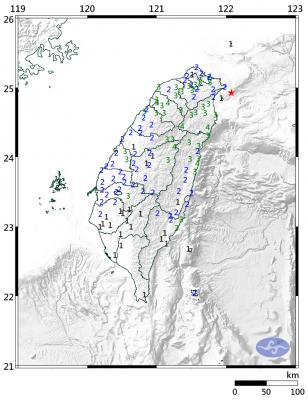
A magnitude 6.1 earthquake struck off the coast of Yilan County at 8:39pm tonight, the Central Weather Administration (CWA) said, with no immediate reports of damage or injuries. The epicenter was 38.7km east-northeast of Yilan County Hall at a focal depth of 98.3km, the CWA’s Seismological Center said. The quake’s maximum intensity, which gauges the actual physical effect of a seismic event, was a level 4 on Taiwan’s 7-tier intensity scale, the center said. That intensity level was recorded in Yilan County’s Nanao Township (南澳), Hsinchu County’s Guansi Township (關西), Nantou County’s Hehuanshan (合歡山) and Hualien County’s Yanliao (鹽寮). An intensity of 3 was
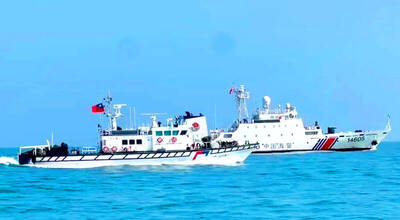
Instead of focusing solely on the threat of a full-scale military invasion, the US and its allies must prepare for a potential Chinese “quarantine” of Taiwan enforced through customs inspections, Stanford University Hoover fellow Eyck Freymann said in a Foreign Affairs article published on Wednesday. China could use various “gray zone” tactics in “reconfiguring the regional and ultimately the global economic order without a war,” said Freymann, who is also a nonresident research fellow at the US Naval War College. China might seize control of Taiwan’s links to the outside world by requiring all flights and ships entering or leaving Taiwan
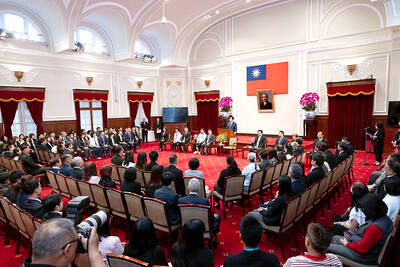
The next minimum wage hike is expected to exceed NT$30,000, President William Lai (賴清德) said yesterday during an award ceremony honoring “model workers,” including migrant workers, at the Presidential Office ahead of Workers’ Day today. Lai said he wished to thank the awardees on behalf of the nation and extend his most sincere respect for their hard work, on which Taiwan’s prosperity has been built. Lai specifically thanked 10 migrant workers selected for the award, saying that although they left their home countries to further their own goals, their efforts have benefited Taiwan as well. The nation’s industrial sector and small businesses lay
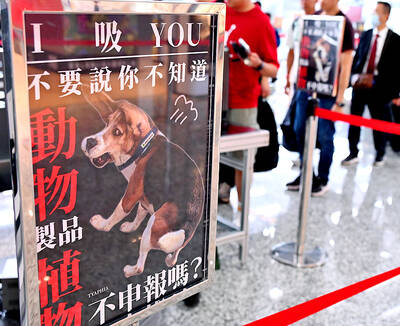
Quarantine awareness posters at Taiwan Taoyuan International Airport have gone viral for their use of wordplay. Issued by the airport branch of the Animal and Plant Health Inspection Agency, the posters feature sniffer dogs making a range of facial expressions, paired with advisory messages built around homophones. “We update the messages for holidays and campaign needs, periodically refreshing materials to attract people’s attention,” quarantine officials said. “The aim is to use the dogs’ appeal to draw focus to quarantine regulations.” A Japanese traveler visiting Taiwan has posted a photo on X of a poster showing a quarantine dog with a


 RSS
RSS