


This week’s think tank forum between the Chinese Communist Party (CCP) and the Chinese Nationalist Party (KMT) was a political ploy targeting the US to foster the illusion of changing public opinion in Taiwan and that the “Taiwan issue” is up for negotiation, cross-strait experts said yesterday.
The CCP-KMT forum was also a tool used to foster the image that China can influence and even claim to represent Taiwanese public opinion, former Tunghai University Center for Mainland China and Regional Development Research deputy director Hung Pu-chao (洪浦釗) said at a forum hosted by the university.
China’s ultimate goal is to “unify” with Taiwan, regardless of how it is accomplished, while the KMT is focused on returning to power, center director Lin Tzu-li (林子立) said.
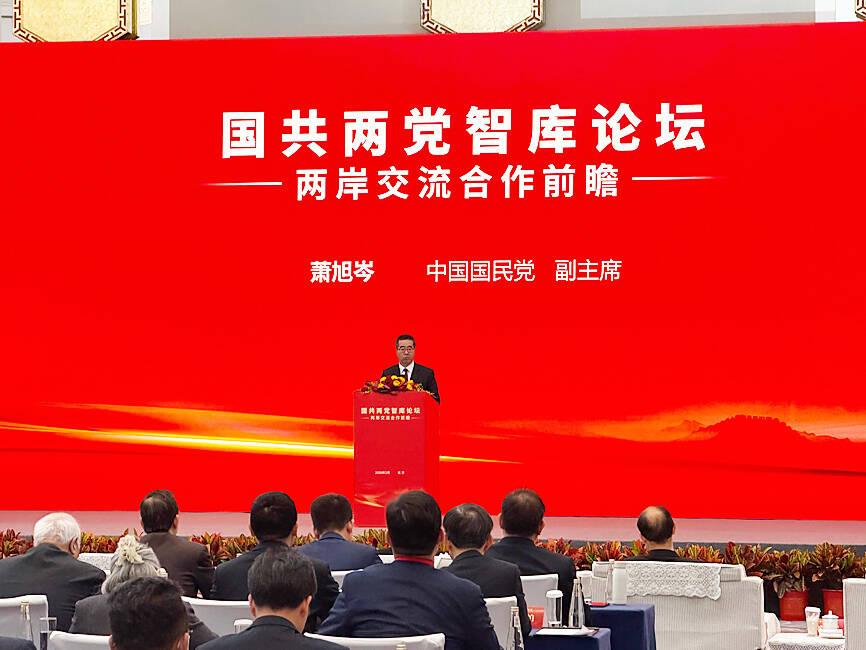
Photo courtesy of the KMT
However, seeking to trade the nation’s sovereignty for a return to power is a trade-off with consequences that Taiwanese society cannot stand, Lin said.
The “true motive” of the forum was to influence how Taiwanese perceive cross-strait relations, Lin said, adding that it should be the sector the government and the public should be most on-guard against.
As Taiwanese businesspeople are moving away from the Chinese market in tandem with European and US companies, Taiwan stands to benefit from the global supply chain restructuring, Lin said, adding that US trade talks could offer Taiwan’s traditional industries the opportunity to achieve an equal market share with Japan and South Korea.
Shen Ming-shih (沈明室), a research fellow at the Institute for National Defense and Security Research, said that the forum was just a front to discuss politically charged topics.
Commenting on the five aspects the KMT and the CCP think tanks said they agreed to work on, Shen said tourism was entirely in China’s court, adding that he was reserved about medical collaboration, as the Chinese investment environment and high-end markets are highly uncertain.
The main item was the collaboration on emerging industries, which might lead to another massive Taiwanese investment spree in China, Shen said.
National Chung Cheng University Department of Political Science professor Tsai Jung-hsiang (蔡榮祥) said the forum reminded him of how the Nazi party sought to dissolve Austria from within by cultivating pro-Nazi parties within Austria and leaning heavily on “national identification” rhetoric.
Tsai said that the so-called “1992 consensus” was a similar ploy, aiming to make the Taiwan issue an internal Chinese issue to reduce the legitimacy of international intervention.
The “1992 consensus” — a term that former Mainland Affairs Council chairman Su Chi (蘇起) in 2006 admitted making up in 2000 — refers to a tacit understanding between the KMT and the CCP that both sides of the Taiwan Strait acknowledge that there is “one China,” with each side having its own interpretation of what “China” means.
National Chengchi University Institute of International Relations assistant researcher Tseng Wei-feng (曾偉?) said that the forum had a clear strategic goal to show the US that China can still influence Taiwanese politics ahead of a planned meeting between US President Donald Trump and Chinese President Xi Jinping (習近平) in April.
China hopes to weaken Taiwan’s “systemic advantage” in international politics by attempting to block arms sales, while talking with other nations regarding tariffs and supply chain collaborations, Tseng said.
The manufacture of the remaining 28 M1A2T Abrams tanks Taiwan purchased from the US has recently been completed, and they are expected to be delivered within the next one to two months, a source said yesterday. The Ministry of National Defense is arranging cargo ships to transport the tanks to Taiwan as soon as possible, said the source, who is familiar with the matter. The estimated arrival time ranges from late this month to early next month, the source said. The 28 Abrams tanks make up the third and final batch of a total of 108 tanks, valued at about NT$40.5 billion
Travel agencies in Taiwan are working to secure alternative flights for travelers bound for New Zealand for the Lunar New Year holiday, as Air New Zealand workers are set to strike next week. The airline said that it has confirmed that the planned industrial action by its international wide-body cabin crew would go ahead on Thursday and Friday next week. While the Auckland-based carrier pledged to take reasonable measures to mitigate the impact of the workers’ strike, an Air New Zealand flight arriving at Taipei from Auckland on Thursday and another flight departing from Taipei for Auckland on Saturday would have to
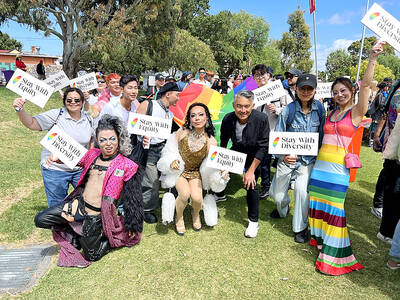
A group from the Taiwanese Designers in Australia association yesterday represented Taiwan at the Midsumma Pride March in Melbourne. The march, held in the St. Kilda suburb, is the city’s largest LGBTQIA+ parade and the flagship event of the annual Midsumma Festival. It attracted more than 45,000 spectators who supported the 400 groups and 10,000 marchers that participated this year, the association said. Taiwanese Designers said they organized a team to march for Taiwan this year, joining politicians, government agencies, professionals and community organizations in showing support for LGBTQIA+ people and diverse communities. As the first country in Asia to legalize same-sex
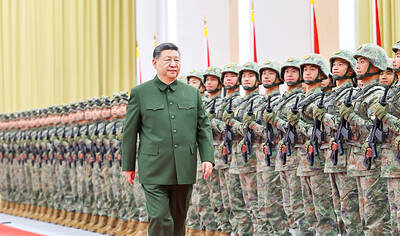
MOTIVES QUESTIONED The PLA considers Xi’s policies toward Taiwan to be driven by personal considerations rather than military assessment, the Epoch Times reports Chinese President Xi Jinping’s (習近平) latest purge of the Chinese People’s Liberation Army (PLA) leadership might have been prompted by the military’s opposition to plans of invading Taiwan, the Epoch Times said. The Chinese military opposes waging war against Taiwan by a large consensus, putting it at odds with Xi’s vision, the Falun Gong-affiliated daily said in a report on Thursday, citing anonymous sources with insight into the PLA’s inner workings. The opposition is not the opinion of a few generals, but a widely shared view among the PLA cadre, the Epoch Times cited them as saying. “Chinese forces know full well that


 RSS
RSS