


With young people investing lots of time and money on K-pop merchandise, the Ministry of Education yesterday released an article on the psychology behind the culture craze with advice to parents on how to handle it.
The ministry in a statement advised parents to use its online Media Literacy Education Resources Network over the winter vacation to help their children understand how media operates and how to protect themselves.
Among the Web site’s many resources is an article on K-pop by Shu-Te University Graduate School of Human Sexuality assistant professor Kuo Hung Kuo-hsiung (郭洪國雄).
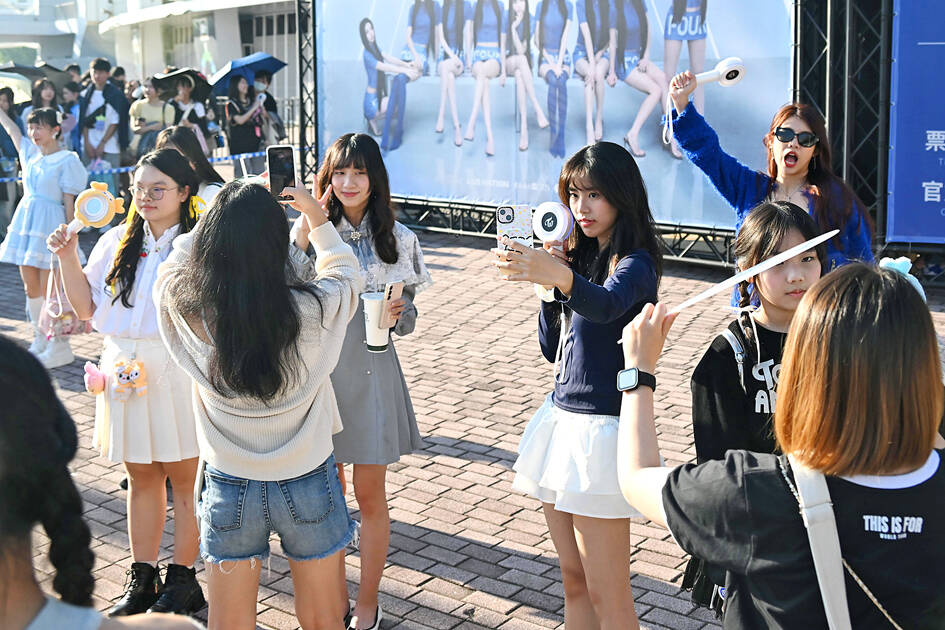
Photo: Lee Hui-chou, Taipei Times
The article, which focuses on the psychology of K-pop’s allure and fandom, discusses how many young Taiwanese rush to get tickets for K-pop concerts, causing soaring hotel prices, long lines and traffic.
Young people devote lots of time and resources to K-pop fandoms, “exceeding what parents imagine,” the article said.
The appeal of K-pop has three layers, starting with the highly visual nature of its music, which appeals to young people, it said.
The second layer is how songs and idols’ narratives are crafted, often emphasizing that hard work eventually leads to success, it said, adding that many young people who feel anxious entering adolescence identify with this sentiment.
The third layer lies in social media, which repeatedly exposes children to related content, such as friends buying concert tickets or unboxing K-pop merchandise.
Social media networks can create the expectation that viewers must like certain idols to fit in, the article said.
For children, K-pop is not just entertainment, but a type of emotional support and source of social connection, the ministry’s media resource network said.
However, parents often do not see their children’s inner growth and instead focus on how they are outwardly conforming to a culture craze, proceeding to limit or deny their access to it, it said.
Parents could start by asking their child what songs they like or lyrics they identify with to give them a chance to express themselves, Kuo wrote in the article.
Next, parents could practice media literacy with their child by breaking down the visuals, storytelling and commercial motive behind the music videos, and discussing real-life pressures behind an idol’s glamorous image, Kuo said.
Parents could also discuss monthly budgets, concert schedules and proper fan behavior, he said.
This advice is not intended to stifle young people, but rather guide them to become responsible fans and take responsibility for their own growth, he added.

Considering that most countries issue more than five denominations of banknotes, the central bank has decided to redesign all five denominations, the bank said as it prepares for the first major overhaul of the banknotes in more than 24 years. Central bank Governor Yang Chin-lung (楊金龍) is expected to report to the Legislative Yuan today on the bank’s operations and the redesign’s progress. The bank in a report sent to the legislature ahead of today’s meeting said it had commissioned a survey on the public’s preferences. Survey results showed that NT$100 and NT$1,000 banknotes are the most commonly used, while NT$200 and NT$2,000

The Centers for Disease Control (CDC) yesterday reported the first case of a new COVID-19 subvariant — BA.3.2 — in a 10-year-old Singaporean girl who had a fever upon arrival in Taiwan and tested positive for the disease. The girl left Taiwan on March 20 and the case did not have a direct impact on the local community, it said. The WHO added the BA.3.2 strain to its list of Variants Under Monitoring in December last year, but this was the first imported case of the COVID-19 variant in Taiwan, CDC Deputy Director-General Lin Ming-cheng (林明誠) said. The girl arrived in Taiwan on

ANNUAL EVENT: Two massive Pokemon balloons are to be set up in Daan Park, with an event zone operating from 10am to 6pm This year’s Taipei Floral Picnic is to be held at Daan Park today and tomorrow, featuring an exclusive Pokemon Go event, a themed food market, a coffee rave picnic area and stage performances, the Taipei Department of Information and Tourism said yesterday. Two massive Pokemon balloons are to be set up in the park as attractions, with an exclusive event zone operating from 10am to 6pm, it said. Participants who complete designated tasks on-site would have a chance to receive limited-edition souvenirs, it added. People could also try the newly launched game Pokemon Pokopia in the trial area, the department said. Three PokeStops are

South Korea is planning to revise its controversial electronic arrival card, a step Taiwanese officials said prompted them to hold off on planned retaliatory measures, a South Korean media report said yesterday. A Yonhap News Agency report said that the South Korean Ministry of Foreign Affairs is planning to remove the “previous departure place” and “next destination” fields from its e-arrival card system. The plan, reached after interagency consultations, is under review and aims to simplify entry procedures and align the electronic form with the paper version, a South Korean ministry official said. The fields — which appeared only on the electronic form


 RSS
RSS