


With young people investing lots of time and money on K-pop fandom, the Ministry of Education today released an article on the psychology behind the culture craze with advice to parents on how to handle it.
In a news release, the ministry advised parents to spend time over winter vacation using its Media Literacy Education Resources Network to help children understand how media operates and protect themselves.
Among the Web site’s many resources is a recent article on K-pop by Shu-Te University Graduate School of Human Sexuality assistant professor Kuo Hung Kuo-hsiung (郭洪國雄).
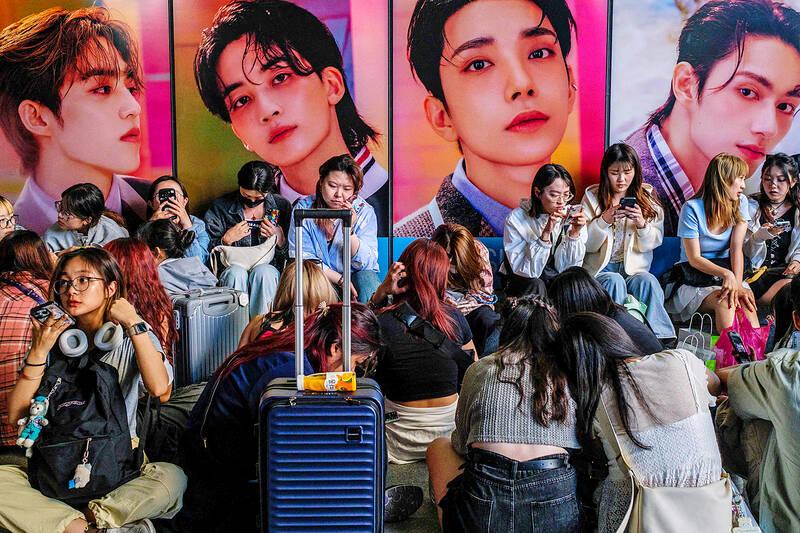
Photo: AFP
The article, which focuses on the psychology of K-pop’s allure and fandom, discusses how many young Taiwanese rush to get tickets for K-pop concerts, causing soaring hotel prices, long lines and traffic.
Young people devote lots of time and resources to K-pop fandom, “exceeding what parents imagine,” the article said.
The appeal of K-pop has three layers, starting with the highly visual nature of its music, which appeals to younger consumers, it said.
The second layer is how songs and idols’ narratives are crafted, often emphasizing that hard work eventually leads to success, it said, adding that many young people who feel anxious entering adolescence identify with these sentiments.
The third layer lies in social media, which repeatedly expose children to related content such as friends buying concert tickets or unboxing K-pop merchandise.
These social media networks can create the expectation that viewers must like certain idols to fit in, the article said.
For children, K-pop is not just entertainment, but a type of emotional support and source of social connection, the ministry’s media resource network said.
However, parents often do not see their children’s inner growth and instead focus on how they are outwardly conforming to a culture craze, proceeding to limit or deny their access to it, it said.
Parents can start by opening a dialogue, asking their child what songs they like or lyrics they identify with to give them a chance to express themselves, Kuo wrote in the article.
Next, parents can practice media literacy with their child by breaking down the visuals, storytelling and commercial motive behind the music videos, and discussing real-life pressures behind an idol’s glamorous image, Kuo said.
Parents can also openly discuss monthly budgets, concert schedules and proper fan behavior, he said.
This advice is not intended to stifle kids, but rather guide them to become responsible fans and take responsibility for their own growth, he added.

LOUD AND PROUD Taiwan might have taken a drubbing against Australia and Japan, but you might not know it from the enthusiasm and numbers of the fans Taiwan might not be expected to win the World Baseball Classic (WBC) but their fans are making their presence felt in Tokyo, with tens of thousands decked out in the team’s blue, blowing horns and singing songs. Taiwanese fans have packed out the Tokyo Dome for all three of their games so far and even threatened to drown out home team supporters when their team played Japan on Friday. They blew trumpets, chanted for their favorite players and had their own cheerleading squad who dance on a stage during the game. The team struggled to match that exuberance on the field, with

UPDATED TEST: The new rules aim to assess drivers’ awareness of risky behaviors and how they respond under certain circumstances, the Highway Bureau said Driver’s license applicants who fail to yield to pedestrians at intersections or to check blind spots, or omit pointing-and-calling procedures would fail the driving test, the Highway Bureau said yesterday. The change is set to be implemented at the end of the month, and is part of the bureau’s reform of the driving portion of the test, which has been criticized for failing to assess whether drivers can operate vehicles safely. Sedan drivers would be tested regarding yielding to pedestrians and turning their heads to check blind spots, while drivers of large vehicles would be tested on their familiarity with pointing-and-calling
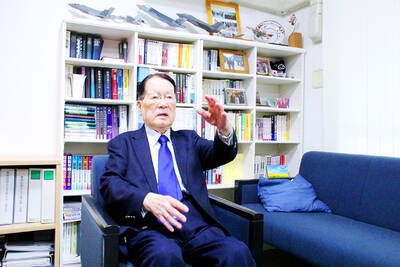
Whether Japan would help defend Taiwan in case of a cross-strait conflict would depend on the US and the extent to which Japan would be allowed to act under the US-Japan Security Treaty, former Japanese minister of defense Satoshi Morimoto said. As China has not given up on the idea of invading Taiwan by force, to what extent Japan could support US military action would hinge on Washington’s intention and its negotiation with Tokyo, Morimoto said in an interview with the Liberty Times (sister paper of the Taipei Times) yesterday. There has to be sufficient mutual recognition of how Japan could provide

A Taiwanese man apologized on Friday after saying in a social media post that he worked with Australia to provide scouting reports on Taiwan’s team, enabling Australia’s victory in this year’s World Baseball Classic (WBC), saying it was a joke and that he did not hold any position with foreign teams or Taiwan’s sports training center. Chen Po-hao (陳柏豪) drew the rage of many Taiwan baseball fans when he posted online on Thursday night, claiming credit for Australia’s 3-0 win over Taiwan in the opening game for Pool C, saying he worked as a physical therapist with the national team and


 RSS
RSS