


A New York court yesterday sentenced a Taiwanese man to 30 years in prison for conspiring to distribute narcotics, money laundering and conspiring to sell adulterated and misbranded medication.
Taiwanese national Lin Rui-siang (林睿庠) was arrested in May 2024 for operating an online narcotics marketplace, called “Incognito Market,” the US Attorney for the Southern District of New York Jay Clayton said in a news release yesterday.
Before Lin’s platform was shut down in March 2024, he had sold more than about 1 tonne of drugs on underground markets, Clayton said.
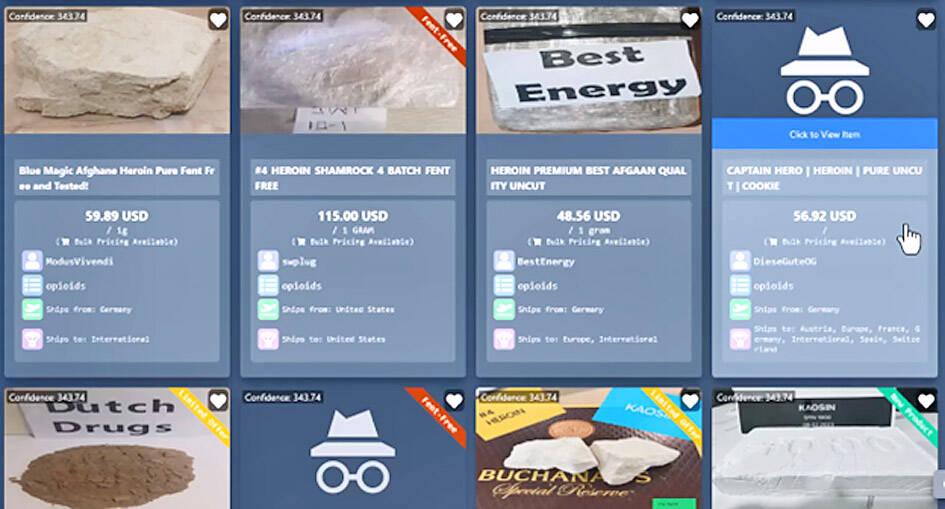
Photo courtesy of the US Department of Justice’s Office of Public Affairs
Lin pled guilty to the crimes on Dec. 16, 2024, before US District Judge Colleen McMahon, who requested a heavy sentence.
While Lin was in the US, he sold US$105 million worth of drugs to online customers, making him “one of the world’s most prolific drug traffickers,” Clayton said.
Lin made millions of US dollars in profits, caused at least one death and exacerbated the opioid crisis, the attorney said.
Lin’s sentence sends a clear message to drug traffickers that “the Internet, ‘decentralization,’ ‘blockchain’ — any technology — is not a license to operate a narcotics distribution business,” he said.
Lin operated the Incognito Market under the online pseudonym “Pharaoh,” supervised its operations and “had ultimate decision-making authority over every aspect of the multimillion-dollar operation,” the court said in its statement.
Lin was a founding member of the market in October 2020 and led the site from January 2022 until he closed it in March 2024, the court said.
He ran the site while based in Saint Lucia and even led a four-day training for Saint Lucian police officers about online crime and cryptocurrency, which he wrote about on his personal Facebook page, it said.
Under Lin’s leadership, the Incognito Market customer base grew to more than 400,000 people, who were served by more than 1,800 narcotics “vendors,” facilitating more than 640,000 narcotics transactions, it said.
Lin, who specialized in information technology, was dispatched to Saint Lucia in November 2023 under Taiwan’s substitute military service program, which allows conscripts to fulfill their national service obligations by assisting with Taiwan’s overseas missions, the Ministry of Foreign Affairs said previously.
The Taipei District Prosecutors’ Office opened a separate investigation into alleged money laundering by Lin, seizing real estate and bank savings in Taiwan totaling more than NT$200 million (US$6.33 million) in May last year.

A magnitude 6.1 earthquake struck off the coast of Yilan County at 8:39pm tonight, the Central Weather Administration (CWA) said, with no immediate reports of damage or injuries. The epicenter was 38.7km east-northeast of Yilan County Hall at a focal depth of 98.3km, the CWA’s Seismological Center said. The quake’s maximum intensity, which gauges the actual physical effect of a seismic event, was a level 4 on Taiwan’s 7-tier intensity scale, the center said. That intensity level was recorded in Yilan County’s Nanao Township (南澳), Hsinchu County’s Guansi Township (關西), Nantou County’s Hehuanshan (合歡山) and Hualien County’s Yanliao (鹽寮). An intensity of 3 was

Instead of focusing solely on the threat of a full-scale military invasion, the US and its allies must prepare for a potential Chinese “quarantine” of Taiwan enforced through customs inspections, Stanford University Hoover fellow Eyck Freymann said in a Foreign Affairs article published on Wednesday. China could use various “gray zone” tactics in “reconfiguring the regional and ultimately the global economic order without a war,” said Freymann, who is also a nonresident research fellow at the US Naval War College. China might seize control of Taiwan’s links to the outside world by requiring all flights and ships entering or leaving Taiwan
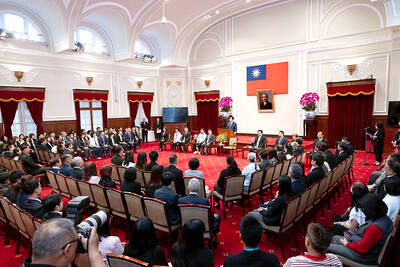
The next minimum wage hike is expected to exceed NT$30,000, President William Lai (賴清德) said yesterday during an award ceremony honoring “model workers,” including migrant workers, at the Presidential Office ahead of Workers’ Day today. Lai said he wished to thank the awardees on behalf of the nation and extend his most sincere respect for their hard work, on which Taiwan’s prosperity has been built. Lai specifically thanked 10 migrant workers selected for the award, saying that although they left their home countries to further their own goals, their efforts have benefited Taiwan as well. The nation’s industrial sector and small businesses lay
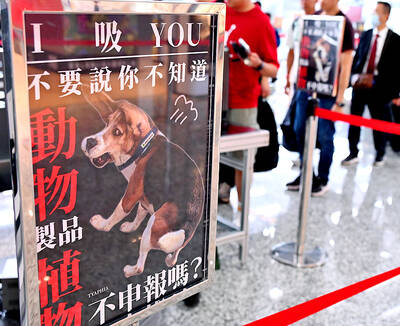
Quarantine awareness posters at Taiwan Taoyuan International Airport have gone viral for their use of wordplay. Issued by the airport branch of the Animal and Plant Health Inspection Agency, the posters feature sniffer dogs making a range of facial expressions, paired with advisory messages built around homophones. “We update the messages for holidays and campaign needs, periodically refreshing materials to attract people’s attention,” quarantine officials said. “The aim is to use the dogs’ appeal to draw focus to quarantine regulations.” A Japanese traveler visiting Taiwan has posted a photo on X of a poster showing a quarantine dog with a


 RSS
RSS