


Seven outbreaks of highly pathogenic avian influenza (bird flu) were reported last month, the Centers for Disease Control (CDC) said yesterday, urging poultry farm workers to enhance protective measures and offering the public tips on avoiding the novel influenza A virus.
Avian influenza outbreaks peak during winter, especially between December and March the following year, CDC Deputy Director-General and spokesman Lin Min-cheng (林明誠) said.
As of Friday last week, seven avian influenza A(H5N1) outbreaks had been reported at poultry farms this year, he said.
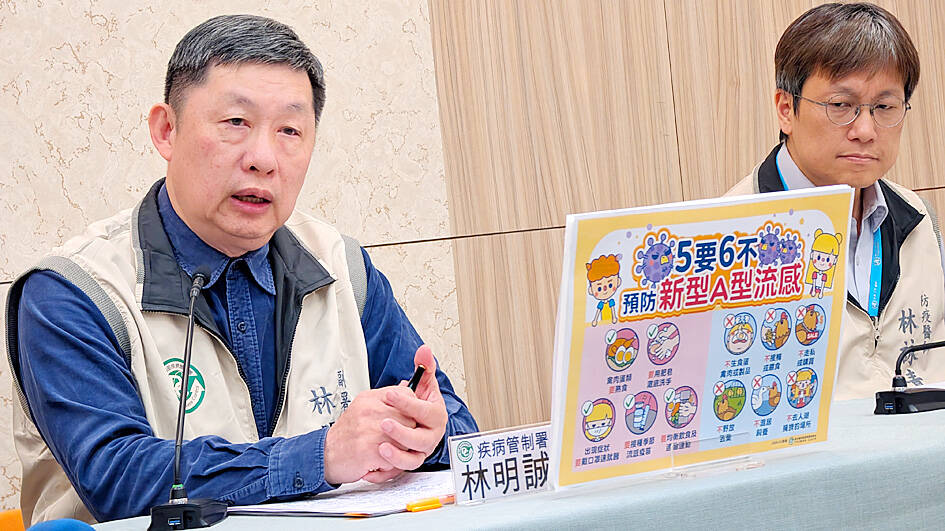
Photo: CNA
Since the first avian influenza A(H5N1) outbreak in Taiwan was reported in November 2022, there have been a total of 135 outbreaks in the nation, statistics from the Animal and Plant Health Inspection Agency showed.
Novel influenza A virus infections are human infections with an influenza virus different from the seasonal circulating influenza A (H1N1) or A (H3N2) strains, often originating from poultry or swine, Lin said.
While no human infections with the avian influenza A(H5N1) virus have been reported in Taiwan, the CDC said that poultry farm workers should step up protective measures, while local health department should conduct contact tracing and assist workers in properly implementing protective measures and self-health monitoring at farms where outbreaks have been reported.
The CDC encourages people to prevent novel influenza A virus infections by implementing the “five do’s and six don’ts,” Lin said.
They include “cooking poultry meat and eggs thoroughly,” as the virus is highly susceptible to heat, and “washing hands frequently with soap,” as it not only protects against flu viruses but also various viruses and bacteria.
People should wear a mask if they have respiratory symptoms or when they visit crowded venues, and eat balanced meals and exercise regularly to increase immunity, Lin said.
Eligible recipients of seasonal flu vaccinations should get their shots regularly, he said.
As for the “don’ts,” they are: do not eat food that include raw egss; do not buy animals from unidentified sources; do not approach or feed wild birds or poultry; do not free or abandon livestock and poultry; do not raise different species of livestock and poultry together; and do not go to poorly ventilated or crowded venues.
In related news, CDC Epidemic Intelligence Center Deputy Director Lee Chia-lin (李佳琳) said that medical visits for flu-like illness from Jan. 25 to Saturday last week increased 3.2 percent to 116,281, 10.3 percent of which were visits to emergency rooms —still below the epidemic threshold of 11 percent.
There were also 25 cases of severe flu and one flu-related death reported between Tuesday last week and Monday, she added.
Lin Min-cheng said it is rare that the seasonal flu has not entered an epidemic period at this time of the year, but flu activity is slowing rising, and as many people are expected to attend gatherings or travel during the Lunar New Year holiday and many clinics are expected to be closed during the holiday, it is likely to enter the epidemic period by then.
There are still about 110,000 doses of government-funded flu vaccines, he said, advising people at a higher risk of severe illness to get vaccinated before it turns into an epidemic.
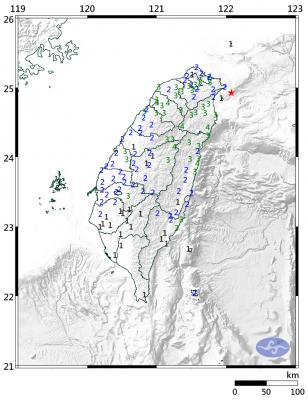
A magnitude 6.1 earthquake struck off the coast of Yilan County at 8:39pm tonight, the Central Weather Administration (CWA) said, with no immediate reports of damage or injuries. The epicenter was 38.7km east-northeast of Yilan County Hall at a focal depth of 98.3km, the CWA’s Seismological Center said. The quake’s maximum intensity, which gauges the actual physical effect of a seismic event, was a level 4 on Taiwan’s 7-tier intensity scale, the center said. That intensity level was recorded in Yilan County’s Nanao Township (南澳), Hsinchu County’s Guansi Township (關西), Nantou County’s Hehuanshan (合歡山) and Hualien County’s Yanliao (鹽寮). An intensity of 3 was

Instead of focusing solely on the threat of a full-scale military invasion, the US and its allies must prepare for a potential Chinese “quarantine” of Taiwan enforced through customs inspections, Stanford University Hoover fellow Eyck Freymann said in a Foreign Affairs article published on Wednesday. China could use various “gray zone” tactics in “reconfiguring the regional and ultimately the global economic order without a war,” said Freymann, who is also a nonresident research fellow at the US Naval War College. China might seize control of Taiwan’s links to the outside world by requiring all flights and ships entering or leaving Taiwan

The next minimum wage hike is expected to exceed NT$30,000, President William Lai (賴清德) said yesterday during an award ceremony honoring “model workers,” including migrant workers, at the Presidential Office ahead of Workers’ Day today. Lai said he wished to thank the awardees on behalf of the nation and extend his most sincere respect for their hard work, on which Taiwan’s prosperity has been built. Lai specifically thanked 10 migrant workers selected for the award, saying that although they left their home countries to further their own goals, their efforts have benefited Taiwan as well. The nation’s industrial sector and small businesses lay
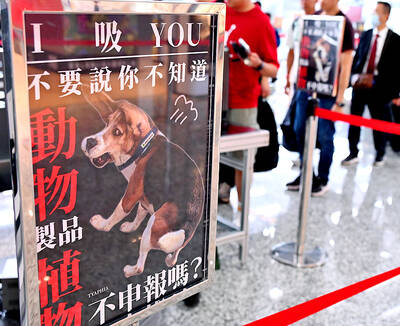
Quarantine awareness posters at Taiwan Taoyuan International Airport have gone viral for their use of wordplay. Issued by the airport branch of the Animal and Plant Health Inspection Agency, the posters feature sniffer dogs making a range of facial expressions, paired with advisory messages built around homophones. “We update the messages for holidays and campaign needs, periodically refreshing materials to attract people’s attention,” quarantine officials said. “The aim is to use the dogs’ appeal to draw focus to quarantine regulations.” A Japanese traveler visiting Taiwan has posted a photo on X of a poster showing a quarantine dog with a


 RSS
RSS