


Six Taiwanese were arrested last month in South Korea for allegedly engaging in scams, the Ministry of Foreign Affairs (MOFA) said yesterday, urging the public not to take advantage of visa-free privileges to conduct illegal activities in other countries.
The ministry has noticed an uptick in the number of Taiwanese arrested in countries that offer visa-free entry, including acting as money or drug mules in South Korea, or traveling first to Thailand and then moving on to Myanmar or Cambodia where they were involved in telecommunications scams, organized crime or online gambling, ministry spokesman Hsiao Kuang-wei (蕭光偉) said.
“Six Taiwanese were arrested in South Korea [over alleged involvement in] scamming-related cases last month, and another Taiwanese was arrested for [allegedly] taking unauthorized photos of military facilities,” Hsiao said.
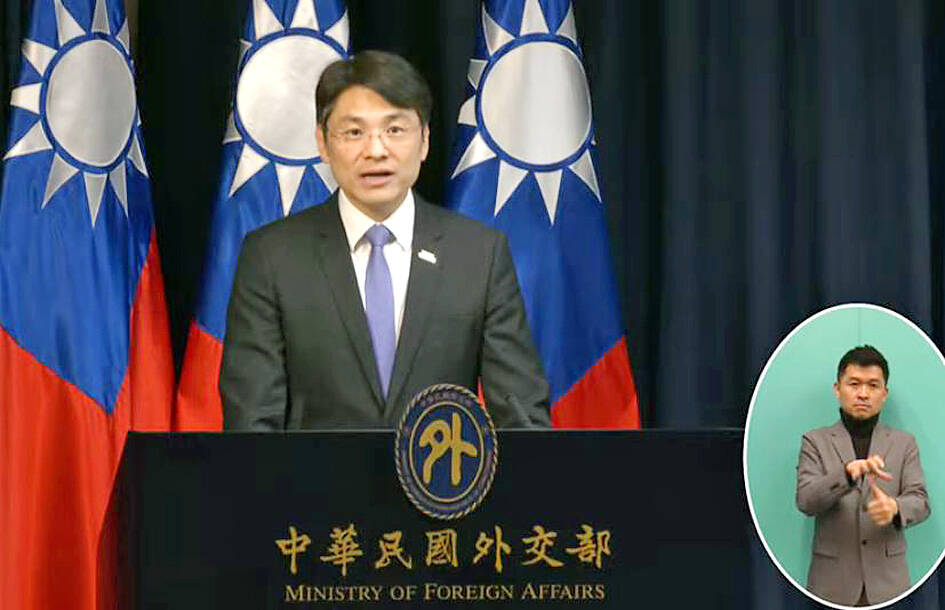
Photo: Screen grab from the Ministry of Foreign Affairs’ live stream
That compares with only one case every one to two months before, he said.
Thailand has tightened immigration inspections to prevent foreigners abusing visa-free entries, he said.
Travelers who frequently visit Thailand and stay for long periods of time, but are unable to clearly explain their itinerary might be denied entry, the ministry said.
People who have been arrested for alleged involvement in illegal activity in Thailand or near its border with Cambodia might also be banned from entry, it added.
“The ministry wants to emphasize that countries have the sovereign right to deny a traveler entry, and other countries, including Taiwan, cannot interfere with their decisions,” Hsiao said, advising the public “to honestly state the purpose of their travel to immigration officers and comply with the law.”
The Taiwanese arrested in South Korea last month were caught “red-handed” and could be indicted after an investigation, he said.
In accordance with local laws and international practice, Taiwan’s representative office in other countries can only assist Taiwanese suspects in contacting their family, offering a list of local lawyers, or conduct consular visits, but cannot interfere with the judicial process of other countries, the ministry said.
The public should be wary of ads about overseas jobs that promise high pay and benefits, including free plane tickets and accommodation, he said.
People should verify or check the ads to avoid becoming victims, he said.
If they have doubts about the jobs, they can call the government’s “165” anti-fraud hotline for inquiry, he said.
“People should avoid taking chances in engaging in illegal activity abroad, as they might end up being confined, lose their freedom, endanger themselves, suffer significant financial losses, or cause serious harm to themselves and their family,” he said.
With people gearing up for travel abroad during the Lunar New Year holiday, the ministry reminded them to check beforehand their travel destination’s entry regulations, including limits on controlled drugs and specific items, public etiquette, restrictions on photography and drone operations, and to purchase travel insurance.

Considering that most countries issue more than five denominations of banknotes, the central bank has decided to redesign all five denominations, the bank said as it prepares for the first major overhaul of the banknotes in more than 24 years. Central bank Governor Yang Chin-lung (楊金龍) is expected to report to the Legislative Yuan today on the bank’s operations and the redesign’s progress. The bank in a report sent to the legislature ahead of today’s meeting said it had commissioned a survey on the public’s preferences. Survey results showed that NT$100 and NT$1,000 banknotes are the most commonly used, while NT$200 and NT$2,000

The Centers for Disease Control (CDC) yesterday reported the first case of a new COVID-19 subvariant — BA.3.2 — in a 10-year-old Singaporean girl who had a fever upon arrival in Taiwan and tested positive for the disease. The girl left Taiwan on March 20 and the case did not have a direct impact on the local community, it said. The WHO added the BA.3.2 strain to its list of Variants Under Monitoring in December last year, but this was the first imported case of the COVID-19 variant in Taiwan, CDC Deputy Director-General Lin Ming-cheng (林明誠) said. The girl arrived in Taiwan on

ANNUAL EVENT: Two massive Pokemon balloons are to be set up in Daan Park, with an event zone operating from 10am to 6pm This year’s Taipei Floral Picnic is to be held at Daan Park today and tomorrow, featuring an exclusive Pokemon Go event, a themed food market, a coffee rave picnic area and stage performances, the Taipei Department of Information and Tourism said yesterday. Two massive Pokemon balloons are to be set up in the park as attractions, with an exclusive event zone operating from 10am to 6pm, it said. Participants who complete designated tasks on-site would have a chance to receive limited-edition souvenirs, it added. People could also try the newly launched game Pokemon Pokopia in the trial area, the department said. Three PokeStops are

South Korea is planning to revise its controversial electronic arrival card, a step Taiwanese officials said prompted them to hold off on planned retaliatory measures, a South Korean media report said yesterday. A Yonhap News Agency report said that the South Korean Ministry of Foreign Affairs is planning to remove the “previous departure place” and “next destination” fields from its e-arrival card system. The plan, reached after interagency consultations, is under review and aims to simplify entry procedures and align the electronic form with the paper version, a South Korean ministry official said. The fields — which appeared only on the electronic form


 RSS
RSS