


Chinese Nationalist Party (KMT) Chairwoman Cheng Li-wun (鄭麗文) told The Economist in an interview that she considers talks on peaceful unification with China “premature,” the party said in a statement yesterday.
She also said that she hopes to meet with Chinese President Xi Jinping (習近平) in the first half of this year to push for a commitment to peace, the KMT said, citing the interview conducted on Tuesday last week and published on Thursday.
Cheng spoke about cross-strait peace, national identity, national defense and security, and US-China relations in the interview, the statement said.
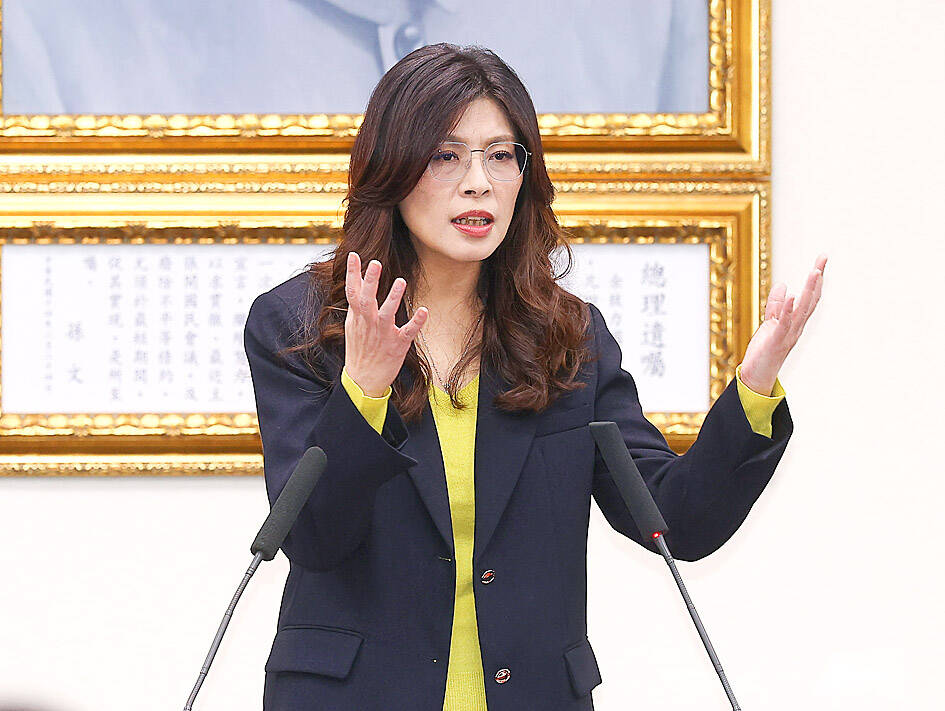
Photo: CNA
The KMT’s most important task for the next three to five years is to create peace and stability in the Taiwan Strait, Cheng said in the interview.
She said she hopes for exchanges and dialogue with China, including meeting with Xi, as she advocates for cross-strait reconciliation.
Communication and interaction at systematic levels could reduce the risk of misjudgement, and avoid conflicts and escalation, she said.
The two sides must absolutely prevent war or armed conflict from occurring, as it would bring unimaginable and catastrophic consequences, she said.
The Democratic Progressive Party (DPP) does not accept the “1992 consensus” and promotes a de facto “two states” theory, which has led to increasingly confrontational cross-strait relations in the past decade, she said.
Embracing the “1992 consensus” would “significantly reduce the likelihood of military confrontation,” Cheng said.
The so-called “1992 consensus” refers to a tacit understanding between the KMT and the Chinese government that both sides of the Strait acknowledge there is “one China,” with each side having its own interpretation of what “China” means.
Asked about Beijing’s high expectations for “peaceful unification,” Cheng called herself a pragmatic politician.
The most important task is to establish a peace framework, she said, adding that she could accept it if it is also acceptable to people on both sides of the Strait.
However, it would be “premature” to discuss it, she said.
Rational dialogue and mutual understanding between China and the US could promote regional peace and stability, she said, adding that she hopes for reconciliation between the two countries.
Hopefully, there is a win-win solution and this is not a zero-sum game, she said, adding that from Taiwan’s perspective, China is an indispensable market.
Asked about concerns that the US would abandon Taiwan, she said they are not unfounded.
“What Taiwan is feeling is the fear that the US may abandon Taiwan,” she said, pointing to a US arms shipment backlog, while Washington is seeking to relocate key industries, including semiconductor manufacturers such as Taiwan Semiconductor Manufacturing Co, to the US.

Considering that most countries issue more than five denominations of banknotes, the central bank has decided to redesign all five denominations, the bank said as it prepares for the first major overhaul of the banknotes in more than 24 years. Central bank Governor Yang Chin-lung (楊金龍) is expected to report to the Legislative Yuan today on the bank’s operations and the redesign’s progress. The bank in a report sent to the legislature ahead of today’s meeting said it had commissioned a survey on the public’s preferences. Survey results showed that NT$100 and NT$1,000 banknotes are the most commonly used, while NT$200 and NT$2,000

The Centers for Disease Control (CDC) yesterday reported the first case of a new COVID-19 subvariant — BA.3.2 — in a 10-year-old Singaporean girl who had a fever upon arrival in Taiwan and tested positive for the disease. The girl left Taiwan on March 20 and the case did not have a direct impact on the local community, it said. The WHO added the BA.3.2 strain to its list of Variants Under Monitoring in December last year, but this was the first imported case of the COVID-19 variant in Taiwan, CDC Deputy Director-General Lin Ming-cheng (林明誠) said. The girl arrived in Taiwan on

ANNUAL EVENT: Two massive Pokemon balloons are to be set up in Daan Park, with an event zone operating from 10am to 6pm This year’s Taipei Floral Picnic is to be held at Daan Park today and tomorrow, featuring an exclusive Pokemon Go event, a themed food market, a coffee rave picnic area and stage performances, the Taipei Department of Information and Tourism said yesterday. Two massive Pokemon balloons are to be set up in the park as attractions, with an exclusive event zone operating from 10am to 6pm, it said. Participants who complete designated tasks on-site would have a chance to receive limited-edition souvenirs, it added. People could also try the newly launched game Pokemon Pokopia in the trial area, the department said. Three PokeStops are

South Korea is planning to revise its controversial electronic arrival card, a step Taiwanese officials said prompted them to hold off on planned retaliatory measures, a South Korean media report said yesterday. A Yonhap News Agency report said that the South Korean Ministry of Foreign Affairs is planning to remove the “previous departure place” and “next destination” fields from its e-arrival card system. The plan, reached after interagency consultations, is under review and aims to simplify entry procedures and align the electronic form with the paper version, a South Korean ministry official said. The fields — which appeared only on the electronic form


 RSS
RSS