


Chinese Nationalist Party (KMT) Deputy Chairman Hsiao Hsu-tsen (蕭旭岑) and China’s Taiwan Affairs Office Director Song Tao (宋濤) both spoke about upholding the so-called “1992 consensus,” opposing Taiwanese independence and “rejuvenating the Chinese nation” as pillars of cross-strait relations at a KMT-Chinese Communist Party (CPP) forum in Beijing yesterday.
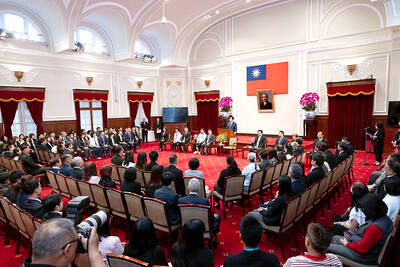
The forum, titled “Prospects for Cross-Strait Exchange and Cooperation,” was held at the China World Hotel.
The forum focused on three topics: cross-strait tourism, industrial exchanges and environmental sustainability cooperation, Song said in his opening remarks.
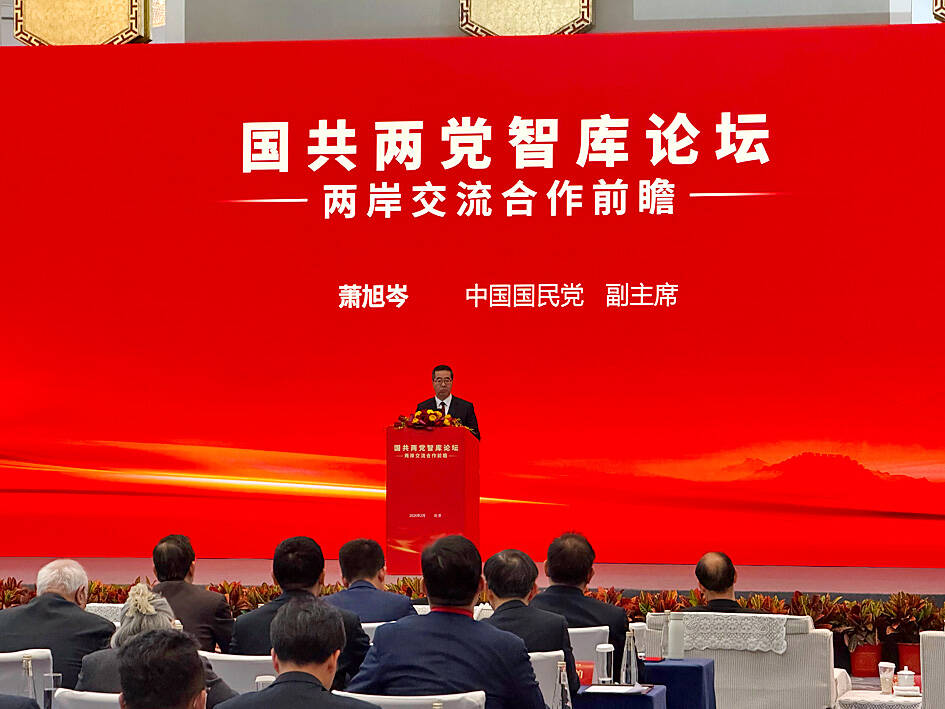
Photo courtesy of the Chinese Nationalist Party (KMT)
The KMT and the CCP are responsible for the peaceful development of cross-strait relations and protecting the “Chinese homeland,” Song added.
He put forward five pillars of cross-strait relations: upholding the “1992 consensus”; deepening integrated development; focusing on people’s well-being and enhancing familial bonds; opposing Taiwanese independence, and safeguarding peace and stability in the Taiwan Strait; and supporting the “joint cause of national rejuvenation.”
The “1992 consensus,” a term that former Mainland Affairs Council chairman Su Chi (蘇起) in 2006 admitted making up in 2000, refers to a tacit understanding between the KMT and the CCP that both sides acknowledge there is “one China,” with each side having its own interpretation of what “China” means.
The Democratic Progressive Party (DPP) has never acknowledged the “consensus.”
China would continue to promote cross-strait economic cooperation and enable all Chinese, including people in Taiwan, to live better lives, Song said, while criticized supporters of Taiwanese independence and calling on people in Taiwan to “stand on the right side of history.”
Hsiao said that KMT Chairwoman Cheng Li-wun (鄭麗文) cares about the forum and hopes to address urgent issues affecting Taiwan’s industrial development, including tourism and cross-strait industrial cooperation.
He said that the forum would address issues relevant to both sides, including healthcare, climate change, disaster prevention, artificial intelligence development, new energy and carbon reduction.
“The two sides of the Strait should cooperate rather than confronting each other and allowing other countries to exploit Taiwan,” he said.
In Taipei, DPP China Affairs Director Wu Jun-zhi (吳峻鋕) said that the forums are packaged as a platform for civil exchanges, which might seem harmless at first glance.
In reality, they are deeply tied to national security and critical supply chains, making them something to be cautious about, Wu said.
Meanwhile, Mainland Affairs Council Minister Chiu Chui-cheng (邱垂正) yesterday said the KMT’s participation ignored what he described as growing hostility from Beijing.
This included military aircraft and naval activity, diplomatic and economic coercion, as well as attempted "cross-border suppression" targeting Taiwanese military personnel, government officials, and civilians, which Chiu said was the real cause of deteriorating cross-strait relations.
Additional reporting by Chen Cheng-yu
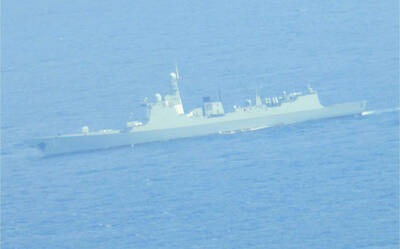
The military has spotted two Chinese warships operating in waters near Penghu County in the Taiwan Strait and sent its own naval and air forces to monitor the vessels, the Ministry of National Defense (MND) said. Beijing sends warships and warplanes into the waters and skies around Taiwan on an almost daily basis, drawing condemnation from Taipei. While the ministry offers daily updates on the locations of Chinese military aircraft, it only rarely gives details of where Chinese warships are operating, generally only when it detects aircraft carriers, as happened last week. A Chinese destroyer and a frigate entered waters to the southwest
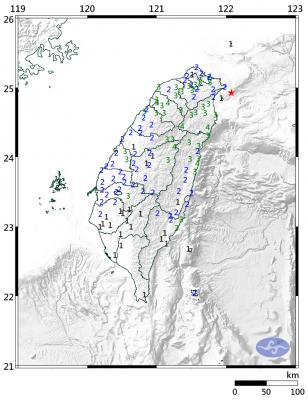
A magnitude 6.1 earthquake struck off the coast of Yilan County at 8:39pm tonight, the Central Weather Administration (CWA) said, with no immediate reports of damage or injuries. The epicenter was 38.7km east-northeast of Yilan County Hall at a focal depth of 98.3km, the CWA’s Seismological Center said. The quake’s maximum intensity, which gauges the actual physical effect of a seismic event, was a level 4 on Taiwan’s 7-tier intensity scale, the center said. That intensity level was recorded in Yilan County’s Nanao Township (南澳), Hsinchu County’s Guansi Township (關西), Nantou County’s Hehuanshan (合歡山) and Hualien County’s Yanliao (鹽寮). An intensity of 3 was
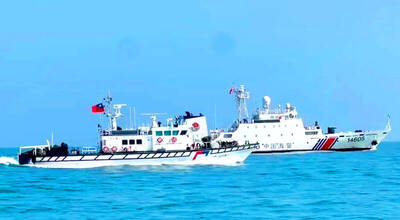
Instead of focusing solely on the threat of a full-scale military invasion, the US and its allies must prepare for a potential Chinese “quarantine” of Taiwan enforced through customs inspections, Stanford University Hoover fellow Eyck Freymann said in a Foreign Affairs article published on Wednesday. China could use various “gray zone” tactics in “reconfiguring the regional and ultimately the global economic order without a war,” said Freymann, who is also a nonresident research fellow at the US Naval War College. China might seize control of Taiwan’s links to the outside world by requiring all flights and ships entering or leaving Taiwan
The next minimum wage hike is expected to exceed NT$30,000, President William Lai (賴清德) said yesterday during an award ceremony honoring “model workers,” including migrant workers, at the Presidential Office ahead of Workers’ Day today. Lai said he wished to thank the awardees on behalf of the nation and extend his most sincere respect for their hard work, on which Taiwan’s prosperity has been built. Lai specifically thanked 10 migrant workers selected for the award, saying that although they left their home countries to further their own goals, their efforts have benefited Taiwan as well. The nation’s industrial sector and small businesses lay


 RSS
RSS