


Chinese Nationalist Party (KMT) Chairwoman Cheng Li-wun (鄭麗文) recently said in an exclusive interview with The Economist that she considers peaceful unification with China “premature,” the party said today.
She also said that she hopes to meet with Chinese President Xi Jinping (習近平) in the first half of the year to strive for commitment to peace, the KMT said in a statement.
In the interview on Tuesday last week, Cheng talked about cross-strait peace, national identity, national defense and security, US-China relations and her political career, the party said.
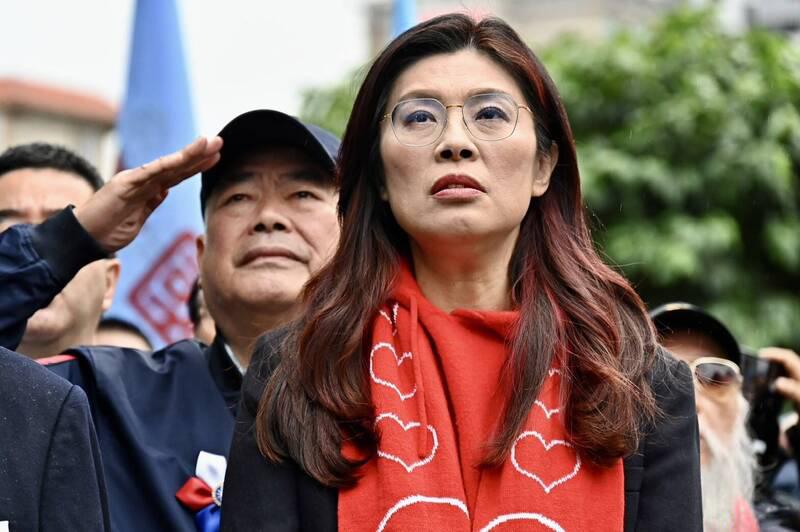
Photo: Taipei Times file photo
The KMT’s most important task for the next three to five years is to create peace and stability in the Taiwan Strait, the party quoted Cheng as saying in the interview.
She said she hopes for exchanges and dialogue with China, including meeting Xi as she advocates for cross-strait reconciliation.
Communication and interaction at systematic levels could reduce the risk of misjudgement and avoid conflicts and escalation, she said.
The two sides must absolutely prevent war or armed conflict from occurring, as it would bring unimaginable and catastrophic consequences, she said.
The ruling Democratic Progressive Party (DPP) does not accept the “1992 consensus” and promotes a de facto “two states” theory, which has led to increasingly confrontational cross-strait relations in the past decade, she said.
Embracing the “1992 consensus” would “significantly reduce the likelihood of military confrontation,” Cheng said.
The so-called “1992 consensus,” a term former Mainland Affairs Council chairman Su Chi (蘇起) in 2006 admitted making up in 2000, refers to a tacit understanding between the KMT and the Chinese government that both sides of the Strait acknowledge there is “one China,” with each side having its own interpretation of what “China” means.
Asked in the interview about Beijing’s high expectations for peaceful unification, she called herself a pragmatic politician.
The most important task is to establish a perpetual peace framework, Chen said, adding that she could accept it if it is also acceptable to people on both sides of the Strait.
However, it is “premature” to discuss the matter, she said.
Rational dialogue and mutual understanding between China and the US could promote regional peace and stability, she said, adding that she hopes for reconciliation between the two countries.
She said she hopes it is not a zero sum game but a win-win situation, adding that from the perspective of Taiwan, China has already become an indispensable market.
She further shared concerns that the US would abandon Taiwan, pointing to a US arms shipment backlog of US$20 billion, while Washington seeks to relocate key industries, including semiconductor manufacturers such as Taiwan Semiconductor Manufacturing Co, to the US.
Commenting on national defense and security, Cheng said the main challenge for Taiwan’s national defense efforts is a shortage of professional career military personnel, not a lack of funding.
Taiwan buys aircraft and artillery, but lacks the trained professionals required to operate them, she said.
Regarding the issue of identity, Cheng said that under the provisions of the Constitution, “we are also so-called Chinese.”
Changes in identity for the Taiwanese people are a result of political manipulation, she said, adding that before she turned 30, the vast majority of people identified as Chinese, though the figure has since rapidly declined.
The concept of Taiwan and China should be inclusive but not mutually exclusive, she said, adding that it is defined by culture, history and bloodlines, with only a small part hinging on modern ideas of sovereignty.
For the past 30 years, the DPP has continuously promoted de-Sinicization, she said.

FUKUOKA SITUATION: Japanese media reported that the pathogen is expected to be identified by the summer, while the CDC downplayed the idea that it was hMPV A “mysterious cold-like illness” reported in Japan’s Fukuoka Prefecture does not seem to be a new disease, but Japanese authorities have been asked about the situation, the Centers for Disease Control (CDC) said yesterday. The Fukuoka Prefectural Medical Association on Wednesday told a news conference that a “mystery cold” that has become a hot topic on social media is “highly likely to be caused by some kind of viral infection,” Japan’s KBC News reported. “Many people are experiencing symptoms starting with a sore throat, followed by a runny nose, phlegm and a severe cough,” KBC News reported, citing association officials. Health authorities are

Nvidia Corp CEO Jensen Huang (黃仁勳) arrived in Taiwan yesterday ahead of upcoming AI and technology events, saying he plans to meet with clients and Taiwan Semiconductor Manufacturing Co Chairman C.C. Wei (魏哲家) during his visit. After landing at Taipei Songshan Airport, Huang posed for photos with fans and handed out Yakult drinks to reporters and supporters waiting at the scene, saying he has “a lot to do” during the trip. Asked about reports that Nvidia’s planned headquarters site in Taipei’s Beitou Shilin Technology Park could break ground on May 27, Huang said that if the company holds an event, he would

Carrefour Taiwan is to begin using a new name from the start of July, but it cannot divulge the name until then, the chairman of the supermarket chain's parent company said today. President Chain Store Co chairman Lo Chih-hsien (羅智先) was asked by reporters after a shareholders' meeting to confirm whether the company has settled on a new name for the supermarket brand. In March, the government-registered name of two Carrefour Taiwan branches was quietly changed to "Le Chia Kang" (樂家康) in Chinese, raising speculation that has been selected as the name. Lo said that because of local regulations and contractual obligations, the
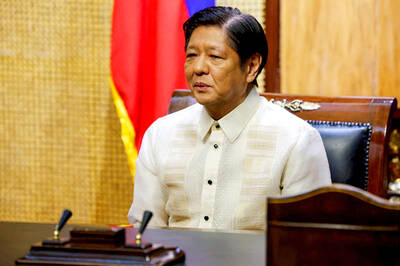
The Philippines would likely be involved in any conflict over Taiwan due to its proximity to the democracy claimed by China, President Ferdinand Marcos Jr said, reiterating a stance that risks angering Beijing. “In the Philippines, we do not have a choice because Taiwan is so close to the Philippines and we have almost 200,000 Filipino nationals living and working in Taiwan,” Marcos said in an interview with Japanese media in Manila on Monday. The Philippine leader’s comments come ahead of a state visit to Japan next week, where he is to meet with Japanese Prime Minister Sanae Takaichi to discuss security


 RSS
RSS