


More than half of people with hypertension also have sleep apnea, leading to nighttime oxygen deprivation that can place undue stress on the heart, especially in the winter, a doctor said.
As temperatures plunge, the conditions are particularly dangerous, with winter being the peak season for sudden deaths during sleep, Wanfang Hospital Department of Otorhinolaryngology director Chen Po-yueh (陳伯岳) said.
“The most common symptom of obstructive sleep apnea is loud snoring. Snoring is not merely a nuisance — it can be a potentially deadly warning sign in winter,” he said. “Chronic snoring causes repeated nighttime oxygen deprivation, forcing blood vessels to constrict and blood pressure to spike, creating a hidden time bomb for cardiovascular disease.”
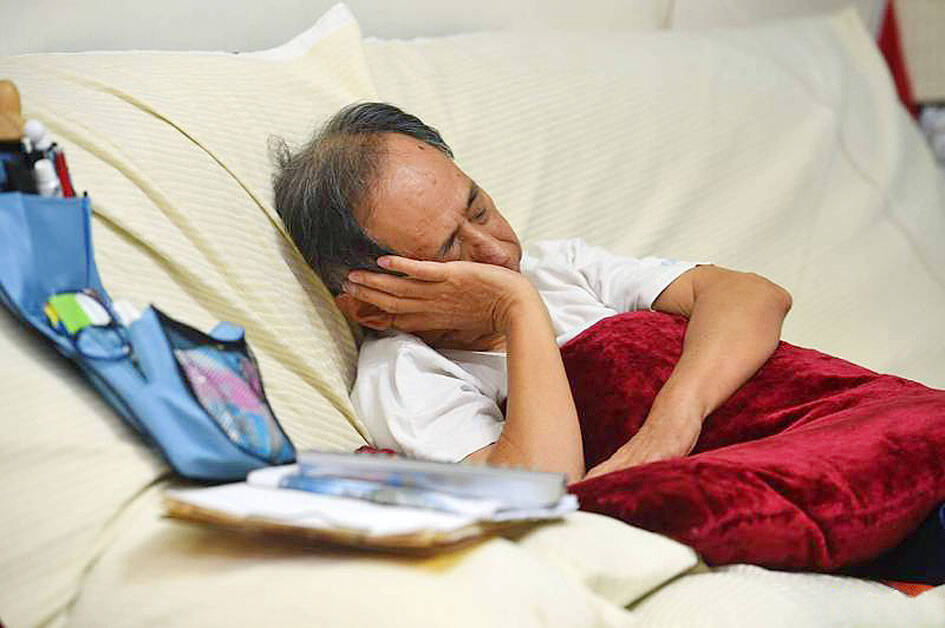
Photo: Taipei Times
Sleep apnea causes the airway to repeatedly collapse during sleep, placing the body in a state of “intermittent hypoxia,” he said.
The oxygen deprivation triggers the sympathetic nervous system, accelerating the heart rate and causing severe vasoconstriction, which leads to abnormal nighttime surges in blood pressure.
Over time, damage and hardening of blood vessel walls significantly increase the risk of arrhythmia, myocardial infarction and stroke, Chen said.
“During winter, falling temperatures already constrict blood vessels. When combined with nighttime hypoxia from sleep apnea, the heart’s workload can reach its limit,” he said, adding that more than 50 percent of people with hypertension he treats also have sleep apnea.
“If they rely solely on blood pressure medication without addressing the underlying sleep apnea, a fatal incident could occur at any time during the night,” Chen added.
Sleep apnea also hampers weight loss, as breathing interruptions prevent deep sleep, reducing leptin secretion and making the brain less responsive to satiety signals, he said.
At the same time, increased secretion of ghrelin — the “hunger hormone” — heightens appetite and cravings for high-calorie, high-sugar foods, he said.
“As people gain weight, fat in the throat and beneath the tongue further compresses the airway, while excess abdominal fat presses on the diaphragm, reducing respiratory drive. That creates a vicious cycle in which weight gain worsens snoring, which in turn promotes more weight gain,” he said.
Weight control and the use of a continuous positive airway pressure device can significantly improve sleep apnea, which is not entirely irreversible.
Separately, sleep technologist Chen Yi-chieh (陳奕潔) urged people experiencing loud snoring, frequent daytime fatigue, being observed by a partner to have stopped breathing or experience choking during sleep, or those with hypertension or a body mass index of more than 35, to seek medical advice.
“High-risk people should not ignore the condition and should arrange for a medical diagnosis, including sleep testing, as soon as possible,” she said. “Home sleep testing allows professional evaluation of sleep apnea to be conducted in a familiar environment.”
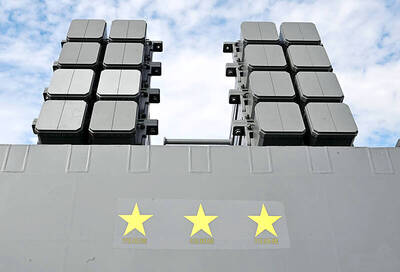
UPGRADE: The Kang Ding-class frigate is replacing its Chaparall missiles with Tien Chien II and Hua Yang VLS, which would provide it with long-range, 360° air defense Taiwan plans to produce 1,200 to 1,376 Hai Chien II missiles (海劍二, Sea Sword II) — also known as TC-2N — to serve as the standard air defense system of the navy’s surface combatant fleet, a source said yesterday. Last week, the Hai Chien II, the naval version of the Tien Kung II missile (天劍二, Sky Sword II), completed a live-fire test in waters off the National Chungshan Institute of Science and Technology’s Jiupeng facility (九鵬) in Pingtung County’s Manjhou Township (滿州). The MIM72 Chaparral and other dated air defense missiles that currently arm Taiwanese ships have inadequate range to combat Chinese

REASONS FOR TRAVEL: An assistant professor said that proposed amendments to penalize drivers if they used drugs overseas would not deter people from traveling People who operate a motor vehicle under the influence of marijuana would have their driver’s license revoked, even if they used the substance while overseas, the Ministry of Transportation and Communications said yesterday, citing proposed amendments to the Road Traffic Management and Penalty Act (道路交通管理處罰條例). The amendments would also authorize the government to revoke the licenses of people determined to have used Category 1 or Category 2 narcotics, even if they were not operating a vehicle while under the influence of drugs, as well as ban them from taking the license test for three years, the ministry said. People aged 18 or

HEAVY WEATHER: Typhoon Jangmi is due to crash straight into the Ryukyus as airlines look to shift flights to larger aircraft or cancel flights to Okinawa entirely Taiwan’s international air carriers announced flight adjustments over the weekend as Typhoon Jangmi is forecast to hit the Ryukyu Islands today and tomorrow. The Central Weather Administration (CWA) upgraded Jangmi from a tropical storm to a typhoon at 8am yesterday, with the eye located 580km south of Naha city. It was moving north at 19kph. Today, China Airlines’ CI-120, CI-121, CI-122 and CI-123 flights between Taoyuan and Naha, Okinawa, have been canceled as well as CI-132 and CI-133 between Kaohsiung and Naha. EVA Air’s BR-112, BR-113, BR-186 and BR-185 flights between Taoyuan and Naha are also canceled. Low-cost carrier Tigerair Taiwan canceled IT-230,
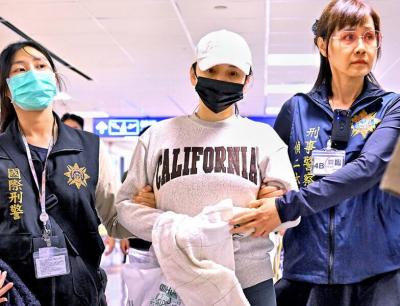
Johanne Liou (劉喬安), a Taiwanese woman who shot to unwanted fame during the Sunflower movement protests in 2014, returned to Taiwan last night after being deported from the US. She is to stand trial in Taiwan for charges involving embezzlement, fraud and drug crimes. The Criminal Investigation Bureau (CIB) said it took her into custody at Taiwan Taoyuan International Airport and would first question her before transferring her to the New Taipei District Prosecutors’ Office. She was arrested upon disembarking a flight from San Francisco that landed shortly before 7pm. Liou absconded to the US in 2019 after jumping bail


 RSS
RSS