


People planning to travel abroad during the Lunar New Year holiday should make sure they have a valid passport, and meet visa and entry requirements, Minister of Foreign Affairs Lin Chia-lung (林佳龍) said yesterday.
In a video posted on Facebook, Lin urged people to check five items before leaving for the holiday.
First, make sure their passport is valid for at least six months with at least four blank pages, and second, make sure pages of the passport have not been defaced with commemorative, or nonofficial stamps or stickers, he said.
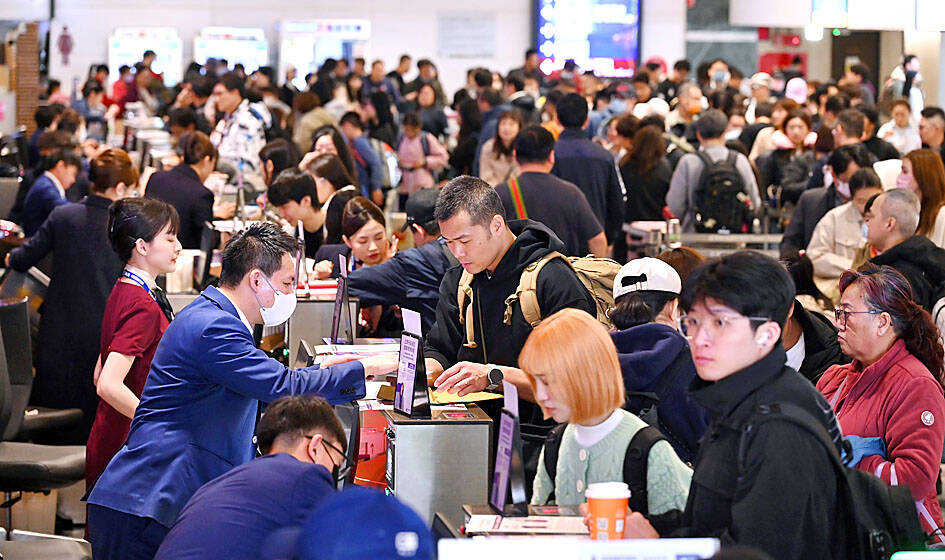
Photo: Liu Hsin-de, Taipei Times
Third, ensure they meet the travel destination’s visa and entry requirements, and fourth, get fully insured for overseas travel, he said.
Last, people who plan to drive while abroad must have a valid Taiwanese license and an international driving permit, he said.
Those planning to drive in Japan would need a Japanese translation of their Taiwanese driver’s license, Lin added.
People should download the government’s Travel Safety Guidance (旅外安全指南) app or add the Consular Affairs Bureau’s official Line account prior to their trip to learn more about traveling overseas, he said.
People should also register as an overseas traveler with the bureau’s Line account or official Web site before their trip, so that overseas missions can get in touch with them and provide aid in an emergency, he said.
Taiwanese encountering emergencies overseas can call the emergency hotlines of Taiwan’s overseas missions — including those with multiple jurisdictions — or have friends or family call the 0800-085-095 hotline of the ministry’s Emergency Coordination Center for help, he said.
Set up at Taiwan Taoyuan International Airport, the center is open 24/7 throughout the year to help overseas travelers’ in emergencies, the ministry said.
Separately, the Mainland Affairs Council yesterday warned against unnecessary travel to Macau or Hong Kong amid an “orange” level travel alert for the regions, due to local law enforcement and unstable situations.
Those who travel to Hong Kong or Macau must be aware of potential risks due to local regulations that could affect their personal rights and safety, and should be aware that their personal items could be subject to searches, the council said.
For example, personal mobile phones or computers might be examined, confiscated or held as “incriminating evidence,” if they contain sensitive information, it said, adding that such content should be backed up and removed from devices prior to traveling to the territories.
People are also advised against bringing gas canisters, pepper spray, stun guns, expandable batons, brass knuckles, switchblades or comb knives to the territories, the council said.
Taiwanese encountering emergencies in Hong Kong can call the emergency hotline of (852) 6143-9012 of the council’s Taipei Economic and Cultural Office in Hong Kong, while those in Macau can call the (853) 6687-2557 hotline of the council’s Taipei Economic and Cultural Office in Macau, it said.

Considering that most countries issue more than five denominations of banknotes, the central bank has decided to redesign all five denominations, the bank said as it prepares for the first major overhaul of the banknotes in more than 24 years. Central bank Governor Yang Chin-lung (楊金龍) is expected to report to the Legislative Yuan today on the bank’s operations and the redesign’s progress. The bank in a report sent to the legislature ahead of today’s meeting said it had commissioned a survey on the public’s preferences. Survey results showed that NT$100 and NT$1,000 banknotes are the most commonly used, while NT$200 and NT$2,000

The Centers for Disease Control (CDC) yesterday reported the first case of a new COVID-19 subvariant — BA.3.2 — in a 10-year-old Singaporean girl who had a fever upon arrival in Taiwan and tested positive for the disease. The girl left Taiwan on March 20 and the case did not have a direct impact on the local community, it said. The WHO added the BA.3.2 strain to its list of Variants Under Monitoring in December last year, but this was the first imported case of the COVID-19 variant in Taiwan, CDC Deputy Director-General Lin Ming-cheng (林明誠) said. The girl arrived in Taiwan on

ANNUAL EVENT: Two massive Pokemon balloons are to be set up in Daan Park, with an event zone operating from 10am to 6pm This year’s Taipei Floral Picnic is to be held at Daan Park today and tomorrow, featuring an exclusive Pokemon Go event, a themed food market, a coffee rave picnic area and stage performances, the Taipei Department of Information and Tourism said yesterday. Two massive Pokemon balloons are to be set up in the park as attractions, with an exclusive event zone operating from 10am to 6pm, it said. Participants who complete designated tasks on-site would have a chance to receive limited-edition souvenirs, it added. People could also try the newly launched game Pokemon Pokopia in the trial area, the department said. Three PokeStops are

South Korea is planning to revise its controversial electronic arrival card, a step Taiwanese officials said prompted them to hold off on planned retaliatory measures, a South Korean media report said yesterday. A Yonhap News Agency report said that the South Korean Ministry of Foreign Affairs is planning to remove the “previous departure place” and “next destination” fields from its e-arrival card system. The plan, reached after interagency consultations, is under review and aims to simplify entry procedures and align the electronic form with the paper version, a South Korean ministry official said. The fields — which appeared only on the electronic form


 RSS
RSS