


Burmese in Taiwan yesterday urged the Taiwanese government to enact an asylum bill and issue temporary Alien Resident Certificates for asylum seekers as the military junta’s suppression of people in Myanmar worsened over the past year.
The campaigners issued the call along with human rights groups at a rally near New Taipei City’s Huasin Street — commonly known as the “Myanmar Street” — on the fifth anniversary of Myanmar’s military coup yesterday.
Taiwan has pledged aid and asylum for refugees since 2021 when the coup in Myanmar occurred, but nothing has been implemented, the campaigners said.
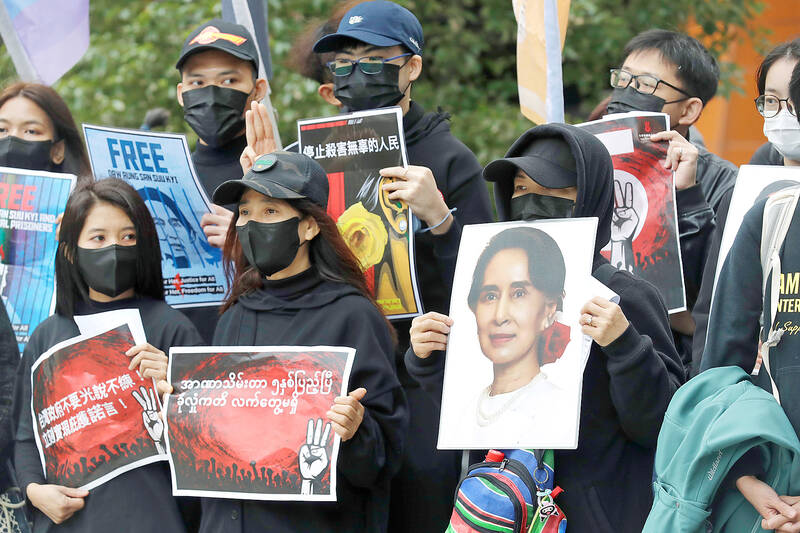
Photo: AP
The cabinet failed to send the asylum bill to the legislature for review, while the asylum scheme of temporary resident certification launched by the National Immigration Agency in 2023 has yet to approve any application by asylum seekers, they said.
The campaigners likened the application process to playing volleyball as different government agencies passed the buck.
A college student from Myanmar, who wished not to be named, said that millions of Burmese were forced to leave their homeland and young people were forced to serve on the front line of battlefields instead of studying in classrooms.
“I have not been able to return to Myanmar for 10 years,” she said.
She said she chose to wear a hat and a mask even in a safe country like Taiwan while speaking about Myanmar, because she still feared the Myanmar military government.
“The military can still control our future and our lives by taking away our passports,” she said.
“We cannot continue this fight alone,” she added. “Taiwan understands the value of democracy and freedom, and your support gives us strength and hope.”
Citing data from the Armed Conflict Location and Event Data Project, Taiwan Myanmar Civil Association chairman Koko Thu (杜可可) said more than 80,000 people had been killed and more than 28,000 were held as political prisoners, including Myanmar’s deposed democratic leader Aung San Suu Kyi, as of the end of last year.
More than 3.5 million Burmese are displaced, while more than 20 million need humanitarian aid, he said.
From Feb. 1, 2021, to the end of last year, the Myanmar military government conducted more than 7,000 airstrikes, with up to 400 launched within a single month, killing more than 2,000 people, Thu said.
More than 90 of the 330 townships in Myanmar had been taken by Myanmar’s armed resistance group toward the end of last year, but the revolution was derailed due to Chinese interference, he said.
“The war would have ended around the end of last year were it not for the Chinese interference,” he said.
Amnesty International Taiwan secretary-general Chiu E-ling (邱伊翎) cited a report by Amnesty International as saying that the Burmese military government has escalated airstrikes against civilians since last year.
Chinese and Iranian oil and aviation companies helped sustain the airstrikes as they continued to supply oil to the Burmese military via “ghost ships” — ships with their automatic identification systems turned off to avoid satellite tracking, she said.
Human rights advocate Lee Ming-che (李明哲) cited a 2024 Justice for Myanmar report as saying Hainan-based Jizhi Information Technology (及至信息科技) collaborated with Myanmar’s Mascots Group to provide surveillance software for the Burmese military government to monitor civilians.
Such Chinese surveillance systems use facial, fingerprint or iris recognition and have aided the forced conscription order enforced by the military government, forcing many young Burmese to go into exile overseas last year, Lee said.
Taiwan is facing soft and hard coercion from Beijing as Myanmar is and should support Burmese in their pursuit of democracy and human rights, he said, calling on the government to fulfil its pledge to help.
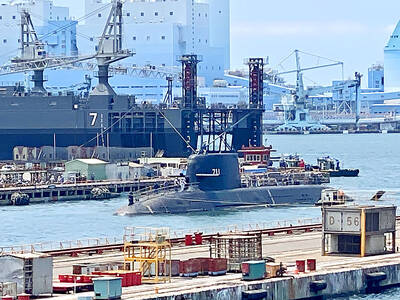
AGING: While Japan has 22 submarines, Taiwan only operates four, two of which were commissioned by the US in 1945 and 1946, and transferred to Taiwan in 1973 Taiwan would need at least 12 submarines to reach modern fleet capabilities, CSBC Corp, Taiwan chairman Chen Cheng-hung (陳政宏) said in an interview broadcast on Friday, citing a US assessment. CSBC is testing the nation’s first indigenous defense submarine, the Hai Kun (海鯤, Narwhal), which is scheduled to be delivered to the navy next month or in July. The Hai Kun has completed torpedo-firing tests and is scheduled to undergo overnight sea trials, Chen said on an SET TV military affairs program. Taiwan would require at least 12 submarines to establish a modern submarine force after assessing the nation’s operational environment and defense

A white king snake that frightened passengers and caused a stir on a Taipei MRT train on Friday evening has been claimed by its owner, who would be fined, Taipei Rapid Transit Corp (TRTC) said yesterday. A person on Threads posted that he thought he was lucky to find an empty row of seats on Friday after boarding a train on the Bannan (Blue) Line, only to spot a white snake with black stripes after sitting down. Startled, he jumped up, he wrote, describing the encounter as “terrifying.” “Taipei’s rat control plan: Release snakes on the metro,” one person wrote in reply, referring
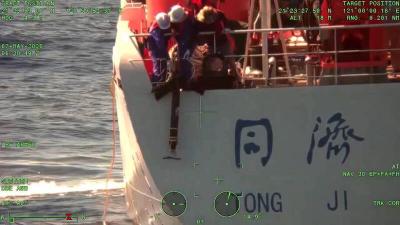
The coast guard today said that it had disrupted "illegal" operations by a Chinese research ship in waters close to the nation and driven it away, part of what Taipei sees a provocative pattern of China's stepped up maritime activities. The coast guard said that it on Thursday last week detected the Chinese ship Tongji (同濟號), which was commissioned only last year, 29 nautical miles (54km) southeast of the southern tip of Taiwan, although just outside restricted waters. The ship was observed lowering ropes into the water, suspected to be the deployment of scientific instruments for "illegal" survey operations, and the coast
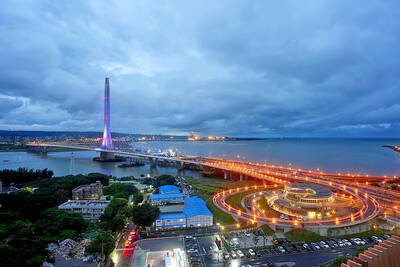
An inauguration ceremony was held yesterday for the Danjiang Bridge, the world’s longest single-mast asymmetric cable-stayed bridge, ahead of its official opening to traffic on Tuesday, marking a major milestone after nearly three decades of planning and construction. At the ceremony in New Taipei City attended by President William Lai (賴清德), Premier Cho Jung-tai (卓榮泰), Minister of Transportation and Communications Chen Shih-kai (陳世凱) and New Taipei City Mayor Hou Yu-ih (侯友宜), the bridge was hailed as both an engineering landmark and a long-awaited regional transport link connecting Tamsui (淡水) and Bali (八里)


 RSS
RSS