


The US Senate Foreign Relations Committee on Thursday advanced three Taiwan-related bills, although a fourth was set aside for later discussion.
The three measures passed are the Taiwan Energy Security and Anti-Embargo Act, the Taiwan Undersea Cable Resilience Initiative Act and the Taiwan Allies Fund Act.
The Taiwan Energy Security and Anti-Embargo Act would authorize expanded US exports of liquefied natural gas and encourage use of nuclear energy to alleviate Taiwan’s vulnerability to coercion by the Chinese Communist Party (CCP).
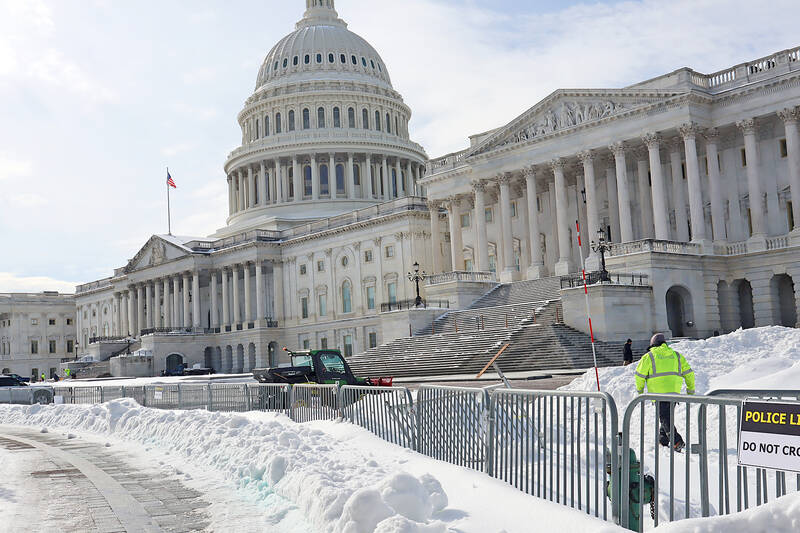
Photo: CNA
The Taiwan Undersea Cable Resilience Initiative Act would coordinate US Navy operations with Taiwan’s Coast Guard Administration, impose sanctions on those who damage undersea cables and provide intelligence warnings.
Finally, the Taiwan Allies Fund Act would authorize the executive branch to establish a fund of US$120 million over three years to assist Taiwan’s diplomatic allies and unofficial partners facing pressure from Beijing.
The three bills go to the full Senate for consideration before referral to the House of Representatives and finally to the president to be signed into law if passed.
The Taiwan Symbols of Sovereignty Act, set aside for the time being, would allow Taiwanese diplomats and military personnel to display symbols of sovereignty such as flags and military insignia during official visits to the US, lifting restrictions put in place under former US president Barack Obama.
The bill was introduced late last year by Senator Ted Cruz, who on Thursday asked the Senate to imagine meeting with French diplomats and requesting that they not use the French flag.
Senators set the act aside over fears of upsetting China, saying that Taiwan had never requested a change in policy.
Under the proposal, the US defense and state secretaries would allow members of the Taiwanese armed forces and government representatives, or the Taipei Economic and Cultural Representative Office (TECRO), to display symbols of sovereignty while on official business in the US.
US Senator Tammy Duckworth said the measure was not supported by the US Department of State, to which Cruz said that he had not received such information and that the Senate does not answer to the State Department.
US Senator Jeff Merkley questioned to what extent the act would assist Taiwan in resisting Chinese coercion and whether the move would anger China.
US Senator Jeanne Shaheen said that — as much as she recognizes the importance of symbolism — Taiwan has not requested the US make such a move.
US Senator Bill Hagerty said he hoped that the bill would not fail in its final review stages, while US Senator Brian Schatz suggested delaying the vote until a consensus is reached.
US Senator Rand Paul said he would vote against the bill unless Taiwan gives a statement on the issue.
Cruz agreed to delay the vote if it meant there was a greater possibility of the bill being passed.
US Senator Steve Daines said that a consensus should be reached before upcoming summits between US President Donald Trump and Chinese President Xi Jinping (習近平).
In the committee, even one member can block a bill and delay discussions until the next hearing.
A date has not yet been set to continue discussion of the act.
TECRO said yesterday in a news release that its goal has always been to strengthen Taiwan-US relations and thanked the Senate for passing legislation that reflects its steadfast support for Taiwan.
It added that it would continue to maintain close communication with the US and build on the already-strong foundation to deepen the tight and lasting partnership between the two countries.

AGING: While Japan has 22 submarines, Taiwan only operates four, two of which were commissioned by the US in 1945 and 1946, and transferred to Taiwan in 1973 Taiwan would need at least 12 submarines to reach modern fleet capabilities, CSBC Corp, Taiwan chairman Chen Cheng-hung (陳政宏) said in an interview broadcast on Friday, citing a US assessment. CSBC is testing the nation’s first indigenous defense submarine, the Hai Kun (海鯤, Narwhal), which is scheduled to be delivered to the navy next month or in July. The Hai Kun has completed torpedo-firing tests and is scheduled to undergo overnight sea trials, Chen said on an SET TV military affairs program. Taiwan would require at least 12 submarines to establish a modern submarine force after assessing the nation’s operational environment and defense

A white king snake that frightened passengers and caused a stir on a Taipei MRT train on Friday evening has been claimed by its owner, who would be fined, Taipei Rapid Transit Corp (TRTC) said yesterday. A person on Threads posted that he thought he was lucky to find an empty row of seats on Friday after boarding a train on the Bannan (Blue) Line, only to spot a white snake with black stripes after sitting down. Startled, he jumped up, he wrote, describing the encounter as “terrifying.” “Taipei’s rat control plan: Release snakes on the metro,” one person wrote in reply, referring
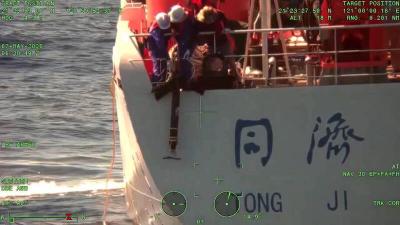
The coast guard today said that it had disrupted "illegal" operations by a Chinese research ship in waters close to the nation and driven it away, part of what Taipei sees a provocative pattern of China's stepped up maritime activities. The coast guard said that it on Thursday last week detected the Chinese ship Tongji (同濟號), which was commissioned only last year, 29 nautical miles (54km) southeast of the southern tip of Taiwan, although just outside restricted waters. The ship was observed lowering ropes into the water, suspected to be the deployment of scientific instruments for "illegal" survey operations, and the coast
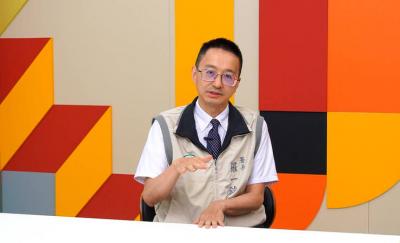
Taiwan’s two cases of hantavirus so far this year are on par with previous years’ case numbers, and the government is coordinating rat extermination work, so there should not be any outbreaks, Centers for Disease Control (CDC) Director-General Philip Lo (羅一鈞) said today in an interview with the Liberty Times (the Taipei Times’ sister newspaper). An increase in rat sightings in Taipei and New Taipei City has raised concerns about the spread of hantavirus, as rats can carry the disease. In January, a man in his 70s who lived in Taipei’s Daan District (大安) tested positive posthumously for hantavirus, Taiwan’s


 RSS
RSS