


An elderly man with underlying health conditions died in mid-January, eight days after the onset of symptoms, marking Taiwan’s first hantavirus death this year, the Centers for Disease Control (CDC) said yesterday.
The man, who was in his 70s and lived in Taipei’s Daan District (大安), tested positive posthumously for hantavirus after passing away on Jan. 13 from sepsis complicated by multiple organ failure and pneumonia, the CDC said in a press release.
According to the CDC, the man sought treatment on Jan. 6 for respiratory issues and low blood pressure before returning two days later with gastrointestinal symptoms and a fever, leading to his admission to the intensive care unit shortly thereafter.
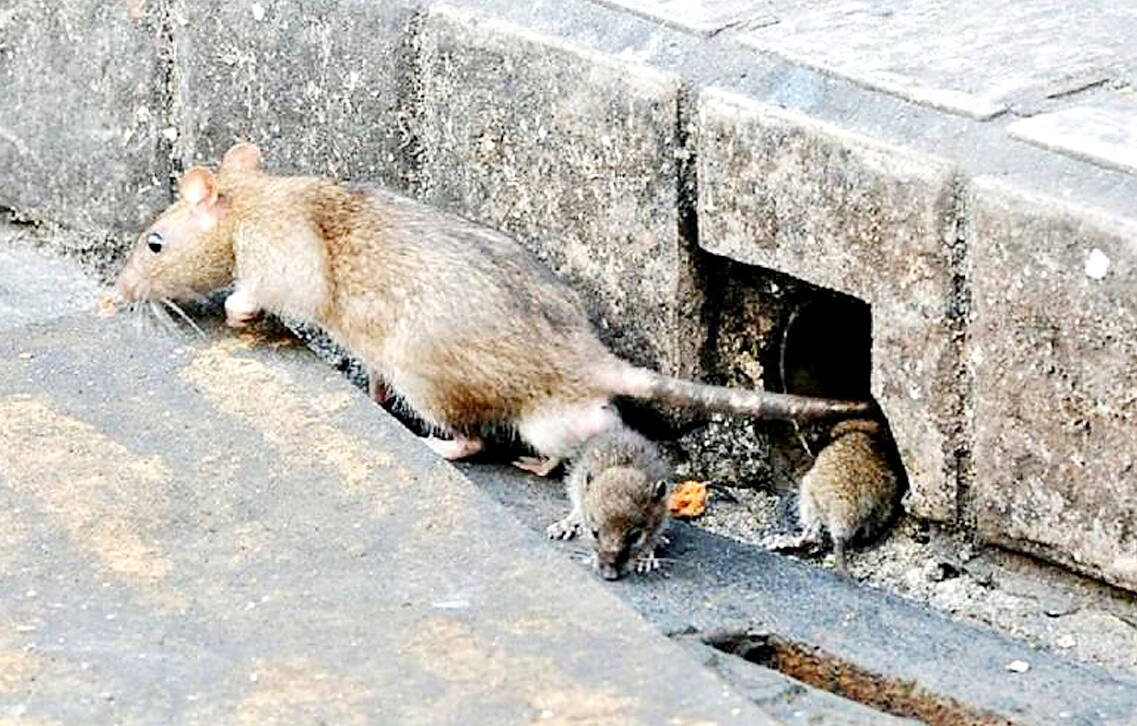
Photo: Chang Chung-yi, Taipei Times
The case marked Taiwan’s first confirmed hantavirus infection of the year, a figure consistent with the zero to one cases typically recorded during the same period over the past four years (2022-2025), bringing the total number of hantavirus cases in Taiwan to 44 since 2017, according to the CDC.
Following the fatality, local authorities conducted a screening near the man’s residence, with two of the four specimens captured testing positive for hantavirus.
To mitigate the risk of transmission, Taipei City Government’s environmental teams conducted a disinfection sweep within a 200-meter radius of the man’s residence and deployed specialized rodenticide to eliminate potential viral vectors.
Humans can contract the zoonotic disease by inhaling or touching dust and objects contaminated with rodent waste, such as droppings, urine, or saliva, or through the bite of an infected animal, according to the CDC.
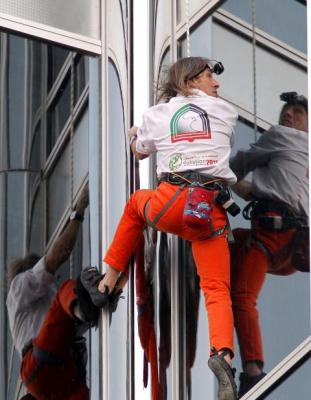
Alain Robert, known as the "French Spider-Man," praised Alex Honnold as exceptionally well-prepared after the US climber completed a free solo ascent of Taipei 101 yesterday. Robert said Honnold's ascent of the 508m-tall skyscraper in just more than one-and-a-half hours without using safety ropes or equipment was a remarkable achievement. "This is my life," he said in an interview conducted in French, adding that he liked the feeling of being "on the edge of danger." The 63-year-old Frenchman climbed Taipei 101 using ropes in December 2004, taking about four hours to reach the top. On a one-to-10 scale of difficulty, Robert said Taipei 101
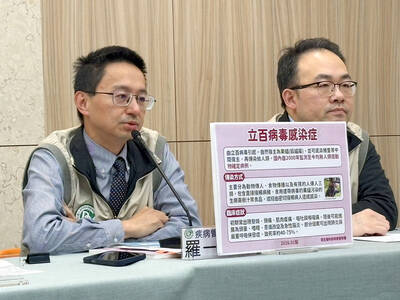
Nipah virus infection is to be officially listed as a category 5 notifiable infectious disease in Taiwan in March, while clinical treatment guidelines are being formulated, the Centers for Disease Control (CDC) said yesterday. With Nipah infections being reported in other countries and considering its relatively high fatality rate, the centers on Jan. 16 announced that it would be listed as a notifiable infectious disease to bolster the nation’s systematic early warning system and increase public awareness, the CDC said. Bangladesh reported four fatal cases last year in separate districts, with three linked to raw date palm sap consumption, CDC Epidemic Intelligence
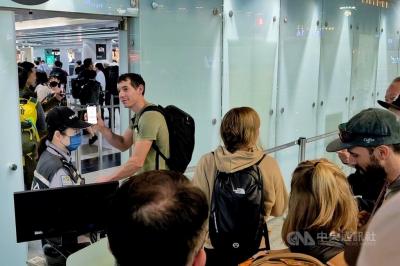
US climber Alex Honnold left Taiwan this morning a day after completing a free-solo ascent of Taipei 101, a feat that drew cheers from onlookers and gained widespread international attention. Honnold yesterday scaled the 101-story skyscraper without a rope or safety harness. The climb — the highest urban free-solo ascent ever attempted — took just more than 90 minutes and was streamed live on Netflix. It was covered by major international news outlets including CNN, the New York Times, the Guardian and the Wall Street Journal. As Honnold prepared to leave Taiwan today, he attracted a crowd when he and his wife, Sanni,

Taiwanese and US defense groups are collaborating to introduce deployable, semi-autonomous manufacturing systems for drones and components in a boost to the nation’s supply chain resilience. Taiwan’s G-Tech Optroelectronics Corp subsidiary GTOC and the US’ Aerkomm Inc on Friday announced an agreement with fellow US-based Firestorm Lab to adopt the latter’s xCell, a technology featuring 3D printers fitted in 6.1m container units. The systems enable aerial platforms and parts to be produced in high volumes from dispersed nodes capable of rapid redeployment, to minimize the risk of enemy strikes and to meet field requirements, they said. Firestorm chief technology officer Ian Muceus said


 RSS
RSS