


Amendments to the law governing foreign professionals have expanded pathways to work and long-term residency, and the International Talent Taiwan Office can help them understand how the new rules apply to their individual circumstances, the office’s managing director said.
“There are many government processes that come with moving to a new country, and we hope to provide the best information we can,” International Talent Taiwan Office Managing Director Jonathan Liao (廖炳坤) said on Thursday.
“If there are questions we cannot answer ourselves, we help verify them with other government agencies,” Liao said, adding that his team offers assistance in multiple areas, including setting up bank accounts, finding housing and schools for children — even importing pets.
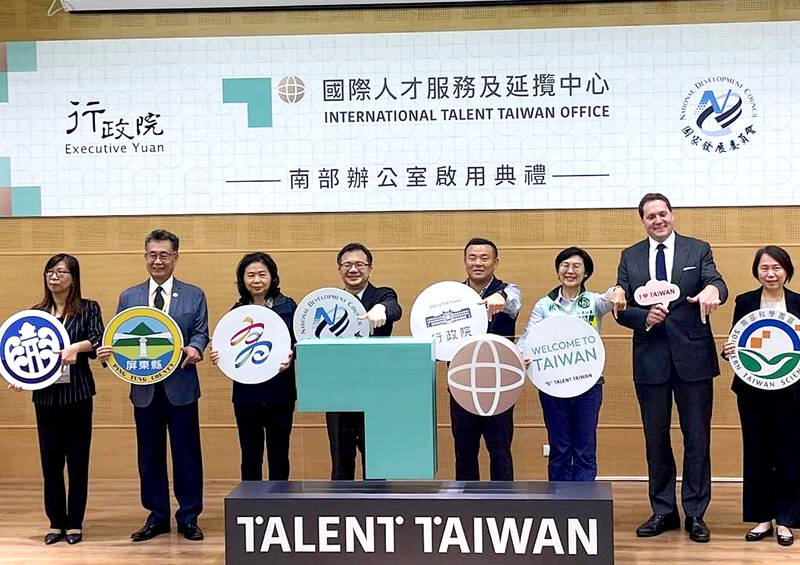
Photo: Ge You-hao, Taipei Times
The International Talent Taiwan Office was set up in November 2023 as part of efforts spearheaded by the National Development Council (NDC) to attract foreign professionals to work in Taiwan.
The office has three branches — in Taipei, Taichung and Kaohsiung — that employ three dozen workers in total.
Every month, the branches respond to about 4,700 e-mails, phone calls and instant messages both domestically and internationally, Liao said, adding that foreign professionals from 119 nations have contacted the office.
The office also provides on-site consultation services for those already in Taiwan, with 416 consultations having taken place in the Taipei office alone last year, he said.
“Ultimately, we want foreign professionals to stay in Taiwan longer,” Liao said.
Official data suggest that Taiwan’s efforts at attracting foreign talent have had some success.
The number of foreign professionals in Taiwan has grown from less than 40,000 in 2018 to “nearly 80,000,” NDC Deputy Minister Jan Fang-guan (詹方冠) said earlier this month at an event explaining amendments to the Act for the Recruitment and Employment of Foreign Professionals (外國專業人才延攬及僱用法), which came into effect this year.
Changes to the law include allowing international graduates of Taiwanese universities to work without a work permit for two years after graduation and giving graduates of the world’s top 200 universities a two-year open work permit.
The reforms also shorten permanent residency timelines for Taiwan-educated foreigners and some “foreign specialist professionals,” allow spouses of foreign specialists to work freely, and expand access to the pension and employment insurance systems.
Under the law, there are different categories of foreign professionals based on factors such as industry and income level, and different legal working options ranging from open-work permits and employer-based working arrangements to digital nomad and premium “gold card” visas.
The office exists to “demystify” the various visa options and answer any questions foreigners might have, Liao said, adding that e-mail is the best way to get in contact.
“There are different funnels for people to ultimately stay in Taiwan,” he said, adding that the office is there to help foreigners understand those various pathways.

Considering that most countries issue more than five denominations of banknotes, the central bank has decided to redesign all five denominations, the bank said as it prepares for the first major overhaul of the banknotes in more than 24 years. Central bank Governor Yang Chin-lung (楊金龍) is expected to report to the Legislative Yuan today on the bank’s operations and the redesign’s progress. The bank in a report sent to the legislature ahead of today’s meeting said it had commissioned a survey on the public’s preferences. Survey results showed that NT$100 and NT$1,000 banknotes are the most commonly used, while NT$200 and NT$2,000

The Centers for Disease Control (CDC) yesterday reported the first case of a new COVID-19 subvariant — BA.3.2 — in a 10-year-old Singaporean girl who had a fever upon arrival in Taiwan and tested positive for the disease. The girl left Taiwan on March 20 and the case did not have a direct impact on the local community, it said. The WHO added the BA.3.2 strain to its list of Variants Under Monitoring in December last year, but this was the first imported case of the COVID-19 variant in Taiwan, CDC Deputy Director-General Lin Ming-cheng (林明誠) said. The girl arrived in Taiwan on

ANNUAL EVENT: Two massive Pokemon balloons are to be set up in Daan Park, with an event zone operating from 10am to 6pm This year’s Taipei Floral Picnic is to be held at Daan Park today and tomorrow, featuring an exclusive Pokemon Go event, a themed food market, a coffee rave picnic area and stage performances, the Taipei Department of Information and Tourism said yesterday. Two massive Pokemon balloons are to be set up in the park as attractions, with an exclusive event zone operating from 10am to 6pm, it said. Participants who complete designated tasks on-site would have a chance to receive limited-edition souvenirs, it added. People could also try the newly launched game Pokemon Pokopia in the trial area, the department said. Three PokeStops are

South Korea is planning to revise its controversial electronic arrival card, a step Taiwanese officials said prompted them to hold off on planned retaliatory measures, a South Korean media report said yesterday. A Yonhap News Agency report said that the South Korean Ministry of Foreign Affairs is planning to remove the “previous departure place” and “next destination” fields from its e-arrival card system. The plan, reached after interagency consultations, is under review and aims to simplify entry procedures and align the electronic form with the paper version, a South Korean ministry official said. The fields — which appeared only on the electronic form


 RSS
RSS