


Opposition parties’ obstruction of the special defense budget would weaken national security planning, as it cripples the smooth functioning of the government, which threatens Taiwan’s economic prospects, the Taiwan Team Alliance said yesterday.
Stalling the budget has rendered the central government unable to administer policies, delaying important national and local projects, and could derail economic development programs, Taiwan Society chairman Weng Ming-jang (翁銘章) told a news conference at the Legislative Yuan in Taipei, adding that it could shake the international community’s confidence in Taiwan.
Opposition parties are impeding review of the 2026 general budget as well as the NT$1.25 trillion (US$39.7 billion) special defense budget, undermining the central government by crippling Taiwan’s military capability, Weng said.
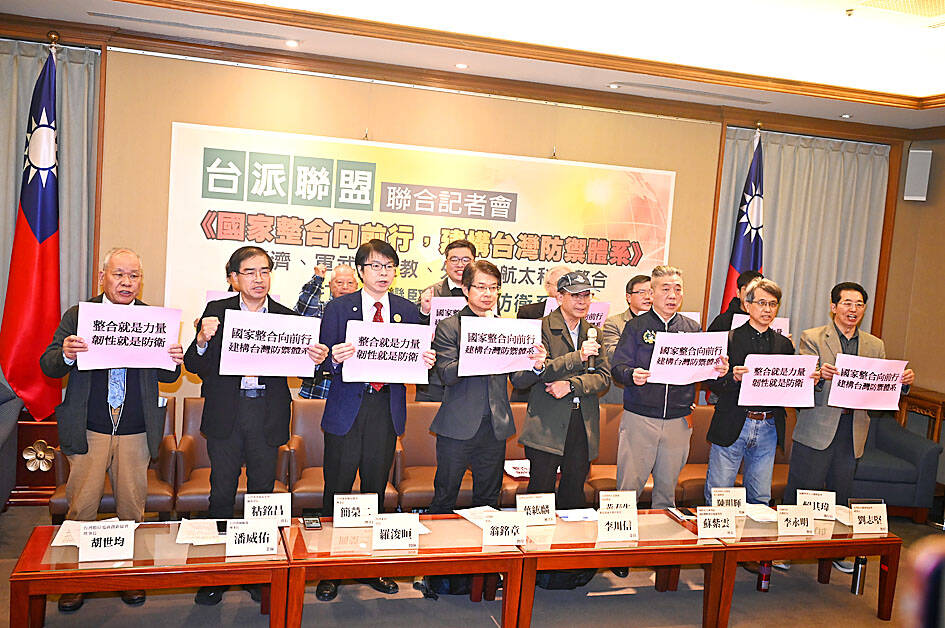
Photo: Wang Yi-sung, Taipei Times
The Chinese Nationalist Party (KMT) and Taiwan People’s Party are on a path of “pro-China, anti-US” policies, which sends the wrong message internationally, he said.
Defense analyst Su Szu-yun (蘇紫雲) said that maintaining strong national defense is a nonpartisan issue that all parties should support, while the US Congress passed a defense bill, allocating US$1.15 billion for security cooperation with Taiwan.
Su said that in its latest National Security Strategy the US clearly said it aims to bolster Taiwan’s self-defense to deter assault by a foreign state.
Many democratic countries are concerned with Taiwan’s situation, and American Institute in Taiwan Director Raymond Greene has stressed that “freedom is not free,” Su added.
Among the items sought with the defense budget, most important is the “T-Dome,” he said.
“To invest in the ‘T-Dome’ is to invest in security and peace,” Su said.
The “T-Dome” is an air-defense architecture that coordinates sensors in a certain volume of airspace, detecting threats and allocating defensive fires against incoming aircraft or missiles at speeds human senses cannot match, he said.
It is vital for Taiwan to strengthen its defensive and combat capabilities, proving to the community that the country would fight to defend itself so that other countries would stand with Taiwan in the case of a conflict, Su said.
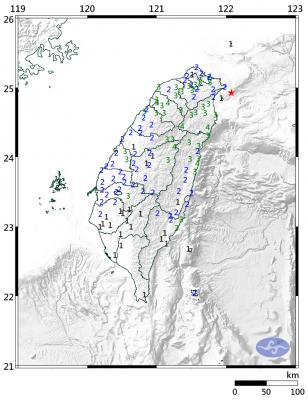
A magnitude 6.1 earthquake struck off the coast of Yilan County at 8:39pm tonight, the Central Weather Administration (CWA) said, with no immediate reports of damage or injuries. The epicenter was 38.7km east-northeast of Yilan County Hall at a focal depth of 98.3km, the CWA’s Seismological Center said. The quake’s maximum intensity, which gauges the actual physical effect of a seismic event, was a level 4 on Taiwan’s 7-tier intensity scale, the center said. That intensity level was recorded in Yilan County’s Nanao Township (南澳), Hsinchu County’s Guansi Township (關西), Nantou County’s Hehuanshan (合歡山) and Hualien County’s Yanliao (鹽寮). An intensity of 3 was
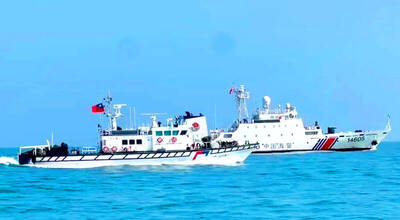
Instead of focusing solely on the threat of a full-scale military invasion, the US and its allies must prepare for a potential Chinese “quarantine” of Taiwan enforced through customs inspections, Stanford University Hoover fellow Eyck Freymann said in a Foreign Affairs article published on Wednesday. China could use various “gray zone” tactics in “reconfiguring the regional and ultimately the global economic order without a war,” said Freymann, who is also a nonresident research fellow at the US Naval War College. China might seize control of Taiwan’s links to the outside world by requiring all flights and ships entering or leaving Taiwan
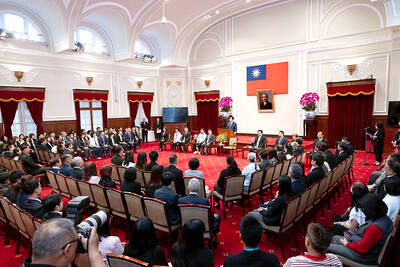
The next minimum wage hike is expected to exceed NT$30,000, President William Lai (賴清德) said yesterday during an award ceremony honoring “model workers,” including migrant workers, at the Presidential Office ahead of Workers’ Day today. Lai said he wished to thank the awardees on behalf of the nation and extend his most sincere respect for their hard work, on which Taiwan’s prosperity has been built. Lai specifically thanked 10 migrant workers selected for the award, saying that although they left their home countries to further their own goals, their efforts have benefited Taiwan as well. The nation’s industrial sector and small businesses lay
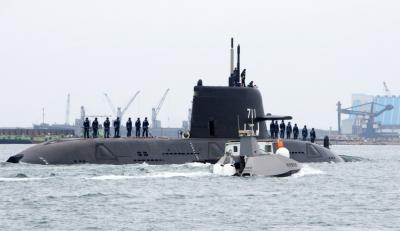
Taiwan's first indigenous defense submarine, the SS-711 Hai Kun (海鯤, or Narwhal), departed for its 13th sea trial at 7am today, marking its seventh submerged test, with delivery to the navy scheduled for July. The outing also marked its first sea deployment since President William Lai (賴清德) boarded the submarine for an inspection on March 19, drawing a crowd of military enthusiasts who gathered to show support. The submarine this morning departed port accompanied by CSBC Corp’s Endeavor Manta (奮進魔鬼魚號) uncrewed surface vessel and a navy M109 assault boat. Amid public interest in key milestones such as torpedo-launching operations and overnight submerged trials,


 RSS
RSS