


US Deputy Secretary of Health and Human Services Jim O’Neill last week said that the WHO ignored early COVID-19 warnings from Taiwan, as part of justification for the US withdrawing from the global health body.
US Secretary of State Marco Rubio on Thursday said that the US was withdrawing from the WHO, as the organization failed to fulfill its responsibilities during the COVID-19 pandemic.
In a post on X on Friday last week, Taiwan time, O’Neill said that the WHO “ignored early COVID warnings from Taiwan in 2019 by pretending Taiwan did not exist. It ignored rigorous science and promoted lockdowns.”
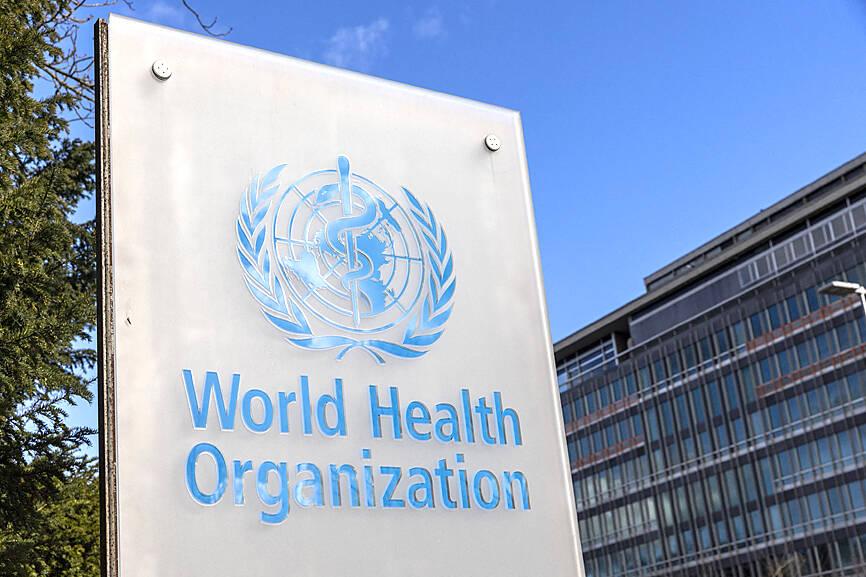
Photo: Reuters
The US would “continue international coordination on infectious disease without the Eurocrats in Geneva,” he added.
WHO COVID-19 technical lead Maria Van Kerkhove on Saturday responded to the post, calling it “all untrue.”
The WHO detected the Wuhan, China, outbreak signal on Dec. 31, 2019, Kerkhove said.
“Taiwan didn't warn us: they asked for information the same day,” she wrote. “We have not ignored Taiwan, we don't ignore science and WHO never recommended lockdowns.”
Taiwan’s Centers for Disease Control (CDC) on Dec. 31, 2019, learned that at least seven cases of atypical pneumonia had occurred in Wuhan, China, then-Central Epidemic Command Center (CECC) spokesperson Chuang Jen-hsiang (莊人祥) said in April 2020.
Drawing on its experience from the SARS outbreak, the CDC reached out to the WHO via e-mail that day requesting more details, Chuang said.
The WHO on April 11, 2020, said that it had not ignored Taiwan’s warnings about COVID-19, adding that Taiwan’s e-mail at the time did not mention the risk of human-to-human transmission.
Then-CECC head Chen Shih-chung (陳時中) said that although Taiwan did not explicitly state the risk of human-to-human transmission, it implied this by emphasizing that all cases were isolated for treatment.
Chen released his Dec. 31, 2019, e-mail to the WHO in April 2020. It reads as follows:
“News resources today indicate that at least seven atypical pneumonia cases were reported in Wuhan, CHINA. Their health authorities replied to the media that the cases were believed not SARS; however the samples are still under examination, and cases have been isolated for treatment.
“I would greatly appreciate it if you have relevant information to share with us.
“Thank you very much in advance for your attention to this matter.”
Separately yesterday, former Japan Self-Defense Forces chief of staff Shigeru Iwasaki said that Taiwan proactively provided Japan with information about the COVID-19 outbreak at the end of 2019, playing an important role in Japan’s decision-making.
Japan knew next to nothing about the COVID-19 outbreak at the end of 2019, while Taiwan detected early warning signs and proactively provided Japan with information, the Executive Yuan consultant said at a meeting of the All Japan Taiwanese Union.
Iwasaki said that when he traveled to Taiwan in January 2020, he was immediately briefed on the situation by Ministry of National Defense and health officials.
Taiwan had already detected an unknown virus emerging in China and asked whether Japan had any relevant information, he said.
Iwasaki was then serving as an advisor to the Japanese government and contacted then-chief cabinet secretary Yoshihide Suga, only to hear: “We know nothing,” he said.
In contrast, Taiwan held an emergency meeting on Jan. 2, 2020, and implemented border and disease-control measures before the outbreak gained international attention, he added.
Many of Japan’s COVID-19 response measures relied on key information provided by Taiwan, which played an important role in Japan’s assessments and decision-making, Iwasaki said.
Taiwan has helped Japan tremendously, but Japan has never properly reciprocated, he said, adding that he hopes to promote more tangible cooperation between the two nations.
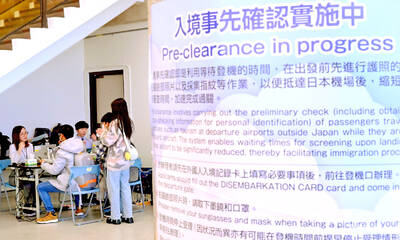
A preclearance service to facilitate entry for people traveling to select airports in Japan would be available from Thursday next week to Feb. 25 at Taiwan Taoyuan International Airport, Taoyuan International Airport Corp (TIAC) said on Tuesday. The service was first made available to Taiwanese travelers throughout the winter vacation of 2024 and during the Lunar New Year holiday. In addition to flights to the Japanese cities of Hakodate, Asahikawa, Akita, Sendai, Niigata, Okayama, Takamatsu, Kumamoto and Kagoshima, the service would be available to travelers to Kobe and Oita. The service can be accessed by passengers of 15 flight routes operated by

GIVE AND TAKE: Blood demand continues to rise each year, while fewer young donors are available due to the nation’s falling birthrate, a doctor said Blood donors can redeem points earned from donations to obtain limited edition Formosan black bear travel mugs, the Kaohsiung Blood Center said yesterday, as it announced a goal of stocking 20,000 units of blood prior to the Lunar New Year. The last month of the lunar year is National Blood Donation Month, when local centers seek to stockpile blood for use during the Lunar New Year holiday. The blood demand in southern Taiwan — including Tainan and Kaohsiung, as well as Chiayi, Pingtung, Penghu and Taitung counties — is about 2,000 units per day, the center said. The donation campaign aims to boost
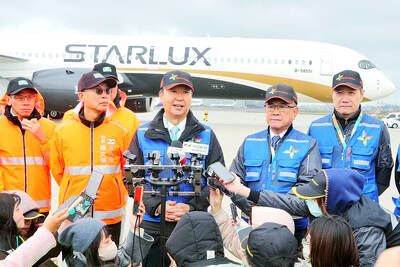
ENHANCING EFFICIENCY: The apron can accommodate 16 airplanes overnight at Taoyuan airport while work on the third runway continues, the transport minister said A new temporary overnight parking apron at Taiwan Taoyuan International Airport is to start operating on Friday next week to boost operational efficiency while the third runway is being constructed, the Ministry of Transportation and Communications said yesterday. The apron — one of the crucial projects in the construction of the third runway — can accommodate 16 aircraft overnight at the nation’s largest international airport, Minister of Transportation and Communications Chen Shih-kai (陳世凱) told reporters while inspecting the new facility yesterday morning. Aside from providing the airport operator with greater flexibility in aircraft parking during the third runway construction,
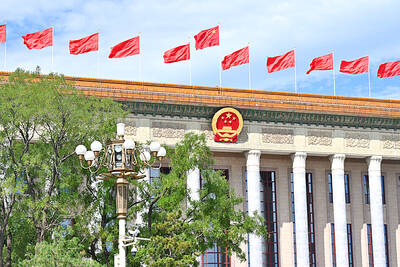
MORE FALL: An investigation into one of Xi’s key cronies, part of a broader ‘anti-corruption’ drive, indicates that he might have a deep distrust in the military, an expert said China’s latest military purge underscores systemic risks in its shift from collective leadership to sole rule under Chinese President Xi Jinping (習近平), and could disrupt its chain of command and military capabilities, a national security official said yesterday. If decisionmaking within the Chinese Communist Party has become “irrational” under one-man rule, the Taiwan Strait and the regional situation must be approached with extreme caution, given unforeseen risks, they added. The anonymous official made the remarks as China’s Central Military Commission Vice Chairman Zhang Youxia (張又俠) and Joint Staff Department Chief of Staff Liu Zhenli (劉振立) were reportedly being investigated for suspected “serious


 RSS
RSS