


China’s new standardized contract for tours to Taiwan failed to address crucial issues impeding normal tourism exchanges across the Taiwan Strait, the Mainland Affairs Council (MAC) said yesterday.
The contract, issued by the Chinese Ministry of Culture and Tourism on Monday, requires Chinese tourists to abide by Taiwanese laws, customs and regulations, and to protect tourism resources and the environment while traveling.
It also prohibits travel agencies from attracting tourists through low-priced tours, or generating improper profits through organized shopping excursions or imposing additional charges on tourists.

Photo: Chen Yu-fu, Taipei Times
The contract, which is scheduled to be implemented on March 31, is perceived by some as goodwill from Beijing to resume cross-strait tourism.
“The new contract shows that Beijing is not unwilling to resume tours to Taiwan, but it has not responded to our requests for negotiations over how it should proceed,” MAC Deputy Minister Liang Wen-chiang (梁文傑) said. “The interaction between Taiwan and China is like playing table tennis, which has no way to continue if China did not return the serve.”
Beijing has regularly updated terms of the contract since 2014, Liang said, adding that the contract was last updated in 2024.
China failed to address the council’s main concern, he said.
“What we care about the most is the stability of cross-strait tourism. As we have seen in the situation in Japan last year, the Chinese government could simply stop the tours to Japan, even though travel agencies in both countries had signed contracts,” Liang said.
“This would affect not only our travel agencies, but also our hoteliers and tour bus operators, who would sustain tremendous financial losses,” he said, adding that cross-strait tourism should be free from political intervention.
Beijing’s hostile actions have made it almost impossible for the government to allow group travel to China, such as the issuance of a 22-point set of “guidelines” penalizing Taiwanese “independence separatists” and adding Taiwanese officials to its list of “Taiwanese independence diehards,” he said.
Regarding the about 5.44 million Taiwanese who traveled between China and Taiwan last year — 1 million more than in 2024 — Liang said that Beijing’s number exceeded Taiwan’s official figure by 1.66 million, as it calculated Taiwanese entering through Taiwan, Hong Kong, Macau, Japan, Singapore, Southeast Asia and the US.
“The council’s priority is maintaining the order of cross-strait exchanges, rather than the number of Chinese visitors. That is the Tourism Administration’s business,” he said.
Liang also commented on criticism from China’s Taiwan Affairs Office about the Taiwan-US trade deal that was finalized last week, which called it an “indentured servitude contract.”
Then-Chinese premier Li Keqiang (李克強) in 2020 said that 600 million Chinese lived on a monthly salary of less than 1,000 yuan (US$143.30), and latest data on their monthly salaries have risen to 1,300 yuan, he said.
“And yet, we have seen that China’s foreign aid and loans to other countries could potentially exceed US$1.5 trillion. Why does China not use this huge amount of funds to improve the lives of its own people?” Liang said. “Taiwan and China have different economic issues, and China should focus on handling theirs.”
In other news, Liang said the government has identified two Hong Kongers as suspects in a case of vandalism involving Hong Kong pro-democracy activist Tang Wei-hung (湯偉雄).
Tang, who owns a Thai boxing gym in Taiwan, was placed on a “wanted list” by the Hong Kong government on Nov. 20 last year for participating in anti-extradition bill protests.
The vandalism occurred three days after the wanted list was issued, during which the gym’s surveillance camera and main entrance were damaged.
Police have identified two main suspects from Hong Kong, who scouted the location before committing the crime and left Taiwan immediately after, Liang said.
“The criminal act was meant to be a scare tactic to intimidate Tang and other Hong Kongers in Taiwan. The government would not tolerate anyone who complies with the Chinese Communist Party to conduct extraterrestrial repressions against Hong Kongers in Taiwan,” he added.

FUKUOKA SITUATION: Japanese media reported that the pathogen is expected to be identified by the summer, while the CDC downplayed the idea that it was hMPV A “mysterious cold-like illness” reported in Japan’s Fukuoka Prefecture does not seem to be a new disease, but Japanese authorities have been asked about the situation, the Centers for Disease Control (CDC) said yesterday. The Fukuoka Prefectural Medical Association on Wednesday told a news conference that a “mystery cold” that has become a hot topic on social media is “highly likely to be caused by some kind of viral infection,” Japan’s KBC News reported. “Many people are experiencing symptoms starting with a sore throat, followed by a runny nose, phlegm and a severe cough,” KBC News reported, citing association officials. Health authorities are

Nvidia Corp CEO Jensen Huang (黃仁勳) arrived in Taiwan yesterday ahead of upcoming AI and technology events, saying he plans to meet with clients and Taiwan Semiconductor Manufacturing Co Chairman C.C. Wei (魏哲家) during his visit. After landing at Taipei Songshan Airport, Huang posed for photos with fans and handed out Yakult drinks to reporters and supporters waiting at the scene, saying he has “a lot to do” during the trip. Asked about reports that Nvidia’s planned headquarters site in Taipei’s Beitou Shilin Technology Park could break ground on May 27, Huang said that if the company holds an event, he would

The Ministry of Finance this afternoon announced the winning numbers for the March-April uniform invoice lottery. The winning number for the NT$10 million (US$318,060) special prize is 19531471, and the winning number for the NT$2 million grand prize is 85941329. Three numbers were drawn for the NT$200,000 first prize: 07225810, 20231230 and 83518781. Those with receipts matching the last seven digits of any of the first-prize numbers will win the NT$40,000 second prize, while those matching the last six digits will win the NT$10,000 third prize. Those whose receipts match the last five digits of the first-prize numbers can claim the NT$4,000 fourth prize,
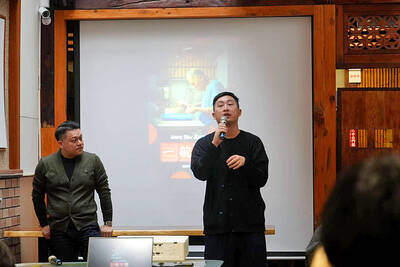
Taiwan Travelogue (臺灣漫遊錄), which earlier this week became the first Taiwanese novel to win the International Booker Prize, is to be adapted into a television series through a Taiwan-Japan coproduction, producer Chang Chen-yu (張辰漁) said yesterday. Chang, a producer at World Softest Production Film Co, wrote on Facebook that the company had been searching for projects with international appeal that retain a strong Taiwanese identity after colleagues and Japanese partners strongly recommended the novel. After reading the book, Chang said he immediately decided to pursue the screen rights. “A great story has the power to transcend time and borders, and connect countless people,”


 RSS
RSS