


The Ministry of Education’s Primary and Secondary School International Educational Exchange Alliance on Monday signed a memorandum of understanding (MOU) with Japan’s Kumamoto Prefecture to deepen bilateral education exchanges in sustainability issues and semiconductors.
Local schools have launched semiconductor programs and collaborated with local industries on designing curricula following the establishment of a wafer fab in the prefecture by Taiwan Semiconductor Manufacturing Co.
To deepen education exchanges with Taiwan, the Kumamoto Prefectural Board of Education invited the alliance to sign the MOU at the Kumamoto Prefectural Office at the end of last year, the ministry said.
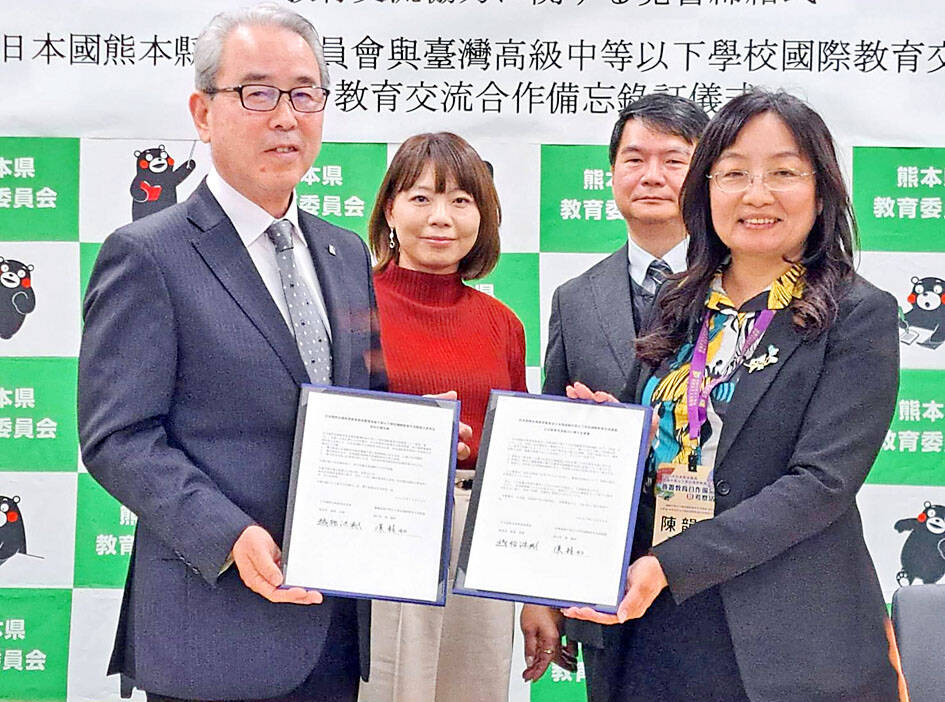
Photo courtesy of the Ministry of Education
The MOU was signed by National Tainan Chia-Chi Senior High School principal Chen Yun-ju (陳韻如) and board superintendent Hiroki Ooi.
Other attendees included K-12 Education Administration Chief Secretary Huang Ching-yi (黃?儀) and Wang Hung-ming (王鴻鳴), an official from the Fukuoka branch of the Taipei Economic and Cultural Office in Osaka.
Japan is the country with most sister schools in Taiwan, at least 290, showing that both sides have established solid ties as education partners, the ministry said.
Ministry data showed that education exchanges between the two nations are common, with about 450 elementary and secondary schools in Taiwan, or about 25,000 students and teachers from Taiwan, participating in such events in 2024 and last year.
About 200 Taiwanese schools and about 15,000 students engaged in online exchanges with Japanese schools in the two-year period, the data showed.
K-12 Education Administration Director-General Sun Min-yi (孫旻儀) said the prefecture is the fourth Japanese local government — following Chiba, Miyagi and Shizuoka prefectures — to sign an education MOU with the alliance.
The cooperation between the alliance and Kumamoto centers on training international talent, Sun said.
The MOU is aimed at facilitating exchanges and research on semiconductors and sustainable development goals-related environmental issues, especially for senior-high students, she said.
Students are encouraged to conduct international research and collaborations to deepen their learning, and broaden their understanding of the social and cultural contexts of different countries, she said.
More exchange opportunities would be developed, Sun said, adding that Taiwanese schools are encouraged to build sister-school relationships with those in Kumamoto Prefecture to explore diverse collaboration modes.
Her agency would continue to integrate resources and mechanisms for bilateral collaborations to help schools align with global trends, thereby supporting students to cultivate global competence through participation in international exchanges, Sun added.
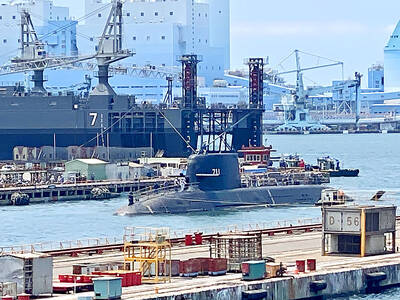
AGING: While Japan has 22 submarines, Taiwan only operates four, two of which were commissioned by the US in 1945 and 1946, and transferred to Taiwan in 1973 Taiwan would need at least 12 submarines to reach modern fleet capabilities, CSBC Corp, Taiwan chairman Chen Cheng-hung (陳政宏) said in an interview broadcast on Friday, citing a US assessment. CSBC is testing the nation’s first indigenous defense submarine, the Hai Kun (海鯤, Narwhal), which is scheduled to be delivered to the navy next month or in July. The Hai Kun has completed torpedo-firing tests and is scheduled to undergo overnight sea trials, Chen said on an SET TV military affairs program. Taiwan would require at least 12 submarines to establish a modern submarine force after assessing the nation’s operational environment and defense
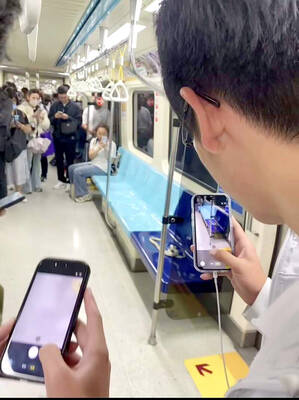
A white king snake that frightened passengers and caused a stir on a Taipei MRT train on Friday evening has been claimed by its owner, who would be fined, Taipei Rapid Transit Corp (TRTC) said yesterday. A person on Threads posted that he thought he was lucky to find an empty row of seats on Friday after boarding a train on the Bannan (Blue) Line, only to spot a white snake with black stripes after sitting down. Startled, he jumped up, he wrote, describing the encounter as “terrifying.” “Taipei’s rat control plan: Release snakes on the metro,” one person wrote in reply, referring
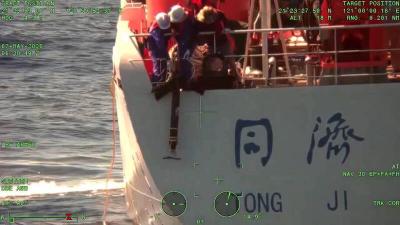
The coast guard today said that it had disrupted "illegal" operations by a Chinese research ship in waters close to the nation and driven it away, part of what Taipei sees a provocative pattern of China's stepped up maritime activities. The coast guard said that it on Thursday last week detected the Chinese ship Tongji (同濟號), which was commissioned only last year, 29 nautical miles (54km) southeast of the southern tip of Taiwan, although just outside restricted waters. The ship was observed lowering ropes into the water, suspected to be the deployment of scientific instruments for "illegal" survey operations, and the coast
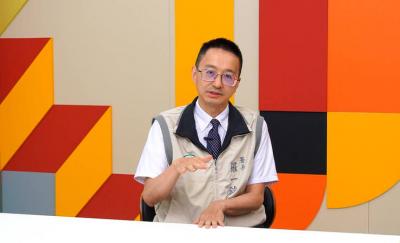
Taiwan’s two cases of hantavirus so far this year are on par with previous years’ case numbers, and the government is coordinating rat extermination work, so there should not be any outbreaks, Centers for Disease Control (CDC) Director-General Philip Lo (羅一鈞) said today in an interview with the Liberty Times (the Taipei Times’ sister newspaper). An increase in rat sightings in Taipei and New Taipei City has raised concerns about the spread of hantavirus, as rats can carry the disease. In January, a man in his 70s who lived in Taipei’s Daan District (大安) tested positive posthumously for hantavirus, Taiwan’s


 RSS
RSS