


The Kaohsiung branch of the High Court today sentenced a Chinese spouse to eight years in prison for creating immigrant associations sponsored by Chinese “united front” groups, overturning its previous acquittal after the Supreme Court remanded the case for a retrial.
The court sentenced Zhou Manzhi (周滿芝) to eight years for contravening the National Security Act (國家安全法).
The ruling may be appealed.

Photo: CNA
As chair of the Taiwan New Residents Care Association, Zhou was accused of acting under the direction of Chinese organizations — including the Shaanxi Patriotic Volunteer Association — to develop organizations in Taiwan.
The Kaohsiung branch of the High Court previously acquitted Zhou due to insufficient evidence.
Zhou obtained residency in Taiwan in 2004 after marrying a Taiwanese man.
She was a member of the Shaanxi Patriotic Volunteer Association and the China Patriotic Volunteer Association, civilian groups commissioned by the Chinese Communist Party’s United Front Work Department, the High Court said.
She established the Kaohsiung New Residents Sisters Care Association in 2016 and the Taiwan New Residents Care Association in 2019, it said.
As a member of the United Front Committee and the Shaanxi Patriotic Volunteer Association, she became acquainted with the groups' chief executive, Cui Guowei (崔國衛), who instructed her to form the auxiliary organizations in Taiwan, the court said.
In 2017, Zhou traveled to China to meet with Huang Lanxiang (黃蘭香), head of the United Front Committee’s Hunan Province division, to seek assistance and sponsorship to form the organizations, although her request for a meeting was denied, it said.
In 2018, she again went to China to meet with Cui and signed a declaration to promote “one country, two systems” in Taiwan and undergo “united front” work, it found.
The Ciaotou District Prosecutors’ Office previously opened an investigation into Zhou and Hsu Shao-tung (徐少東), former vice chair of the For Public Good Party, a Chinese nationalist right-wing party in Taiwan, who has since become a fugitive.
The two were suspected of contravening the Anti-infiltration Act (反滲透法) and other laws.
Prosecutors then suspected Zhou of forming “united front” organizations and transferred the case to the Kaohsiung High Prosecutors’ Office, as it fell under second-instance jurisdiction.
The Kaohsiung branch of the High Court then consulted the Ministry of Justice’s Investigation Bureau, which initially found that there was no evidence of substantive control or direct links between Chinese authorities and organizations.
Prosecutors also previously failed to prove that Zhou had directly or indirectly received funds or sponsorship from China, or that she had concrete meetings with "united front" officials, thereby finding insufficient evidence for a conviction, the court said.
In its second ruling, the court cited evidence from the National Security Bureau as proving that the Shaanxi Patriotic Volunteer Association is under the control of China’s “united front” apparatus.
It said that Zhou organized the organizations in Taiwan under the instruction of these Chinese organizations and “actively planned and implemented activities with clear ‘united front’ objectives,” posing a threat to national security and social stability.

The Ministry of Finance this afternoon announced the winning numbers for the March-April uniform invoice lottery. The winning number for the NT$10 million (US$318,060) special prize is 19531471, and the winning number for the NT$2 million grand prize is 85941329. Three numbers were drawn for the NT$200,000 first prize: 07225810, 20231230 and 83518781. Those with receipts matching the last seven digits of any of the first-prize numbers will win the NT$40,000 second prize, while those matching the last six digits will win the NT$10,000 third prize. Those whose receipts match the last five digits of the first-prize numbers can claim the NT$4,000 fourth prize,

SIX SUBSIDIES: The monthly allowance for older farmers is to increase to NT$10,000, and NT$5,000 is to be given to homemakers under the national pension system, Lai said The government is to implement major welfare policies for disadvantaged groups, including raising the monthly allowance for older farmers to NT$10,000 and providing homemakers with NT$5,000 per month, President William Lai (賴清德) said yesterday. Lai made the remarks during a visit to Wangling Temple in Chiayi County, saying that the planned increases were being introduced amid economic growth and an increase in tax revenue. Touting a policy, in which the government plans to provide a monthly allowance of NT$5,000 for every child under the age of 18 in a bid to address Taiwan’s low birthrate, Lai said that if received for the
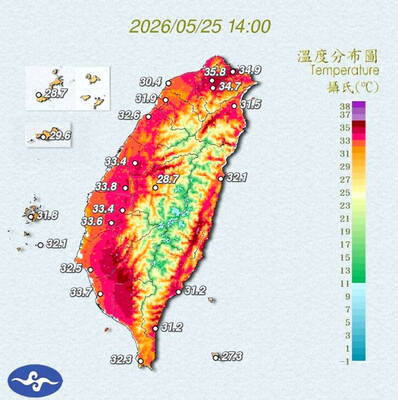
STAY COOL: The HPA recommended that people stay hydrated, use air-conditioning or fans while indoors, wear loose-fitting clothes and walk in the shade while outdoors Employers must implement measures such as installing cooling equipment, and providing drinking water and rest breaks for outdoor workers starting from Monday next week, the Taipei Department of Labor said on Sunday. Employers who fail to comply could face fines of NT$30,000 to NT$300,000 under the Occupational Safety and Health Act (職業安全衛生法), the department said. Businesses in Taipei employing fewer than 100 workers, as well as registered self-employed workers with labor insurance coverage, could receive on-site assessments and guidance from occupational safety consultants to help them apply for central government subsidies to implement or improve heat-protection measures, it said. Under the Ministry of
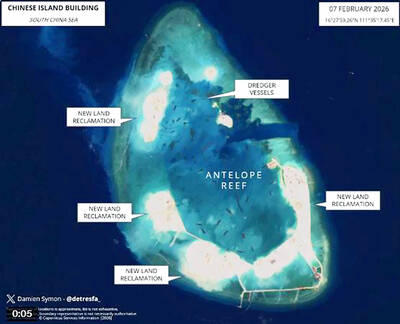
ISOLATION: The outposts would serve as support and backup bases, forcing US forces to either face China head-on or reroute, increasing travel time and operational costs China’s outposts in the South China Sea could be used to delay and constrain foreign forces during a conflict in the Taiwan Strait, giving Beijing a critical window to carry out amphibious landing and blockade operations, a report said. The Chinese Communist Party’s (CCP) forward operating bases on islands and reclaimed features in the South China Sea could delay foreign forces long enough for the Chinese People’s Liberation Army (PLA) to secure a key 48-to-72-hour window in the Taiwan Strait, a report commissioned by the Mainland Affairs Council found. The report, conducted by the Institute for National Defense and Security Research, examined


 RSS
RSS