


After a tariff agreement was reached this week addressing key economic issues, Taiwan and the US can now focus more on security cooperation in the Indo-Pacific region, a former White House official said on Friday.
Alexander Gray, who served as deputy assistant to the president and chief of staff of the US National Security Council during US President Donald Trump’s first term, made the comments in an interview with the Central News Agency.
Gray called the trade deal a “very positive development in the US-Taiwan relationship,” as Washington has had several disagreements with Taiwan on trade matters over the years, going back to the first Trump administration.
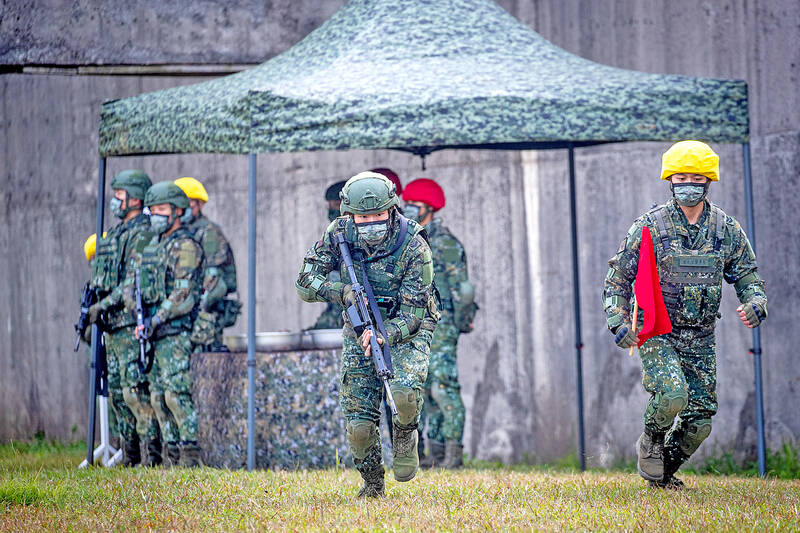
Photo: Ritchie B. Tongo, EPA
The deal is a step toward resolving US concerns about semiconductor imports, which have long been a major source of friction between the two sides, he said.
However, with the issue taken off the table for the time being, “there’s a huge opportunity for the US and Taiwan to focus on strengthening our partnership and security, strengthening our regional collaboration and deterrence in the Indo-Pacific,” he added.
The Executive Yuan on Friday said the US agreed to lower tariffs on Taiwanese goods from 20 percent to 15 percent, without stacking them on existing most-favored-nation rates.
Meanwhile, Taiwanese semiconductor, electronics manufacturing services, artificial intelligence and energy companies would invest US$250 billion in the US based on their own plans.
Additionally, the government has pledged to provide up to US$250 billion in credit guarantees for financial institutions to support investments the semiconductor, and information and communications technology sectors would make in the US.
Gray, CEO of American Global Strategies, an international strategic advisory firm, said the arms deal that was approved and sent to Taiwan late last year sends a “great signal” to Beijing that the US remains steadfast in following the Taiwan Relations Act and the Six Assurances.
The US government last month announced the potential sale of eight arms packages to Taiwan, including M142 High Mobility Artillery Rocket Systems, anti-tank missiles and drones, at an estimated total cost of US$11.1 billion.
Gray said he hoped the deal leads to more arms sales over the coming year, but acknowledged that the US has a significant delivery backlog in arms deliveries to Taiwan.
As the US works to expand its defense industrial base, the country needs to make sure that it is “not just doing new sales, but actually delivering on the weapons Taiwan has already purchased,” he added.
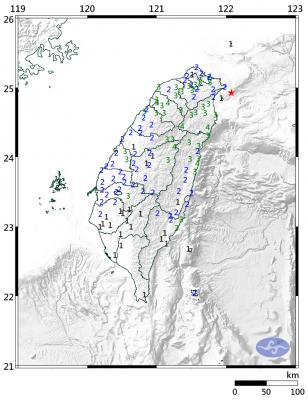
A magnitude 6.1 earthquake struck off the coast of Yilan County at 8:39pm tonight, the Central Weather Administration (CWA) said, with no immediate reports of damage or injuries. The epicenter was 38.7km east-northeast of Yilan County Hall at a focal depth of 98.3km, the CWA’s Seismological Center said. The quake’s maximum intensity, which gauges the actual physical effect of a seismic event, was a level 4 on Taiwan’s 7-tier intensity scale, the center said. That intensity level was recorded in Yilan County’s Nanao Township (南澳), Hsinchu County’s Guansi Township (關西), Nantou County’s Hehuanshan (合歡山) and Hualien County’s Yanliao (鹽寮). An intensity of 3 was
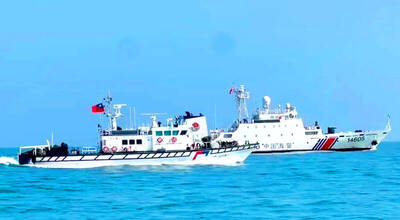
Instead of focusing solely on the threat of a full-scale military invasion, the US and its allies must prepare for a potential Chinese “quarantine” of Taiwan enforced through customs inspections, Stanford University Hoover fellow Eyck Freymann said in a Foreign Affairs article published on Wednesday. China could use various “gray zone” tactics in “reconfiguring the regional and ultimately the global economic order without a war,” said Freymann, who is also a nonresident research fellow at the US Naval War College. China might seize control of Taiwan’s links to the outside world by requiring all flights and ships entering or leaving Taiwan
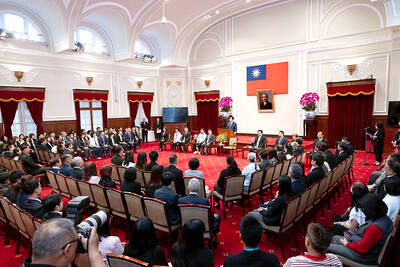
The next minimum wage hike is expected to exceed NT$30,000, President William Lai (賴清德) said yesterday during an award ceremony honoring “model workers,” including migrant workers, at the Presidential Office ahead of Workers’ Day today. Lai said he wished to thank the awardees on behalf of the nation and extend his most sincere respect for their hard work, on which Taiwan’s prosperity has been built. Lai specifically thanked 10 migrant workers selected for the award, saying that although they left their home countries to further their own goals, their efforts have benefited Taiwan as well. The nation’s industrial sector and small businesses lay
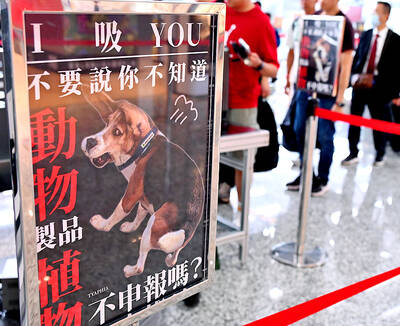
Quarantine awareness posters at Taiwan Taoyuan International Airport have gone viral for their use of wordplay. Issued by the airport branch of the Animal and Plant Health Inspection Agency, the posters feature sniffer dogs making a range of facial expressions, paired with advisory messages built around homophones. “We update the messages for holidays and campaign needs, periodically refreshing materials to attract people’s attention,” quarantine officials said. “The aim is to use the dogs’ appeal to draw focus to quarantine regulations.” A Japanese traveler visiting Taiwan has posted a photo on X of a poster showing a quarantine dog with a


 RSS
RSS