


There are likely tactical implications when comparing the recent incursion of a Chinese military drone into the airspace of the Taiwan-controlled Pratas Islands (Dongsha, 東沙群島) and a report last year on China building oil rigs within Taiwan’s exclusive economic zone (EEZ) around that island.
The Ministry of National Defense on Saturday said a Chinese People’s Liberation Army (PLA) surveillance and reconnaissance drone was detected entering the territorial airspace of the Pratas Islands at 5:44am, and then left a few minutes later, after the military broadcast a warning through an international channel.
The Jamestown Foundation think tank in a report published in September last year said that oil rigs could serve as relay stations for drone communications, and that China’s oil rigs around the Pratas Islands are boosting its “kill chain,” as well as its command, control, communications, computers, cyber, intelligence, surveillance, reconnaissance and targeting (C5ISRT) capabilities.
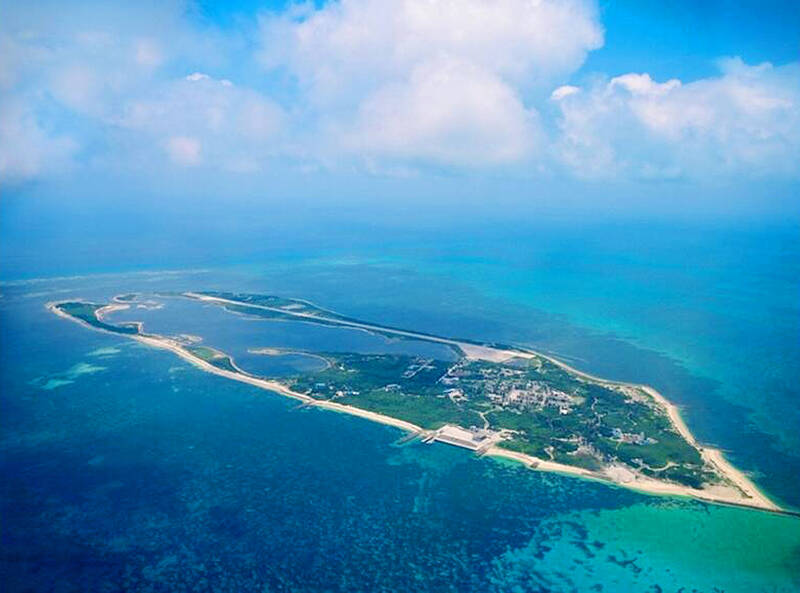
Photo courtesy of Chen Ching-neng
China has 12 oil rigs around Pratas Islands, owned by the China National Offshore Oil Company (CNOOC), including seven rig structures, three floating production storage and offloading vessels, and two semi-submersible oil platforms, it said.
These state-owned structures have dual-use potential and “may be more valuable for constraining Taiwan’s space than for their nominal commercial purpose of extracting oil,” the report said.
These structures could be integrated into the state-owned China Electronics Technology Group Corp’s “Blue Ocean Information Network,” functioning as relay stations for drone communications, and “facilitate a full range of coercion, blockade, bombardment and/or invasion scenarios against Pratas or Taiwan more generally,” it said.
Then-CNOOC chairman Wang Yilin (王宜林) in 2012 said “large-scale deep-water rigs are our mobile national territory and a strategic weapon,” the report said, warning that oil rigs “advance territorial claims, establish creeping jurisdictional presence in contested spaces and shape the operational environment in Beijing’s favor without open conflict — often under the guise of commercial activity.”
Although these actions are nominally commercial, they are a classic example of China’s “gray zone” threats, Institute for National Defense and Security Research assistant research fellow Alice Yang (楊長蓉) said.
On the surface, they are tools for developing resources, but they could also be used to gather intelligence and deploy the military, Yang said.
Establishing offshore platforms inside Taiwan’s EEZ without permission infringes on UN law, but Taiwan cannot dispute this, as it is not a UN member, she added.
In addition to diplomatic protests, Taiwan should respond to China’s drone and platform incursions by clarifying domestic laws, coordinating with agencies and bolstering international legal arguments to better protect key maritime resources, Yang said.

FUKUOKA SITUATION: Japanese media reported that the pathogen is expected to be identified by the summer, while the CDC downplayed the idea that it was hMPV A “mysterious cold-like illness” reported in Japan’s Fukuoka Prefecture does not seem to be a new disease, but Japanese authorities have been asked about the situation, the Centers for Disease Control (CDC) said yesterday. The Fukuoka Prefectural Medical Association on Wednesday told a news conference that a “mystery cold” that has become a hot topic on social media is “highly likely to be caused by some kind of viral infection,” Japan’s KBC News reported. “Many people are experiencing symptoms starting with a sore throat, followed by a runny nose, phlegm and a severe cough,” KBC News reported, citing association officials. Health authorities are

Nvidia Corp CEO Jensen Huang (黃仁勳) arrived in Taiwan yesterday ahead of upcoming AI and technology events, saying he plans to meet with clients and Taiwan Semiconductor Manufacturing Co Chairman C.C. Wei (魏哲家) during his visit. After landing at Taipei Songshan Airport, Huang posed for photos with fans and handed out Yakult drinks to reporters and supporters waiting at the scene, saying he has “a lot to do” during the trip. Asked about reports that Nvidia’s planned headquarters site in Taipei’s Beitou Shilin Technology Park could break ground on May 27, Huang said that if the company holds an event, he would

The Ministry of Finance this afternoon announced the winning numbers for the March-April uniform invoice lottery. The winning number for the NT$10 million (US$318,060) special prize is 19531471, and the winning number for the NT$2 million grand prize is 85941329. Three numbers were drawn for the NT$200,000 first prize: 07225810, 20231230 and 83518781. Those with receipts matching the last seven digits of any of the first-prize numbers will win the NT$40,000 second prize, while those matching the last six digits will win the NT$10,000 third prize. Those whose receipts match the last five digits of the first-prize numbers can claim the NT$4,000 fourth prize,

SIX SUBSIDIES: The monthly allowance for older farmers is to increase to NT$10,000, and NT$5,000 is to be given to homemakers under the national pension system, Lai said The government is to implement major welfare policies for disadvantaged groups, including raising the monthly allowance for older farmers to NT$10,000 and providing homemakers with NT$5,000 per month, President William Lai (賴清德) said yesterday. Lai made the remarks during a visit to Wangling Temple in Chiayi County, saying that the planned increases were being introduced amid economic growth and an increase in tax revenue. Touting a policy, in which the government plans to provide a monthly allowance of NT$5,000 for every child under the age of 18 in a bid to address Taiwan’s low birthrate, Lai said that if received for the


 RSS
RSS