


Democratic Progressive Party (DPP) Legislator Wu Pei-yi (吳沛憶), in collaboration with the Taiwan Veterinary Medical Association and civic group Watchout, on Friday presented the animal edition of the National Public Safety Guide, which aims to help the public prepare for evacuating animals during disasters.
As the number of households with animals continues to grow, ensuring that people and animals can evacuate safely together in the face of sudden disasters, such as earthquakes and typhoons, has become an indispensable part of disaster preparedness, Wu said.
The Legislative Yuan’s All-Out Defense Network is publishing the Animal Companion Disaster Preparedness and Evacuation Handbook to provide the public with knowledge about how to prepare for animal evacuations, she said.

Photo: George Tsorng, Taipei Times
The handbook is available for free online, and is also being distributed to veterinary hospitals and clinics through veterinarians’ associations, she added.
DPP Legislator Su Chiao-hui (蘇巧慧) said that pets are considered part of the family.
The handbook provides practical principles and methods for animal disaster preparedness and evacuation, she said, adding that it would also be educational for people without pets, as they could teach them how to interact with animals during disasters, collectively enhancing Taiwan’s resilience.
Association chairman David Tan (譚大倫) said the handbook covers what to do before a disaster occurs, what items to prepare and how to respond once a disaster happens.
It also includes topics such as animal cardiopulmonary resuscitation, how to stop an animal’s bleeding, how to care for animals during an evacuation and how to help animals recover after a disaster, he added.
Department of Animal Welfare Director Chiang Wen-chuan (江文全) said plans to publish a pet disaster preparedness handbook and a disaster response manual for livestock farms are also underway.
The publication of the Animal Companion Disaster Preparedness and Evacuation Handbook is welcome, as it would help everyone be prepared and know how to respond when incidents occur, Chiang said.
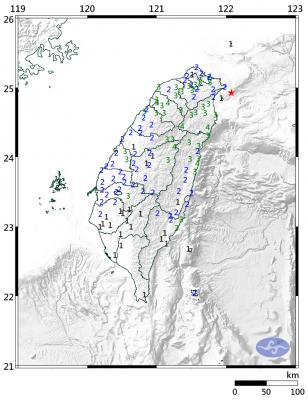
A magnitude 6.1 earthquake struck off the coast of Yilan County at 8:39pm tonight, the Central Weather Administration (CWA) said, with no immediate reports of damage or injuries. The epicenter was 38.7km east-northeast of Yilan County Hall at a focal depth of 98.3km, the CWA’s Seismological Center said. The quake’s maximum intensity, which gauges the actual physical effect of a seismic event, was a level 4 on Taiwan’s 7-tier intensity scale, the center said. That intensity level was recorded in Yilan County’s Nanao Township (南澳), Hsinchu County’s Guansi Township (關西), Nantou County’s Hehuanshan (合歡山) and Hualien County’s Yanliao (鹽寮). An intensity of 3 was
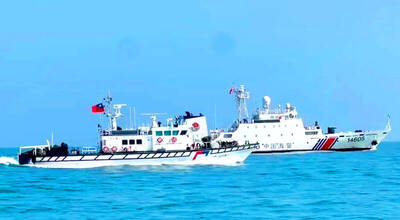
Instead of focusing solely on the threat of a full-scale military invasion, the US and its allies must prepare for a potential Chinese “quarantine” of Taiwan enforced through customs inspections, Stanford University Hoover fellow Eyck Freymann said in a Foreign Affairs article published on Wednesday. China could use various “gray zone” tactics in “reconfiguring the regional and ultimately the global economic order without a war,” said Freymann, who is also a nonresident research fellow at the US Naval War College. China might seize control of Taiwan’s links to the outside world by requiring all flights and ships entering or leaving Taiwan
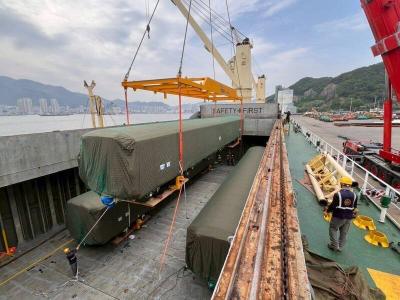
The first of 10 new high-capacity trains purchased from South Korea’s Hyundai Rotem arrived at the Port of Taipei yesterday to meet the demands of an expanding metro network, Taipei Rapid Transit Corp (TRTC) said yesterday. The train completed a three-day, 1,200km voyage from the Port of Masan in South Korea, the company said. Costing NT$590 million (US$18.79 million) each, the new six-carriage trains feature a redesigned interior based on "human-centric" transportation concepts, TRTC said. The design utilizes continuous longitudinal seating to widen the aisles and optimize passenger flow, while also upgrading passenger information displays and driving control systems for a more comfortable
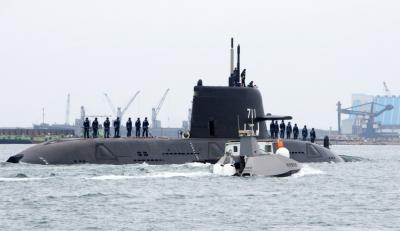
Taiwan's first indigenous defense submarine, the SS-711 Hai Kun (海鯤, or Narwhal), departed for its 13th sea trial at 7am today, marking its seventh submerged test, with delivery to the navy scheduled for July. The outing also marked its first sea deployment since President William Lai (賴清德) boarded the submarine for an inspection on March 19, drawing a crowd of military enthusiasts who gathered to show support. The submarine this morning departed port accompanied by CSBC Corp’s Endeavor Manta (奮進魔鬼魚號) uncrewed surface vessel and a navy M109 assault boat. Amid public interest in key milestones such as torpedo-launching operations and overnight submerged trials,


 RSS
RSS