


The Ministry of Health and Welfare (MOHW) has announced new measures to ease emergency room overcrowding during the upcoming Lunar New Year holiday after Taiwan faced a serious overcrowding strain last year that was called “unprecedented.”
Emergency room visits during the Lunar New Year holiday typically climb to 1.5 to 1.7 times the normal daily average because of visits by mostly noncritical cases, largely driven by cold weather, and gatherings that fuel respiratory infections and viral gastroenteritis, the ministry said.
The situation is also exacerbated by fewer primary care clinics operating.
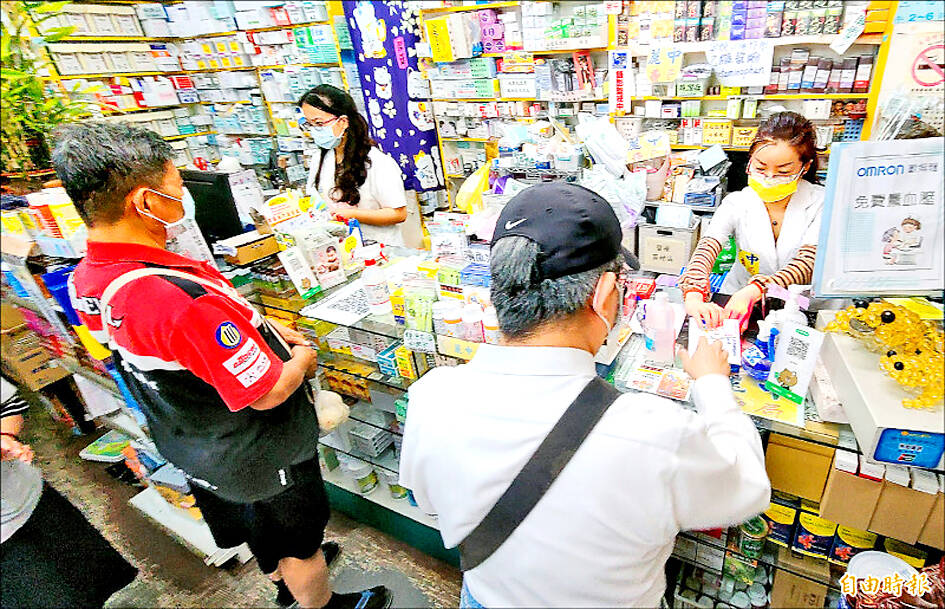
Photo: Taipei Times
Those factors came to a head last year when emergency rooms were so overcrowded, the Taiwan Society of Emergency Medicine described it as “unprecedented.”
To improve access to medical care during this year’s holiday from Feb. 14 to Feb. 22, the ministry said that the 13 urgent care centers nationwide would close only on Lunar New Year’s Eve (Feb. 16) and the second-to-last day of the holiday (Feb. 21).
They are to operate on the other seven days to provide services in internal medicine, general surgery, pediatrics and orthopedics.
Launched in Taiwan’s six major cities in early November last year, the urgent care centers program normally offers medical services from 8am to midnight on Sundays and national holidays to divert non-emergency patients and ease pressure on hospitals.
Deputy Minister of Health and Welfare Chuang Jen-hsiang (莊人祥) said patients with gastrointestinal, infectious or lower respiratory illnesses can also seek care at designated “emergency responsibility hospitals” that are to open infectious disease clinics from the first to the third day of the Lunar New Year (Feb. 17 to Feb. 19).
Emergency responsibility hospitals are facilities designated under a tiered emergency medical system to provide round-the-clock emergency care in their service areas, with 204 nationwide as of September last year.
Extra precautions would also be taken to prevent transmission of the flu, which could be exacerbated by holiday travel, Centers for Disease Control Director-General Philip Lo (羅一鈞) said.
The Centers for Disease Control would broaden eligibility for publicly funded flu antivirals from Jan. 20 to Feb. 28 for people with flu-like symptoms who belong to “high transmission” groups, including medical workers and long-term care facility workers, he said.
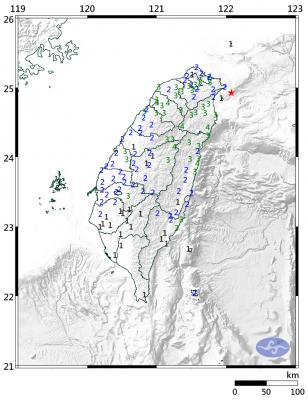
A magnitude 6.1 earthquake struck off the coast of Yilan County at 8:39pm tonight, the Central Weather Administration (CWA) said, with no immediate reports of damage or injuries. The epicenter was 38.7km east-northeast of Yilan County Hall at a focal depth of 98.3km, the CWA’s Seismological Center said. The quake’s maximum intensity, which gauges the actual physical effect of a seismic event, was a level 4 on Taiwan’s 7-tier intensity scale, the center said. That intensity level was recorded in Yilan County’s Nanao Township (南澳), Hsinchu County’s Guansi Township (關西), Nantou County’s Hehuanshan (合歡山) and Hualien County’s Yanliao (鹽寮). An intensity of 3 was
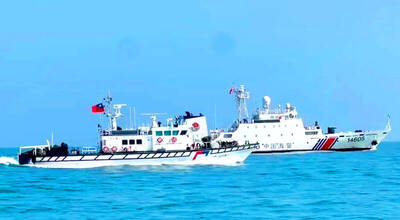
Instead of focusing solely on the threat of a full-scale military invasion, the US and its allies must prepare for a potential Chinese “quarantine” of Taiwan enforced through customs inspections, Stanford University Hoover fellow Eyck Freymann said in a Foreign Affairs article published on Wednesday. China could use various “gray zone” tactics in “reconfiguring the regional and ultimately the global economic order without a war,” said Freymann, who is also a nonresident research fellow at the US Naval War College. China might seize control of Taiwan’s links to the outside world by requiring all flights and ships entering or leaving Taiwan
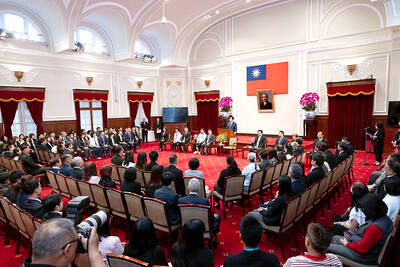
The next minimum wage hike is expected to exceed NT$30,000, President William Lai (賴清德) said yesterday during an award ceremony honoring “model workers,” including migrant workers, at the Presidential Office ahead of Workers’ Day today. Lai said he wished to thank the awardees on behalf of the nation and extend his most sincere respect for their hard work, on which Taiwan’s prosperity has been built. Lai specifically thanked 10 migrant workers selected for the award, saying that although they left their home countries to further their own goals, their efforts have benefited Taiwan as well. The nation’s industrial sector and small businesses lay
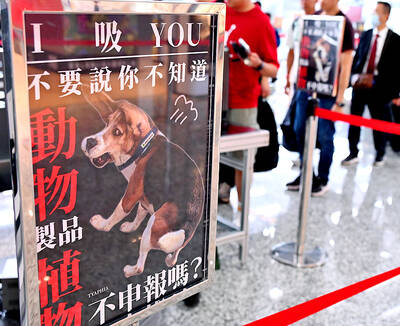
Quarantine awareness posters at Taiwan Taoyuan International Airport have gone viral for their use of wordplay. Issued by the airport branch of the Animal and Plant Health Inspection Agency, the posters feature sniffer dogs making a range of facial expressions, paired with advisory messages built around homophones. “We update the messages for holidays and campaign needs, periodically refreshing materials to attract people’s attention,” quarantine officials said. “The aim is to use the dogs’ appeal to draw focus to quarantine regulations.” A Japanese traveler visiting Taiwan has posted a photo on X of a poster showing a quarantine dog with a


 RSS
RSS