


Hospital visits for flu-like illnesses increased by about 10 percent last week from a week earlier, with local flu activity expected to peak next month, the Centers for Disease Control (CDC) said yesterday.
Flu viruses were the most common pathogen spreading in the past few weeks, CDC Epidemic Intelligence Center Director Guo Hung-wei (郭宏偉) said, citing respiratory pathogen monitoring data.
There were 91,842 hospital visits for flu-like illnesses at outpatient departments and emergency rooms last week, up 9.6 percent from the previous week, Guo said.
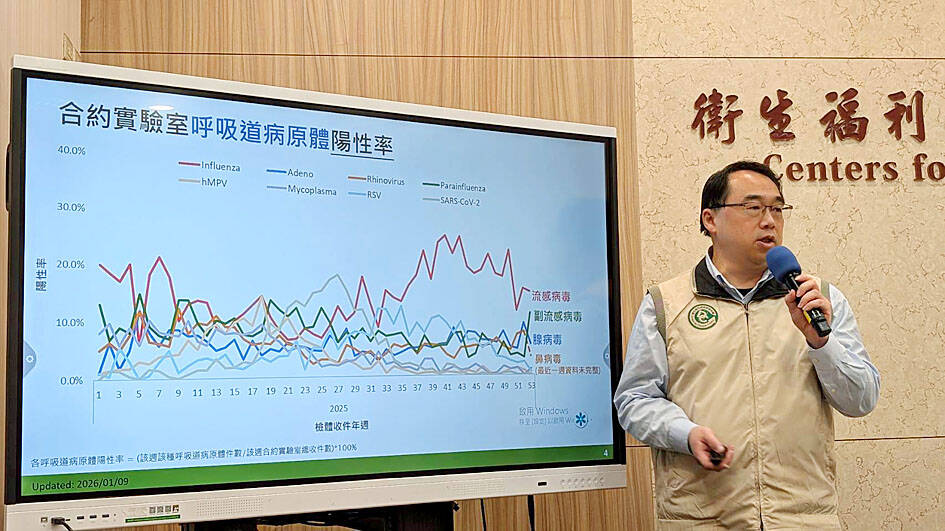
Photo: CNA
Among the hospital visits last week, 9.7 percent sought treatment at emergency rooms, almost at the epidemic threshold of 11 percent, he said, adding that influenza A(H3N2) was the dominant strain over the past few weeks.
Twenty-three cases of severe flu complications and three flu-related deaths were reported from Tuesday last week to Monday, he said, adding that since the start of the flu season on Oct. 1 last year, there have been 441 severe cases and 86 deaths.
CDC physician Lin Yung-ching (林詠青) said that among those who died last week was a man in his 60s who had chronic hypertension, hyperlipidemia, diabetes and hepatitis B.
The man did not get vaccinated this season, Lin said.
Among the severe cases is a man in his 30s who has hypertension and has a body mass index greater than 35, and also did not get vaccinated this season, Lin said, adding that the man is being treated in an intensive care unit.
Irrespective of age, people with underlying health conditions, chronic diseases and obesity are at higher risk of developing severe complications from flu infection, so they are eligible for the government-funded vaccine and are encouraged to get vaccinated for better protection, Lin said.
CDC Deputy Director-General and spokesman Lin Min-cheng (林明誠) said that flu activity is rising and is expected enter an epidemic period in about two weeks, with a peak at about the time of the Lunar New Year holidays in the middle of next month.
With low temperatures, and year-end gatherings and travel, the risk of respiratory infections is high, he said, adding that there are still about 179,000 doses of government-funded flu vaccine available.
The CDC encourages elderly people and those with higher risk of severe illness to get vaccinated, he said.
Meanwhile, cases of invasive pneumococcal disease (IPD) last year rose to 347, the highest in five years, Gou said, adding that 36 people died of the disease.
Linkou Chang Gung Memorial Hospital deputy superintendent Chiu Cheng-hsun (邱政洵), an infectious diseases specialist, said that global IPD cases fell during the COVID-19 pandemic, but they are beginning to increase again.
Pneumonia is the third leading cause of death in Taiwan and pneumococcus is one of the most common pathogens, Chiu said, adding that pneumococcal infection can lead to severe illness such as pneumonia, sepsis and meningitis, or even death.
The fatality rate of IPD can be up to 20 percent, he said.
Studies show that getting vaccinated can provide about 75 percent protection against IPD, he said.
A new government-funded single-dose 20-valent pneumococcal conjugate vaccine for adults would be available to eligible recipients from tomorrow, Lin Min-cheng said.
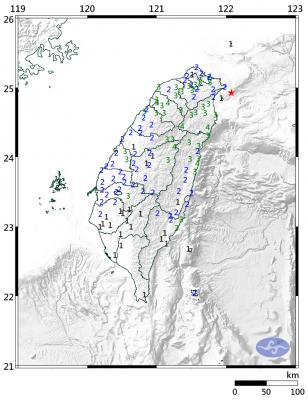
A magnitude 6.1 earthquake struck off the coast of Yilan County at 8:39pm tonight, the Central Weather Administration (CWA) said, with no immediate reports of damage or injuries. The epicenter was 38.7km east-northeast of Yilan County Hall at a focal depth of 98.3km, the CWA’s Seismological Center said. The quake’s maximum intensity, which gauges the actual physical effect of a seismic event, was a level 4 on Taiwan’s 7-tier intensity scale, the center said. That intensity level was recorded in Yilan County’s Nanao Township (南澳), Hsinchu County’s Guansi Township (關西), Nantou County’s Hehuanshan (合歡山) and Hualien County’s Yanliao (鹽寮). An intensity of 3 was

Instead of focusing solely on the threat of a full-scale military invasion, the US and its allies must prepare for a potential Chinese “quarantine” of Taiwan enforced through customs inspections, Stanford University Hoover fellow Eyck Freymann said in a Foreign Affairs article published on Wednesday. China could use various “gray zone” tactics in “reconfiguring the regional and ultimately the global economic order without a war,” said Freymann, who is also a nonresident research fellow at the US Naval War College. China might seize control of Taiwan’s links to the outside world by requiring all flights and ships entering or leaving Taiwan

The next minimum wage hike is expected to exceed NT$30,000, President William Lai (賴清德) said yesterday during an award ceremony honoring “model workers,” including migrant workers, at the Presidential Office ahead of Workers’ Day today. Lai said he wished to thank the awardees on behalf of the nation and extend his most sincere respect for their hard work, on which Taiwan’s prosperity has been built. Lai specifically thanked 10 migrant workers selected for the award, saying that although they left their home countries to further their own goals, their efforts have benefited Taiwan as well. The nation’s industrial sector and small businesses lay
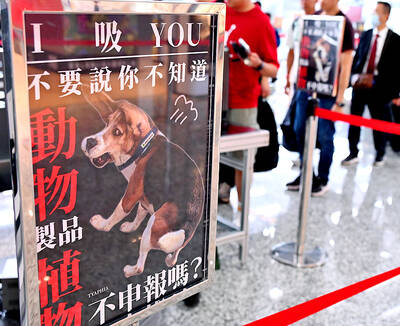
Quarantine awareness posters at Taiwan Taoyuan International Airport have gone viral for their use of wordplay. Issued by the airport branch of the Animal and Plant Health Inspection Agency, the posters feature sniffer dogs making a range of facial expressions, paired with advisory messages built around homophones. “We update the messages for holidays and campaign needs, periodically refreshing materials to attract people’s attention,” quarantine officials said. “The aim is to use the dogs’ appeal to draw focus to quarantine regulations.” A Japanese traveler visiting Taiwan has posted a photo on X of a poster showing a quarantine dog with a


 RSS
RSS