


The Ministry of Environment yesterday approved the initial environmental impact assessment (EIA) for the proposed Phase 2 development plan for the Southern Taiwan Science Park’s (南部科學園區) Chiayi County campus, with construction expected to begin in the second of half this year and completed by 2031.
The Phase 2 plan is expected to meet the expansion needs of Taiwan Semiconductor Manufacturing Co (TSMC), which is growing its advanced packaging production facilities to meet expanding demand driven by demand for artificial intelligence (AI) products. As land use at the Chiayi campus is already at capacity, the Phase 2 plan seeks to add approximately 89 hectares of land and introduce three more factories.
At the EIA review meeting, committee members discussed concerns including water use, air pollution, ecological impact, transportation, economic output and health risk assessments. The environmental subcommittee approved the initial review and forwarded the plan to the full committee for further assessment.

Photo: CNA
Building out a southern technology corridor and expanding advanced processes such as chip-on-wafer-on-substrate and system-on-integrated-chips packaging technologies — key bottlenecks in AI chip production — would be essential to implement the government’s plan of turning Taiwan into an “AI island,” Southern Taiwan Science Park Bureau Director-General Cheng Hsiu-jung (鄭秀絨) said.
“Chip packaging must remain rooted in Taiwan, and this is being facilitated by TSMC’s expansion in Chiayi,” she said.
The Phase 2 site is located in the county’s Taibao City (太保), mainly on land owned by Taiwan Sugar Corp, Cheng said.
In addition to semiconductor packaging, the plan envisions attracting firms in high-speed broadband, AI, cybersecurity technologies, heterogeneous integration packaging, net zero industries and quantum technologies, she added.
Once Phase 2 is completed, its output is expected to add about NT$210 billion (US$6.64 billion) to the park’s economic value on top of the about NT$100 billion from the first phase, bringing total output at the campus to about NT$310 billion and creating an estimated 3,500 new jobs, Cheng said.
With both phases combined, total employment at the Chiayi campus could exceed 9,200 people, she said.
Chiayi County Deputy Commissioner Liu Pei-tung (劉培東) said the campus is just one of numerous development projects in the county, citing as an example a Gloria Outlets branch, which began construction on Thursday last week.
The Phase 2 development plan would be complemented by the Chiayi High Speed Rail Station redevelopment plan, which is to cover about 360 hectares of land rezoned for commercial, retail and industrial development, he said.
“Looking ahead, the county plans to fully review transport impacts, bicycle path planning and strategies to reduce air pollution in coordination with the science park’s development,” Liu said.

FUKUOKA SITUATION: Japanese media reported that the pathogen is expected to be identified by the summer, while the CDC downplayed the idea that it was hMPV A “mysterious cold-like illness” reported in Japan’s Fukuoka Prefecture does not seem to be a new disease, but Japanese authorities have been asked about the situation, the Centers for Disease Control (CDC) said yesterday. The Fukuoka Prefectural Medical Association on Wednesday told a news conference that a “mystery cold” that has become a hot topic on social media is “highly likely to be caused by some kind of viral infection,” Japan’s KBC News reported. “Many people are experiencing symptoms starting with a sore throat, followed by a runny nose, phlegm and a severe cough,” KBC News reported, citing association officials. Health authorities are

Nvidia Corp CEO Jensen Huang (黃仁勳) arrived in Taiwan yesterday ahead of upcoming AI and technology events, saying he plans to meet with clients and Taiwan Semiconductor Manufacturing Co Chairman C.C. Wei (魏哲家) during his visit. After landing at Taipei Songshan Airport, Huang posed for photos with fans and handed out Yakult drinks to reporters and supporters waiting at the scene, saying he has “a lot to do” during the trip. Asked about reports that Nvidia’s planned headquarters site in Taipei’s Beitou Shilin Technology Park could break ground on May 27, Huang said that if the company holds an event, he would

The Ministry of Finance this afternoon announced the winning numbers for the March-April uniform invoice lottery. The winning number for the NT$10 million (US$318,060) special prize is 19531471, and the winning number for the NT$2 million grand prize is 85941329. Three numbers were drawn for the NT$200,000 first prize: 07225810, 20231230 and 83518781. Those with receipts matching the last seven digits of any of the first-prize numbers will win the NT$40,000 second prize, while those matching the last six digits will win the NT$10,000 third prize. Those whose receipts match the last five digits of the first-prize numbers can claim the NT$4,000 fourth prize,
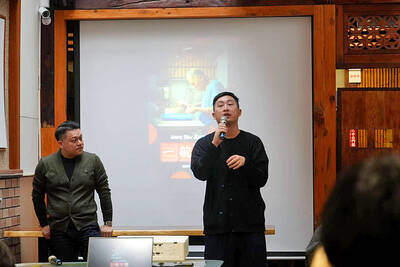
Taiwan Travelogue (臺灣漫遊錄), which earlier this week became the first Taiwanese novel to win the International Booker Prize, is to be adapted into a television series through a Taiwan-Japan coproduction, producer Chang Chen-yu (張辰漁) said yesterday. Chang, a producer at World Softest Production Film Co, wrote on Facebook that the company had been searching for projects with international appeal that retain a strong Taiwanese identity after colleagues and Japanese partners strongly recommended the novel. After reading the book, Chang said he immediately decided to pursue the screen rights. “A great story has the power to transcend time and borders, and connect countless people,”


 RSS
RSS