


The “Healthy Taiwan Sprout Project” launched last year has approved funding worth NT$2.94 billion (US$93.05 million) for 197 smart healthcare projects, President William Lai (賴清德) said yesterday, adding that he hoped to see healthcare and technology integration become the next “divine mountains” maintaining Taiwan’s international competitiveness.
He made the remark at the opening ceremony of the 19th Nobel Health Care Forum in Taipei.
The forum, which started in 2017, has a clear mission to implement the nation’s healthcare policies and engage in frontline medical services, Lai said, adding that it has become a vital platform promoting Taiwan’s healthcare industry.
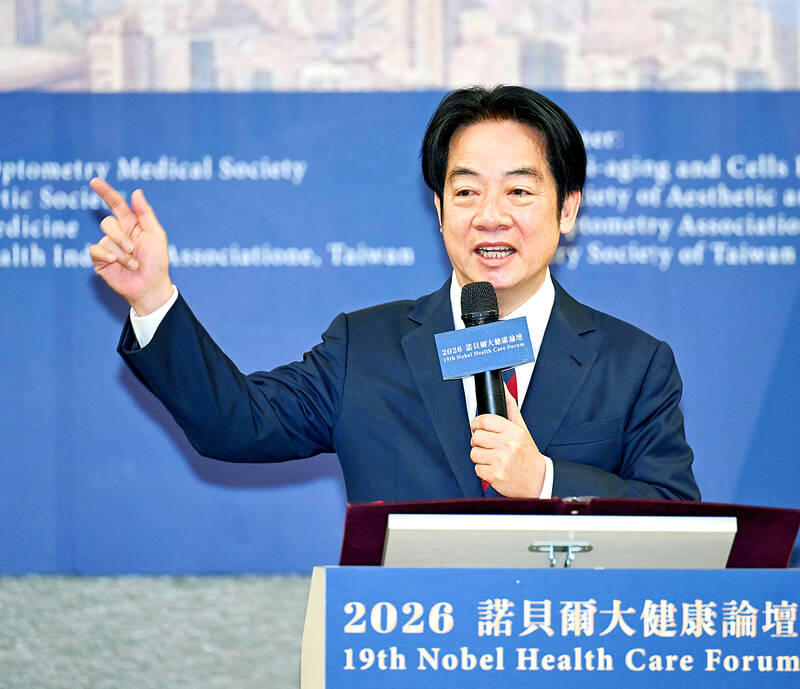
Photo: Fang Pin-chao, Taipei Times
Cross-sector collaboration — especially the integration of healthcare and technology — diversified topics reflecting the medical community’s continuous efforts to push for innovative health management, and the implementation of smart healthcare solutions contributed to the forum’s success, he said.
The Healthy Taiwan Promotion Committee was established to reduce the number of years Taiwanese would live in poor health as the nation’s average life expectancy grows, Lai said.
The average life expectancy has exceeded 80 years, but the average number of years lived in poor health is about 8.4 years, which means people spend 10 percent of their lives in relatively unhealthy conditions, such as being bedridden, in a wheelchair or depending on others for daily tasks, he added.
The five-year NT$48.9 billion “Healthy Taiwan Sprout Project” was launched last year, and it focuses on better healthcare by cultivating talent, improving healthcare staff’s work environment and conditions, practicing social responsibilities and maintaining healthcare sustainability, he said.
It also includes smart healthcare, Lai said, adding that NT$2.94 billion in funding for 197 smart healthcare projects has been approved since last year, mainly for optimizing clinical workflows and improving service efficiency, he added.
Taiwan ranked first on the Numbeo Health Care Index for eight consecutive years, and has a special place in semiconductor, information and communications technology, and electronic components production, Lai said.
In line with the continuous efforts of Taiwan’s medical community, industrial and technology sectors, the government has proposed a “10 Major AI Infrastructure Projects” initiative to further cement the nation’s leading competitive advantage in the world, he said.
The government has set a goal of training 500,000 AI professionals by 2040, Lai said, adding that the new National Center for High-performance Computing has begun operations while he National AI Data Center is to open soon.
The initiative would develop three critical technologies: silicon photonics, quantum computing and robotics, he said.
The government also hopes to assist 1 million micro, small and medium-sized enterprises in Taiwan in integrating AI into their operations, which would comprehensively enhance their competitiveness, Lai said.
“The ‘divine mountains’ are not a single enterprise, but a whole industrial ecological chain,” Lai said, adding that he hoped that through government-private cooperation, the integration of healthcare and technology could become the next “divine mountains” pushing Taiwan to have even better global competitiveness.

NATIONAL SECURITY: Authorities are working to confirm the identities of the military personnel involved and investigating possible illegal conduct and regulatory violations Authorities are probing possible national security implications after Kinmen police and immigration officers on Sunday found a Chinese woman allegedly posing as a tourist while engaging in prostitution involving more than 10 military personnel. The woman, surnamed Chen (陳), has since been deported, authorities said, adding that investigators are still working to confirm the identities of those implicated, as the records only listed code names and aliases. The case stemmed from a report received by the Kinmen District Prosecutors’ Office on Friday last week from the Jinhu Precinct of the Kinmen County Police Bureau. On Sunday, police, along with the National Immigration

REASONS FOR TRAVEL: An assistant professor said that proposed amendments to penalize drivers if they used drugs overseas would not deter people from traveling People who operate a motor vehicle under the influence of marijuana would have their driver’s license revoked, even if they used the substance while overseas, the Ministry of Transportation and Communications said yesterday, citing proposed amendments to the Road Traffic Management and Penalty Act (道路交通管理處罰條例). The amendments would also authorize the government to revoke the licenses of people determined to have used Category 1 or Category 2 narcotics, even if they were not operating a vehicle while under the influence of drugs, as well as ban them from taking the license test for three years, the ministry said. People aged 18 or

GLOBALGIVING: ‘ Caving to external pressure is not acceptable for an organization that has cultivated justice reform and human rights for 30 years,’ one NGO said A slew of non-government organizations (NGOs) have withdrawn from the GlobalGiving fundraising platform after it announced it would use “Chinese Taipei” instead of “Taiwan” from next month. The Taiwan Good Rice Association wrote on Facebook on Friday that it was informed on April 28 via a teleconference call of the change, which was made because the platform wanted to operate in China. Taiwan Good Rice is to terminate all cooperative relationships with GlobalGiving in response to the platform’s “unilateral and non-negotiable” decision to remove references to Taiwan, the NGO said. “Taiwan is in the official name of Taiwan Good Rice Association and the

HEAVY WEATHER: Typhoon Jangmi is due to crash straight into the Ryukyus as airlines look to shift flights to larger aircraft or cancel flights to Okinawa entirely Taiwan’s international air carriers announced flight adjustments over the weekend as Typhoon Jangmi is forecast to hit the Ryukyu Islands today and tomorrow. The Central Weather Administration (CWA) upgraded Jangmi from a tropical storm to a typhoon at 8am yesterday, with the eye located 580km south of Naha city. It was moving north at 19kph. Today, China Airlines’ CI-120, CI-121, CI-122 and CI-123 flights between Taoyuan and Naha, Okinawa, have been canceled as well as CI-132 and CI-133 between Kaohsiung and Naha. EVA Air’s BR-112, BR-113, BR-186 and BR-185 flights between Taoyuan and Naha are also canceled. Low-cost carrier Tigerair Taiwan canceled IT-230,


 RSS
RSS