


The air force plans to urge the US to expedite work to install automatic ground collision avoidance systems (Auto-GCAS) on its F-16V jets, with the aim of completing the process by the end of this year if possible, a military official said yesterday, after an F-16V jet went missing the day earlier.
Authorities have been searching for the missing F-16V aircraft and its pilot, Air Force Captain Hsin Po-yi (辛柏毅), following the incident on Tuesday.
Taiwan plans to have Auto-GCAS installed on all of its F-16V aircraft, a project scheduled for completion in 2028.
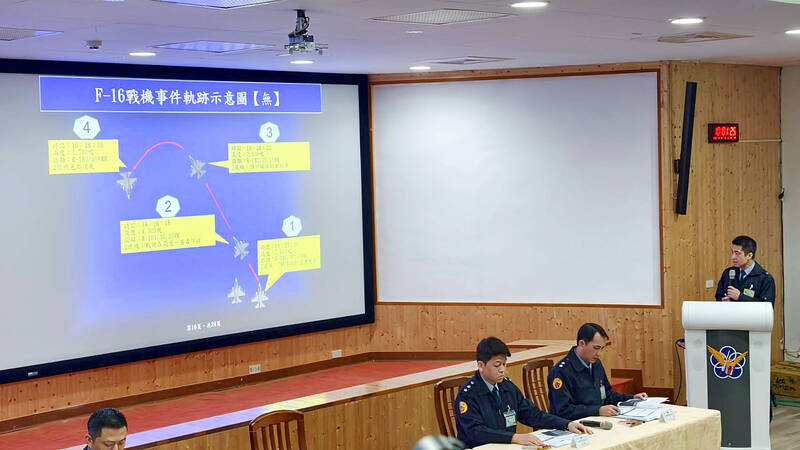
Photo: Wang Chin-yi, Taipei Times
Auto-GCAS uses data such as aircraft speed, heading and terrain to assess the risk of a ground or sea collision and alert the pilot.
If the pilot does not respond, the system automatically adjusts the aircraft’s attitude and altitude to prevent a crash.
Asked about the issue at a news conference yesterday, air force Inspector General Chiang Yi-cheng (江義誠) said that the system is being jointly modified by relevant parties in Taiwan, as well as the US National Guard, which also operates F-16 jets.
“We will push the US military to complete work on the systems as soon as possible,” Chiang said. “We hope the work will proceed as planned, if not ahead of schedule, so that we can receive Auto-GCAS and related equipment by the end of the year.”
During the Han Kuang military exercises on June 4, 2018, air force Major Wu Yen-ting (吳彥霆) was killed when the F-16 jet he was piloting, tail No. 6685, crashed into Wufen Mountain (五分山) in Keelung.
The air force subsequently announced that all F-16s would be fitted with Auto-GCAS.
Auto-GCAS is standard equipment on Taiwan’s 66 newly purchased F-16 jets, said Su Tzu-yun (蘇紫雲), a research fellow at the government-sponsored Institute for National Defense and Security Research.
However, integrating the system into the 139 remaining F-16 aircraft upgraded under the Peace Phoenix Rising project is more complicated, as it involves rewiring, structural modifications to the airframe, and integration with existing fly-by-wire flight control systems, he said.
US military experience shows that Auto-GCAS has saved the lives of hundreds of pilots, making investment in collision-avoidance systems highly cost-effective, Su said.
In addition to accelerating installation, the air force could also follow US practice by issuing pilots military-grade watches, he said.
Such devices provide GPS-based altitude and heading information, allowing basic flight control and landing in situations where cockpit instruments become unreadable due to incidents such as cabin depressurization or avionics failure, he said.

NATIONAL SECURITY: Authorities are working to confirm the identities of the military personnel involved and investigating possible illegal conduct and regulatory violations Authorities are probing possible national security implications after Kinmen police and immigration officers on Sunday found a Chinese woman allegedly posing as a tourist while engaging in prostitution involving more than 10 military personnel. The woman, surnamed Chen (陳), has since been deported, authorities said, adding that investigators are still working to confirm the identities of those implicated, as the records only listed code names and aliases. The case stemmed from a report received by the Kinmen District Prosecutors’ Office on Friday last week from the Jinhu Precinct of the Kinmen County Police Bureau. On Sunday, police, along with the National Immigration

GLOBALGIVING: ‘ Caving to external pressure is not acceptable for an organization that has cultivated justice reform and human rights for 30 years,’ one NGO said A slew of non-government organizations (NGOs) have withdrawn from the GlobalGiving fundraising platform after it announced it would use “Chinese Taipei” instead of “Taiwan” from next month. The Taiwan Good Rice Association wrote on Facebook on Friday that it was informed on April 28 via a teleconference call of the change, which was made because the platform wanted to operate in China. Taiwan Good Rice is to terminate all cooperative relationships with GlobalGiving in response to the platform’s “unilateral and non-negotiable” decision to remove references to Taiwan, the NGO said. “Taiwan is in the official name of Taiwan Good Rice Association and the

HEAVY WEATHER: Typhoon Jangmi is due to crash straight into the Ryukyus as airlines look to shift flights to larger aircraft or cancel flights to Okinawa entirely Taiwan’s international air carriers announced flight adjustments over the weekend as Typhoon Jangmi is forecast to hit the Ryukyu Islands today and tomorrow. The Central Weather Administration (CWA) upgraded Jangmi from a tropical storm to a typhoon at 8am yesterday, with the eye located 580km south of Naha city. It was moving north at 19kph. Today, China Airlines’ CI-120, CI-121, CI-122 and CI-123 flights between Taoyuan and Naha, Okinawa, have been canceled as well as CI-132 and CI-133 between Kaohsiung and Naha. EVA Air’s BR-112, BR-113, BR-186 and BR-185 flights between Taoyuan and Naha are also canceled. Low-cost carrier Tigerair Taiwan canceled IT-230,

MULTIPRONGED APPROACH: China has sought to pressure Palau across a number of fronts, but the island nation has staunchly resisted overtures to ditch Taiwan Palau has been firm in backing Taiwan despite Chinese pressure that uses tourism economics, cyberattacks and criminal infiltration as tools to threaten the Pacific ally into renouncing its recognition of Taiwan as a sovereign state. The Presidential Office yesterday announced that Vice President Hsiao Bi-khim (蕭美琴) would visit Palau from Saturday to Wednesday next week at the invitation of Palauan President Surangel Whipps Jr. Whipps in April said in an interview that China had outspokenly asked Palau to “denounce Taiwan.” “And we have said: ‘We have no enemies, but nobody tells us who our friends are,’” he said. Whipps has told reporters multiple times


 RSS
RSS