


The abduction of deposed Venezuelan president Nicolas Maduro on Saturday bolstered Washington’s global credibility without setting a precedent for China to attempt a similar action in Taiwan, a policy expert said.
Atlantic Council vice president Matthew Kroenig made the remarks at a panel discussion in Washington on Tuesday.
US special operations forces on Saturday carried out a nighttime operation in Caracas to capture Maduro, following a series of paralyzing airstrikes directed against Venezuela’s Russian-made air defense systems.
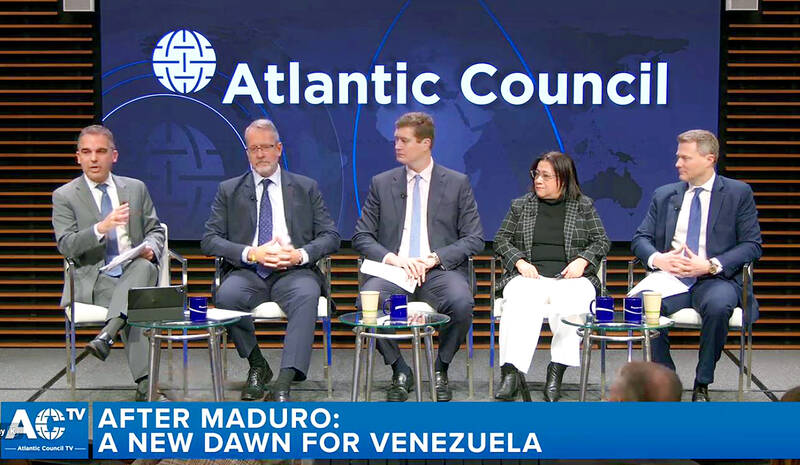
Screen grab from the Atlantic Council’s YouTube channel
The US military operation represented an opportunity for Washington to tackle the threat posed by Maduro’s government in the form of narcotics trafficking and the flow of refugees, Kroenig said.
Iran is changing its approach to its handling of ongoing protests in response to the raid, as US President Donald Trump has threatened to intervene to protect the demonstrators, he said.
Commentary suggesting that the US has set an example for Chinese President Xi Jinping (習近平) to target Taiwanese political leaders is unfounded, as Beijing has long claimed Taiwan to be an internal Chinese territory, he said.
Xi’s calculations regarding the use of force in Taiwan are concerned with the balance of power and political trends in Taiwan, not any action undertaken by the US, he said.
US allies in the Indo-Pacific region were less concerned about any potential precedents the operation would set than impressed by the military capabilities on display, Kroenig said.
Some Asian allies have expressed hopes that common regional adversaries would take notice of US military power the operation showcased, he added.
Certain actions might be necessary for the US to re-establish deterrence against potential foes to ensure peace, which the strike on Caracas has done, he said.
The strikes have caused China and Russia to dial back or adjust their “malicious” interference campaigns in the western hemisphere, although there would likely be structural challenges elsewhere, he said.
Separately, a former Pentagon official on Tuesday said that China is unlikely to succeed in capturing Taiwan’s leaders in a swift aerial military operation due to Taiwan’s extensive air-defense systems.
Kris Osborn, a former expert with the Office of the Assistant Secretary of the US Army, wrote on the defense news Web site 19FortyFive that the US’ operation targeting Maduro was an example of a modern “decapitation strike” intended to disable an adversary’s ability to fight without widespread destruction.
The operation relied on precise intelligence, surveillance, and strikes on key military targets and power infrastructure, enabling US special forces to capture Maduro with “little to no unwanted damage,” he said.
Osborn said that Venezuela has only “a small number of Russian-built air defenses, which appear to have been destroyed quickly by US forces,” while Taiwan operates a “much more extensive and elaborate” air defense network, making helicopter or aircraft strikes extremely difficult despite China’s intelligence capabilities.

Considering that most countries issue more than five denominations of banknotes, the central bank has decided to redesign all five denominations, the bank said as it prepares for the first major overhaul of the banknotes in more than 24 years. Central bank Governor Yang Chin-lung (楊金龍) is expected to report to the Legislative Yuan today on the bank’s operations and the redesign’s progress. The bank in a report sent to the legislature ahead of today’s meeting said it had commissioned a survey on the public’s preferences. Survey results showed that NT$100 and NT$1,000 banknotes are the most commonly used, while NT$200 and NT$2,000

The Centers for Disease Control (CDC) yesterday reported the first case of a new COVID-19 subvariant — BA.3.2 — in a 10-year-old Singaporean girl who had a fever upon arrival in Taiwan and tested positive for the disease. The girl left Taiwan on March 20 and the case did not have a direct impact on the local community, it said. The WHO added the BA.3.2 strain to its list of Variants Under Monitoring in December last year, but this was the first imported case of the COVID-19 variant in Taiwan, CDC Deputy Director-General Lin Ming-cheng (林明誠) said. The girl arrived in Taiwan on

South Korea is planning to revise its controversial electronic arrival card, a step Taiwanese officials said prompted them to hold off on planned retaliatory measures, a South Korean media report said yesterday. A Yonhap News Agency report said that the South Korean Ministry of Foreign Affairs is planning to remove the “previous departure place” and “next destination” fields from its e-arrival card system. The plan, reached after interagency consultations, is under review and aims to simplify entry procedures and align the electronic form with the paper version, a South Korean ministry official said. The fields — which appeared only on the electronic form

The Ministry of Foreign Affairs (MOFA) is suspending retaliation measures against South Korea that were set to take effect tomorrow, after Seoul said it is updating its e-arrival system, MOFA said today. The measures were to be a new round of retaliation after Taiwan on March 1 changed South Korea's designation on government-issued alien resident certificates held by South Korean nationals to "South Korea” from the "Republic of Korea," the country’s official name. The move came after months of protests to Seoul over its listing of Taiwan as "China (Taiwan)" in dropdown menus on its new online immigration entry system. MOFA last week


 RSS
RSS