


There were 477 acute hepatitis A cases reported last year, the most in nine years, the Centers for Disease Control (CDC) said yesterday.
The hepatitis A case total last year was the highest since 2017, comprising 447 locally acquired cases and 30 imported cases, CDC Epidemic Intelligence Center Deputy Director Lee Chia-lin (李佳琳) said.
Among the local cases, 82.8 percent were men, while the 30-to-39 age group accounted for 36.2 percent, followed by the 20-to-29 age group at 28.5 percent, Lee said.
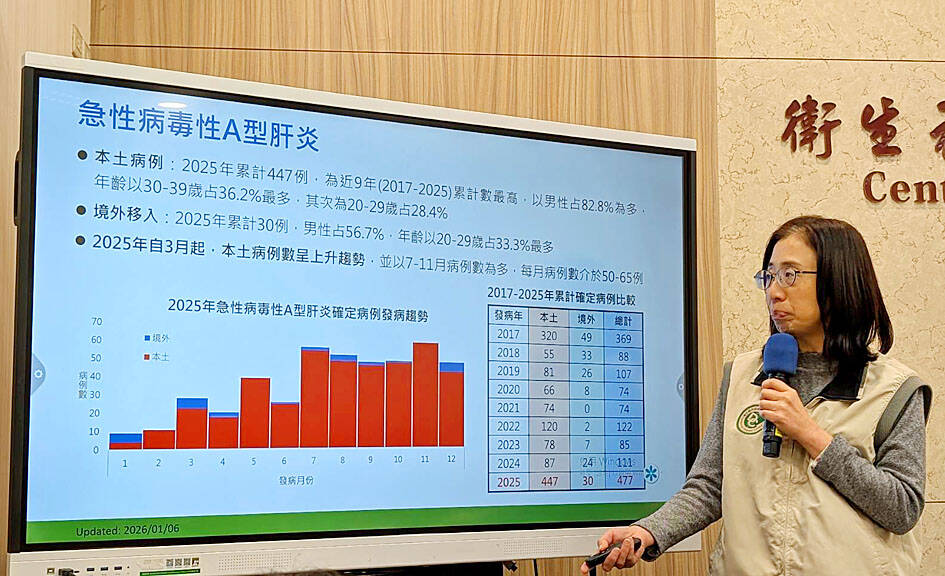
Photo: CNA
The monthly count of local cases last year significantly increased after March, with 50 to 65 new cases reported every month from July to November, she said.
“Unlike hepatitis B or C, acute hepatitis A primarily transmits through the fecal-oral route, meaning that people can become infected by ingesting contaminated food or having close personal contact with an infected person,” CDC Acute Infectious Diseases Division Director Yang Ching-hui (楊靖慧) said.
Among local cases, nearly 40 percent were infected through intimate contact with an infected person, the CDC said.
The incubation period for acute hepatitis A is typically 15 to 50 days, and the virus can spread during that period, even before the onset of symptoms, which commonly include fever, fatigue and poor appetite, Yang said, adding that adults often have more serious symptoms.
People with pre-existing liver disease or chronic hepatitis who contract the disease have significantly increased risk of developing severe illness, including acute liver failure, but people who fully recover from an acute hepatitis A infection generally obtain lifelong immunity and do not become chronic carriers, she said.
The government began offering hepatitis A vaccines to children aged 15 months or older in mountainous areas in June 1995, Yang said.
With donations from civic groups, the vaccine has been available nationwide to children aged 12 months or older since 2018, so children under 10 years old generally have good protection against the virus, she said.
However, a CDC survey in 2020 found that only about 10 percent of people aged 21 to 40 have immunity against hepatitis A, while the rate is 40 percent among people aged 41 to 50, she said.
Hepatitis A can be avoided through good hygiene, including frequent handwashing and cooking food thoroughly, she said, adding that a single-dose vaccination can provide protection of up to 90 percent for three to five years, while two doses can provide protection for more than 20 years.
CDC Deputy Director-General and spokesman Lin Min-cheng (林明誠) said that hepatitis A prevention has three main aspects: food, environment and personal hygiene.
People should cook food thoroughly, as the hepatitis A virus can be destroyed in food by heating it to 85°C for at least one minute, while environments can be effectively disinfected using a diluted bleach solution of 1,000 parts per million, Lin said.
People should get vaccinated, wash their hands frequently and thoroughly with soap, use separate utensils to transfer food from serving dishes to individual plates and avoid unsafe sex, he said.

NATIONAL SECURITY: Authorities are working to confirm the identities of the military personnel involved and investigating possible illegal conduct and regulatory violations Authorities are probing possible national security implications after Kinmen police and immigration officers on Sunday found a Chinese woman allegedly posing as a tourist while engaging in prostitution involving more than 10 military personnel. The woman, surnamed Chen (陳), has since been deported, authorities said, adding that investigators are still working to confirm the identities of those implicated, as the records only listed code names and aliases. The case stemmed from a report received by the Kinmen District Prosecutors’ Office on Friday last week from the Jinhu Precinct of the Kinmen County Police Bureau. On Sunday, police, along with the National Immigration

GLOBALGIVING: ‘ Caving to external pressure is not acceptable for an organization that has cultivated justice reform and human rights for 30 years,’ one NGO said A slew of non-government organizations (NGOs) have withdrawn from the GlobalGiving fundraising platform after it announced it would use “Chinese Taipei” instead of “Taiwan” from next month. The Taiwan Good Rice Association wrote on Facebook on Friday that it was informed on April 28 via a teleconference call of the change, which was made because the platform wanted to operate in China. Taiwan Good Rice is to terminate all cooperative relationships with GlobalGiving in response to the platform’s “unilateral and non-negotiable” decision to remove references to Taiwan, the NGO said. “Taiwan is in the official name of Taiwan Good Rice Association and the

HEAVY WEATHER: Typhoon Jangmi is due to crash straight into the Ryukyus as airlines look to shift flights to larger aircraft or cancel flights to Okinawa entirely Taiwan’s international air carriers announced flight adjustments over the weekend as Typhoon Jangmi is forecast to hit the Ryukyu Islands today and tomorrow. The Central Weather Administration (CWA) upgraded Jangmi from a tropical storm to a typhoon at 8am yesterday, with the eye located 580km south of Naha city. It was moving north at 19kph. Today, China Airlines’ CI-120, CI-121, CI-122 and CI-123 flights between Taoyuan and Naha, Okinawa, have been canceled as well as CI-132 and CI-133 between Kaohsiung and Naha. EVA Air’s BR-112, BR-113, BR-186 and BR-185 flights between Taoyuan and Naha are also canceled. Low-cost carrier Tigerair Taiwan canceled IT-230,

MULTIPRONGED APPROACH: China has sought to pressure Palau across a number of fronts, but the island nation has staunchly resisted overtures to ditch Taiwan Palau has been firm in backing Taiwan despite Chinese pressure that uses tourism economics, cyberattacks and criminal infiltration as tools to threaten the Pacific ally into renouncing its recognition of Taiwan as a sovereign state. The Presidential Office yesterday announced that Vice President Hsiao Bi-khim (蕭美琴) would visit Palau from Saturday to Wednesday next week at the invitation of Palauan President Surangel Whipps Jr. Whipps in April said in an interview that China had outspokenly asked Palau to “denounce Taiwan.” “And we have said: ‘We have no enemies, but nobody tells us who our friends are,’” he said. Whipps has told reporters multiple times


 RSS
RSS